
Spotted Giant Flying Squirrel
Petaurista elegans
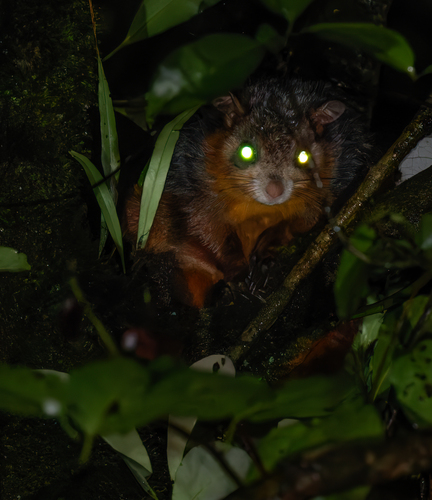
The spotted giant flying squirrel (Petaurista elegans), also known as the lesser giant flying squirrel, is a species of rodent in the family Sciuridae.
- Kingdom
- Animalia
- Phylum
- Chordata
- Class
- Mammalia
- Order
- Rodentia
- Family
- Sciuridae
- Genus
- Petaurista
- Species
- Petaurista elegans
Description
The spotted giant flying squirrel (Petaurista elegans), also known as the lesser giant flying squirrel, is a species of rodent in the family Sciuridae. It is found in hill and mountain forests at altitudes of 200–4,000 m (660–13,120 ft) in Southeast Asia north to central China and the east Himalayan region, although the northern populations sometimes are regarded as separate species as the grey-headed giant flying squirrel (P. caniceps), Chindwin giant flying squirrel (P. sybilla) and P. marica. Two of these, as well as a few other populations, lack the white spots on the upperparts for which it is named. Although a large flying squirrel, it is a relatively small giant flying squirrel. Like other flying squirrels, it is nocturnal and able to glide (not actually fly like a bat) long distances between trees by spreading out its patagium, skin between its limbs. A rather noisy species that has a drawn-out cry that often can be heard at night, it spends the day in a tree hollow, or, less often, on a cliff ledge or in a nest made of vegetation in a tree. It feeds on fruits, seeds, leaves, buds and flowers, and has one, occasionally two, young per litter.
Gallery
Ajouter des photos
Partagez vos photos de cette espèce (jusqu'à 20 à la fois) : elles sont vérifiées automatiquement, puis publiées.
Répartition
Occurrences observées (données GBIF). Les zones hors aire d'origine peuvent indiquer une présence introduite ou invasive.
Sources et crédits
Informations provenant de plusieurs sources vérifiées. Dernière mise à jour : .
Crédits photos (6)
- Photo : (c) My World of Bird Photography, some rights reserved (CC BY-NC) · CC BY-NC 4.0 · via iNaturalist
- Photo : Green Hill - Bukit Lawang (Andrea Molyneaux) (@greenhillsumatra) · CC BY-NC 4.0 · via iNaturalist
- Photo : Tim Forrester (@tim_forrester) · CC BY-NC 4.0 · via iNaturalist
- Photo : @thewildgtrv · CC BY-NC 4.0 · via iNaturalist
- Photo : @andraescholz · CC BY-NC 4.0 · via iNaturalist
- Photo : Forest Botial-Jarvis (@tiluchi) · CC BY 4.0 · via iNaturalist
Mentions de licence
Texte disponible sous licence CC BY-SA 4.0. Il adapte notamment Wikipedia (CC BY-SA) : Spotted giant flying squirrel (Wikipédia, auteurs dans l’historique de l’article).
- Taxonomie : GBIF Backbone Taxonomy (CC BY 4.0)
- Carte : occurrences GBIF, fond © contributeurs OpenStreetMap (ODbL)
- Statut de conservation : Liste rouge de l'UICN, via Wikidata (CC0)
Détail : Sources et licences.
Discussion (0)
Aucun message pour l’instant. Lancez la discussion sur cette fiche (sources, précisions, débats éditoriaux).
Connectez-vous pour participer à la discussion.