
Red and White Giant Flying Squirrel
Petaurista alborufus
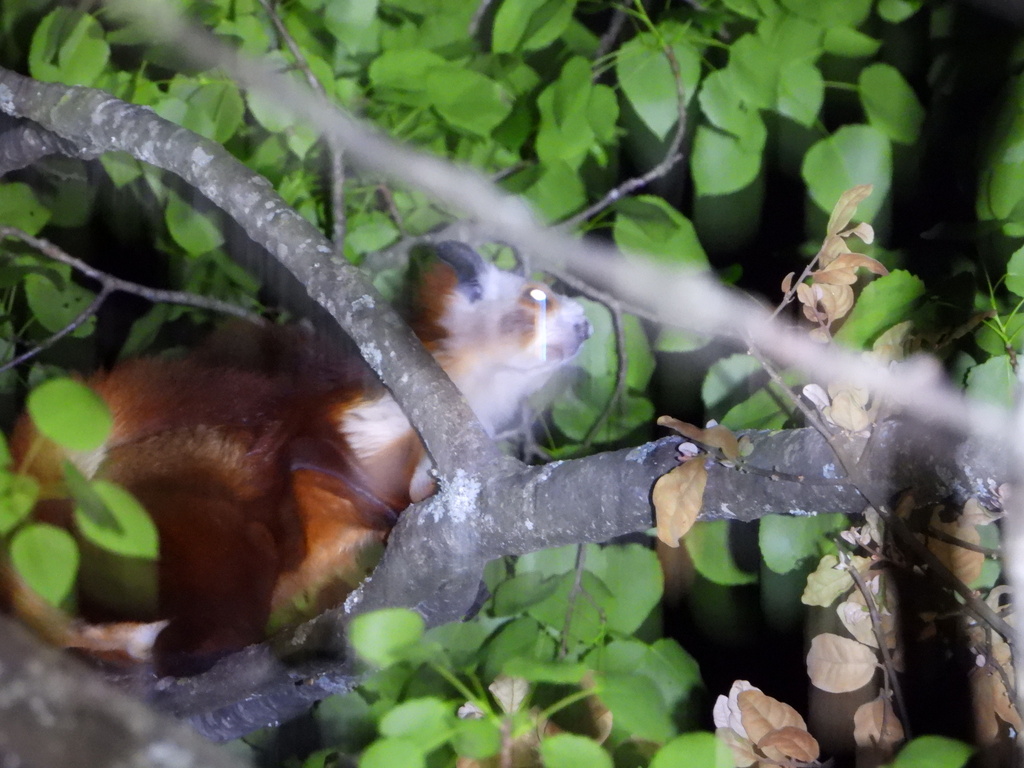
The red and white giant flying squirrel (Petaurista alborufus) is a species of rodent in the family Sciuridae.
- Kingdom
- Animalia
- Phylum
- Chordata
- Class
- Mammalia
- Order
- Rodentia
- Family
- Sciuridae
- Genus
- Petaurista
- Species
- Petaurista alborufus
Description
The red and white giant flying squirrel (Petaurista alborufus) is a species of rodent in the family Sciuridae. It is a very large, dark rufous-red, buff and white flying squirrel found in forests at altitudes of 800–3,500 m (2,600–11,500 ft) in mainland China and 1,200–3,750 m (3,940–12,300 ft) in Taiwan, although the population of the latter island is distinctive and likely better regarded as a separate species, the Taiwan giant flying squirrel (P. lena). Additionally, the red and white giant flying squirrel possibly ranges into northeastern South Asia and far northern Mainland Southeast Asia. This squirrel has a wide range and is relatively common, and the International Union for Conservation of Nature lists it as being of "least concern". They spend their days sleeping in a tree hollow, emerging at night to forage in the trees. Their diet consists primarily of nuts and fruits, but also includes leafy vegetation, insects and their larvae. Like other flying squirrels, this species can move between trees by gliding (not actually flying like a bat), exceptionally as much as 400 m (1,300 ft). This is achieved by the patagium, skin spread out between its limbs.
Gallery
Ajouter des photos
Partagez vos photos de cette espèce (jusqu'à 20 à la fois) : elles sont vérifiées automatiquement, puis publiées.
Répartition
Occurrences observées (données GBIF). Les zones hors aire d'origine peuvent indiquer une présence introduite ou invasive.
Sources et crédits
Informations provenant de plusieurs sources vérifiées. Dernière mise à jour : .
Crédits photos (8)
- Photo : @georgeyang · CC BY-NC 4.0 · via iNaturalist
- Photo : 云鸮 (@littlexiao) · CC BY-NC 4.0 · via iNaturalist
- Photo : Royle Safaris (@roylesafaris) · CC BY-NC 4.0 · via iNaturalist
- Photo : @lbwjian · CC BY-NC 4.0 · via iNaturalist
- Photo : 通通 (@tong-tong-) · CC BY-NC 4.0 · via iNaturalist
- Photo : @beilan · CC BY-NC 4.0 · via iNaturalist
- Photo : @roger_e_n_smith · CC BY-NC 4.0 · via iNaturalist
- Photo : Ying Gao (@ggyy9999) · CC BY-NC 4.0 · via iNaturalist
Mentions de licence
Texte disponible sous licence CC BY-SA 4.0. Il adapte notamment Petaurista alborufus, Wikipedia (CC BY-SA) : Red and white giant flying squirrel (Wikipédia, auteurs dans l’historique de l’article).
- Taxonomie : GBIF Backbone Taxonomy (CC BY 4.0)
- Carte : occurrences GBIF, fond © contributeurs OpenStreetMap (ODbL)
- Statut de conservation : Liste rouge de l'UICN, via Wikidata (CC0)
Détail : Sources et licences.
Discussion (0)
Aucun message pour l’instant. Lancez la discussion sur cette fiche (sources, précisions, débats éditoriaux).
Connectez-vous pour participer à la discussion.