
White-lipped peccary
Tayassu pecari
The white-lipped peccary (Tayassu pecari) is a species of peccary found in Central and South America and the only extant member of the genus Tayassu.
- Kingdom
- Animalia
- Phylum
- Chordata
- Class
- Mammalia
- Order
- Artiodactyla
- Family
- Tayassuidae
- Genus
- Tayassu
- Species
- Tayassu pecari
Description
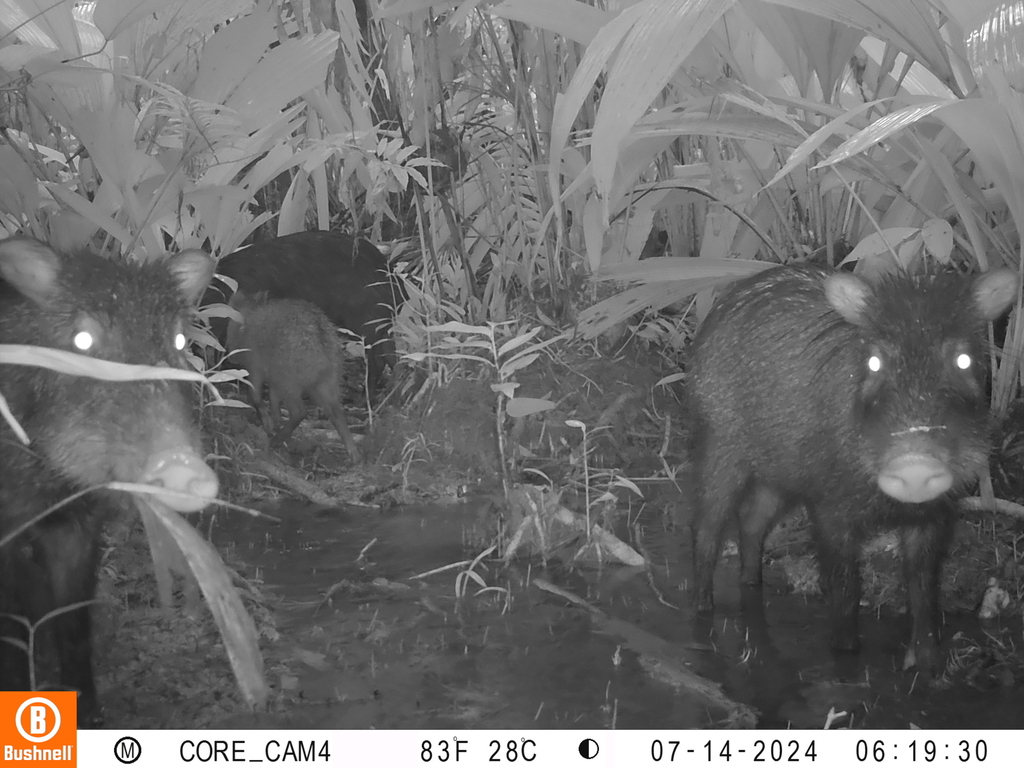
The white-lipped peccary (Tayassu pecari) is a species of peccary found in Central and South America and the only extant member of the genus Tayassu. Multiple subspecies have been identified. White-lipped peccaries are similar in appearance to pigs, but with some distinct differences. Males don't have upward-pointing tusks, and both males and females are covered in dark hair (except on certain regions, such as the throat, where it is cream). The range of T. pecari, which extends from Mexico to Argentina, has become fragmented, and the species's population is declining overall (especially in Mexico and Central America). They can be found in a variety of habitats. Social animals, white-lipped peccaries typically forage in large groups, which can have as many as 300 peccaries. They are an important part of their ecosystem and multiple efforts are being made to preserve them in the wild. Not all disappearances are explained, but human activities play a role, with two major threats being deforestation and hunting; the latter is very common in rural areas. They are hunted for both their hide and meat.
Gallery
Ajouter des photos
Partagez vos photos de cette espèce (jusqu'à 20 à la fois) : elles sont vérifiées automatiquement, puis publiées.
Répartition
Occurrences observées (données GBIF). Les zones hors aire d'origine peuvent indiquer une présence introduite ou invasive.
Sources et crédits
Informations provenant de plusieurs sources vérifiées. Dernière mise à jour : .
Crédits photos (7)
- Photo : InverBosques (@inverbosques) · CC BY-NC 4.0 · via iNaturalist
- Photo : @idratherbewithananimal · CC BY-NC 4.0 · via iNaturalist
- Photo : InverBosques (@inverbosques) · CC BY-NC 4.0 · via iNaturalist
- Photo : @las_oncas · CC BY-NC 4.0 · via iNaturalist
- Photo : Núcleo Palmero Aceites Morichal S.A.S. (@nucleopalmeroaceitesmorichalsas) · CC BY-NC 4.0 · via iNaturalist
- Photo : @jungleanor · CC BY-NC 4.0 · via iNaturalist
- Photo : InverBosques (@inverbosques) · CC BY-NC 4.0 · via iNaturalist
Mentions de licence
Texte disponible sous licence CC BY-SA 4.0. Il adapte notamment Pécari à lèvres blanches, Wikipedia (CC BY-SA) : White-lipped peccary (Wikipédia, auteurs dans l’historique de l’article).
- Taxonomie : GBIF Backbone Taxonomy (CC BY 4.0)
- Carte : occurrences GBIF, fond © contributeurs OpenStreetMap (ODbL)
- Statut de conservation : Liste rouge de l'UICN, via Wikidata (CC0)
Détail : Sources et licences.
Discussion (0)
Aucun message pour l’instant. Lancez la discussion sur cette fiche (sources, précisions, débats éditoriaux).
Connectez-vous pour participer à la discussion.