
Flores Giant Rat
Papagomys armandvillei
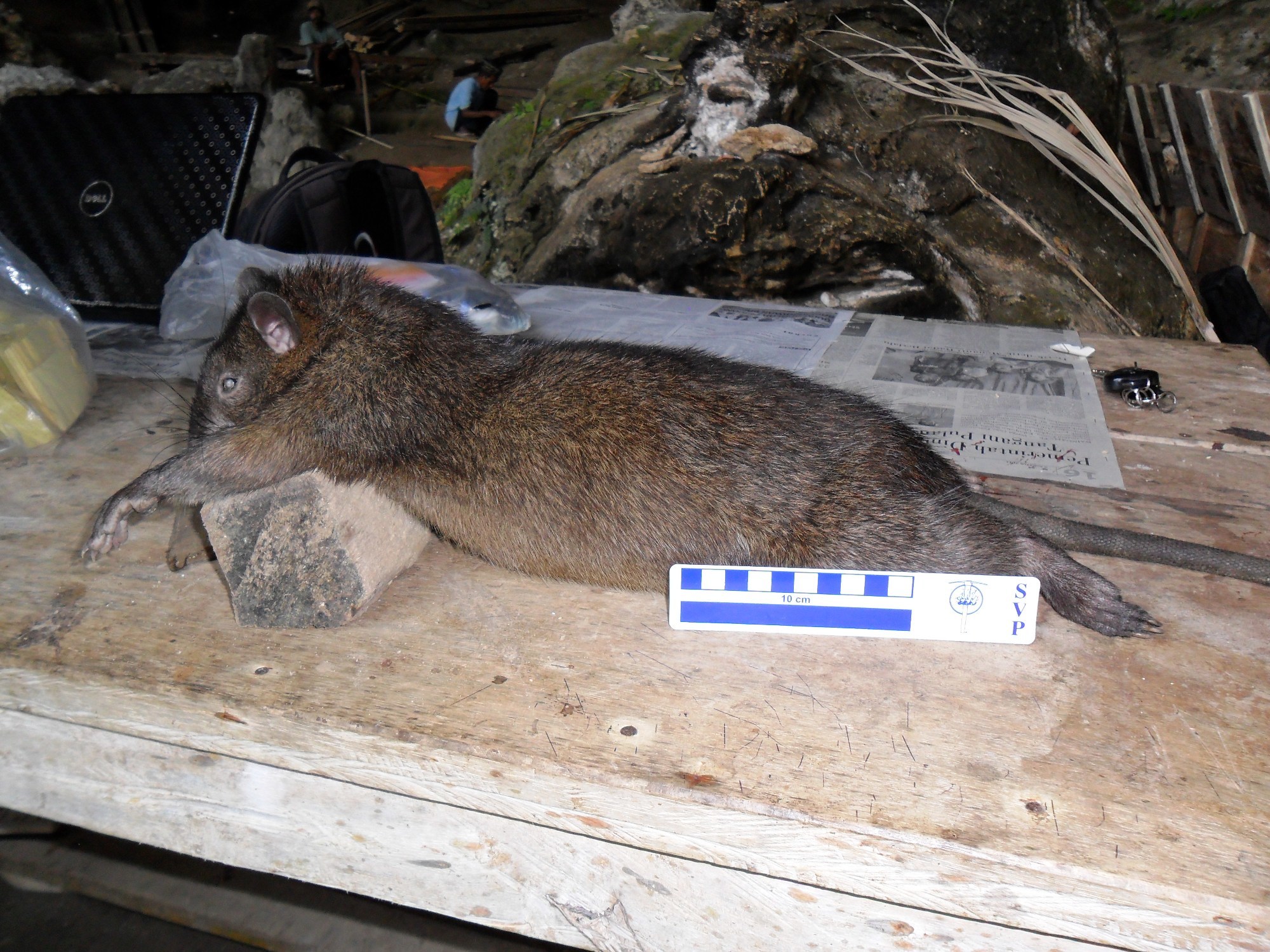
The Flores giant rat (Papagomys armandvillei) is a rodent of the family Muridae that occurs on the island of Flores in Indonesia.
- Kingdom
- Animalia
- Phylum
- Chordata
- Class
- Mammalia
- Order
- Rodentia
- Family
- Muridae
- Genus
- Papagomys
- Species
- Papagomys armandvillei
Description
The Flores giant rat (Papagomys armandvillei) is a rodent of the family Muridae that occurs on the island of Flores in Indonesia. It has been recorded in Rutong Protection Forest. The species is found in primary, secondary and disturbed forest over a wide range of elevations. Its head and body length is 41–45 cm (16–17.5 in) and its tail length is 33–70 cm (13–27.5 in). These dimensions are about twice as large as those of a typical brown rat (Rattus norvegicus), which suggests about eight times the body mass. The body mass has been estimated at 1.2–2.5 kilograms (2.6–5.5 lb), comparable to a rabbit. Papagomys armandvillei is the only extant species in the genus Papagomys, with another smaller species, Papagomys theodorverhoeveni, known from subfossil remains. The specific epithet, armandvillei, honours the Dutch Jesuit missionary Cornelis Johann Le Cocq d'Armandville (1846–1896), who was stationed in the Dutch East Indies, beginning in Java, East Nusa Tenggara, and later in New Guinea. Guy Musser describes the Flores giant rat as having small, round ears, a chunky body, and a small tail, and as appearing to be adapted for life on the ground with refuge in burrows. It has dense dark hair (pelage). Analysis of the teeth suggests a diet of leaves, buds, fruit, and certain kinds of insects as inferred by large hypsodont teeth. The Flores giant rat has been suggested to have been a prey item of the extinct dwarf human species Homo floresiensis.
Gallery
Ajouter des photos
Partagez vos photos de cette espèce (jusqu'à 20 à la fois) : elles sont vérifiées automatiquement, puis publiées.
Répartition
Occurrences observées (données GBIF). Les zones hors aire d'origine peuvent indiquer une présence introduite ou invasive.
Sources et crédits
Informations provenant de plusieurs sources vérifiées. Dernière mise à jour : .
Crédits photos (3)
- Photo : Mark Schellekens · CC BY-NC 4.0 · via GBIF
- Photo : Mark Schellekens (@mark027) · CC BY-NC 4.0 · via iNaturalist
- Photo : James Eaton (@james_birdtourasia) · CC0 (domaine public) · via iNaturalist
Mentions de licence
Texte disponible sous licence CC BY-SA 4.0. Il adapte notamment Wikipedia (CC BY-SA) : Flores giant rat (Wikipédia, auteurs dans l’historique de l’article).
- Taxonomie : GBIF Backbone Taxonomy (CC BY 4.0)
- Carte : occurrences GBIF, fond © contributeurs OpenStreetMap (ODbL)
- Statut de conservation : Liste rouge de l'UICN, via Wikidata (CC0)
Détail : Sources et licences.
Discussion (0)
Aucun message pour l’instant. Lancez la discussion sur cette fiche (sources, précisions, débats éditoriaux).
Connectez-vous pour participer à la discussion.