
Black-tailed marmoset
Mico melanurus
The black-tailed marmoset (Mico melanurus) is a species of New World monkey from central South America, where it ranges from the south-central Amazon in Brazil, south through the Pantanal and eastern Bolivia, to the Chaco in far…
- Kingdom
- Animalia
- Phylum
- Chordata
- Class
- Mammalia
- Order
- Primates
- Family
- Callitrichidae
- Genus
- Mico
- Species
- Mico melanurus
Description
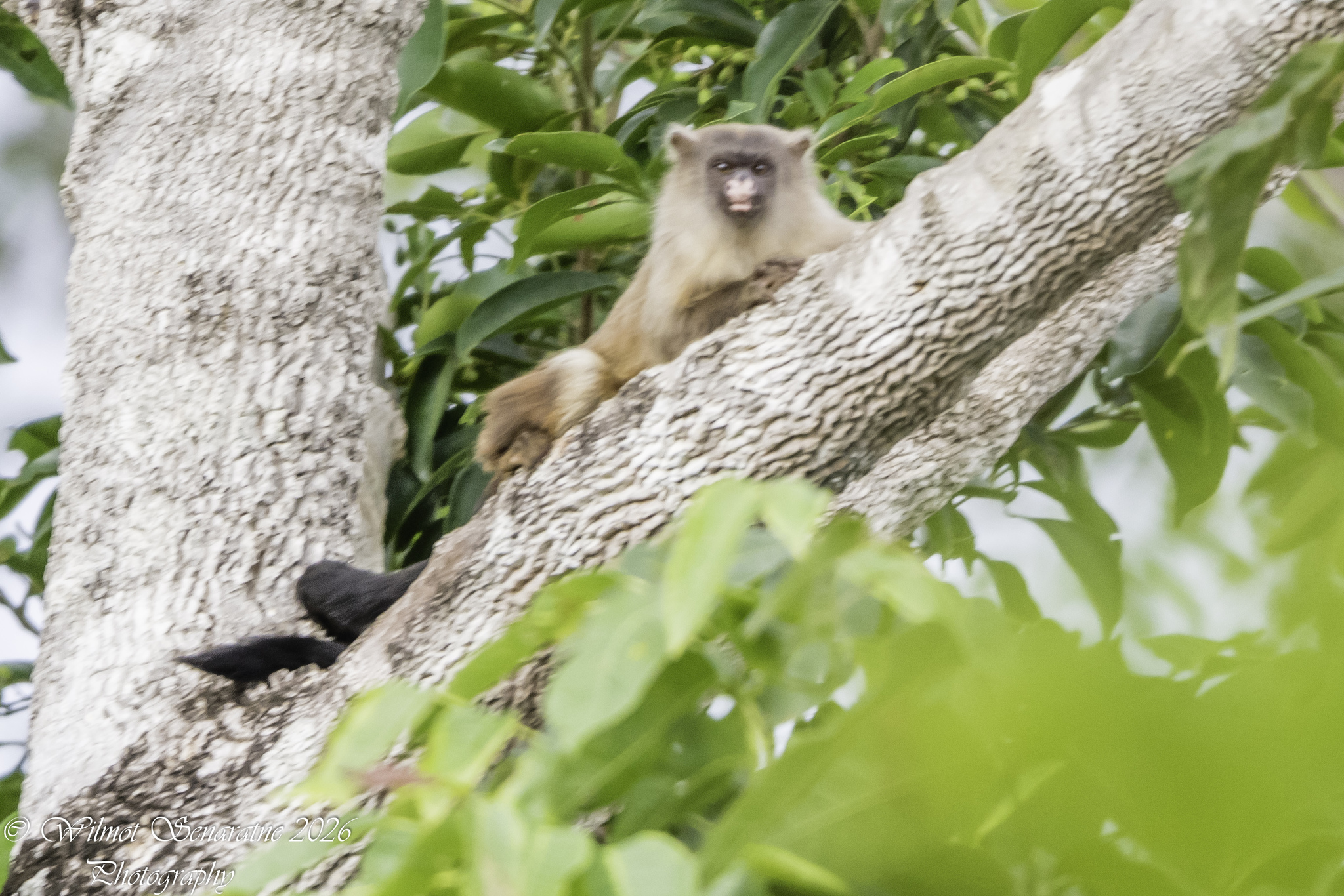
The black-tailed marmoset (Mico melanurus) is a species of New World monkey from central South America, where it ranges from the south-central Amazon in Brazil, south through the Pantanal and eastern Bolivia, to the Chaco in far northern Paraguay. It is the southernmost member of the genus Mico and the only species where most of its range is outside the Amazon. The black-tailed marmoset is dark brown with paler foreparts and a black tail. Unlike most of its relatives, it has a striking white or yellow-white stripe that extends down its thigh. Its ears are naked, flesh-colored and stand out from the fur. They reach a size of 18 to 28 cm and weigh from 300 to 400 g. Black-tailed marmosets are diurnal and arboreal, using their claws to climb trees. Originally rain forest inhabitants, plantations have caused them to expanded them their range. They spend the night in tree hollows or in very close vegetation. They live together in small groups and mark their territory with scent glands, driving out intruders by shouting or by facial expressions, including lowered brows and guarded lips. The diet of the black-tailed marmoset predominantly consists of tree sap. To a lesser extent, they also eat bird eggs, fruits, insects, and small vertebrates. After a 145-day gestation period, the female bears two (or rarely three) offspring. As is the case for many callitrichines, the father and the other group members take part with the raising of the offspring. Within six months the young are weaned, with full maturity coming at about two years of age.
Gallery
Ajouter des photos
Partagez vos photos de cette espèce (jusqu'à 20 à la fois) : elles sont vérifiées automatiquement, puis publiées.
Répartition
Occurrences observées (données GBIF). Les zones hors aire d'origine peuvent indiquer une présence introduite ou invasive.
Sources et crédits
Informations provenant de plusieurs sources vérifiées. Dernière mise à jour : .
Crédits photos (6)
- Photo : wilmotsenaratne · CC BY-NC 4.0 · via GBIF
- Photo : Tulio Dornas (@tuliodornas) · CC BY-NC 4.0 · via iNaturalist
- Photo : Rogerio Eduardo (@rogerioeduardo) · CC BY-NC 4.0 · via iNaturalist
- Photo : Becky Brenner (@jbecky) · CC BY-NC 4.0 · via iNaturalist
- Photo : Josh Noseworthy (@josh_noseworthy) · CC BY 4.0 · via iNaturalist
- Photo : Holly Greening (@hsgzoe) · CC BY-NC 4.0 · via iNaturalist
Mentions de licence
Texte disponible sous licence CC BY-SA 4.0. Il adapte notamment Ouistiti mélanure, Wikipedia (CC BY-SA) : Black-tailed marmoset (Wikipédia, auteurs dans l’historique de l’article).
- Taxonomie : GBIF Backbone Taxonomy (CC BY 4.0)
- Carte : occurrences GBIF, fond © contributeurs OpenStreetMap (ODbL)
- Statut de conservation : Liste rouge de l'UICN, via Wikidata (CC0)
Détail : Sources et licences.
Discussion (0)
Aucun message pour l’instant. Lancez la discussion sur cette fiche (sources, précisions, débats éditoriaux).
Connectez-vous pour participer à la discussion.