
Bat-eared fox
Otocyon megalotis
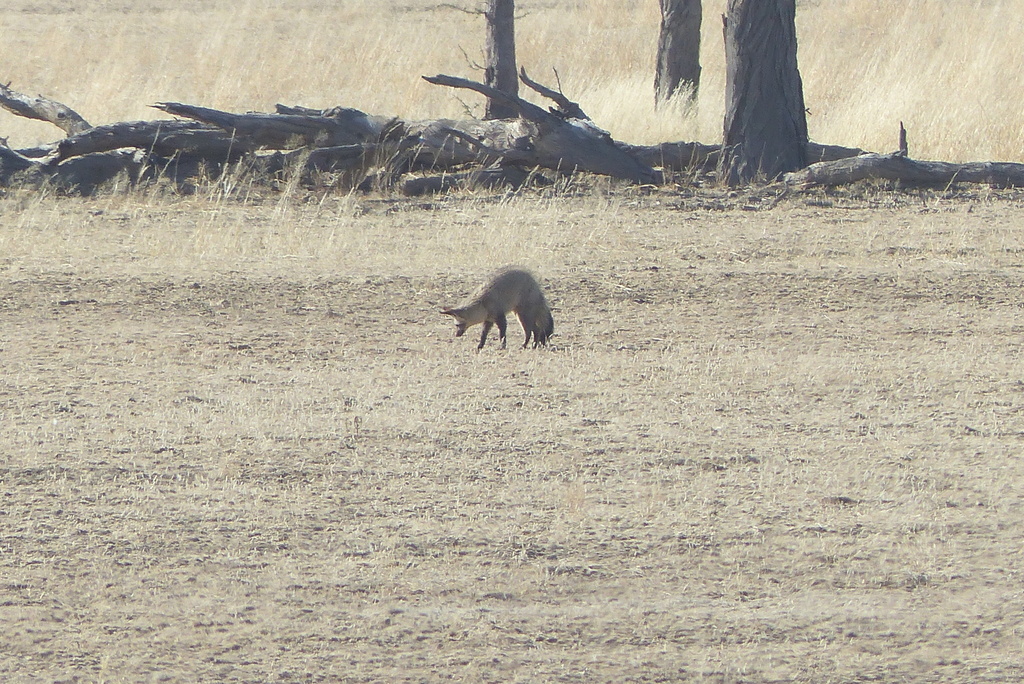
The bat-eared fox (Otocyon megalotis) is a species of fox found on the African savanna.
- Kingdom
- Animalia
- Phylum
- Chordata
- Class
- Mammalia
- Order
- Carnivora
- Family
- Canidae
- Genus
- Otocyon
- Species
- Otocyon megalotis
Description
The bat-eared fox (Otocyon megalotis) is a species of fox found on the African savanna. It is the only extant species of the genus Otocyon, and is the sister species to all other members of the tribe Vulpini, not genetically being a true fox. Fossil records indicate this canid first appeared during the middle Pleistocene. There are two separate populations of the bat-eared fox, each of which makes up a subspecies. The bat referred to in its colloquial name is possibly the Egyptian slit-faced bat (Nycteris thebaica), which is abundant in the region and has very large ears. Other vernacular names include big-eared fox, black-eared fox, long-eared fox, Delalande's fox, cape fox, and motlosi. It is named for its large ears, which have a role in thermoregulation. It is a small canid, being of comparable size to the closely related cape fox and common raccoon dog. Its fur varies in color depending on the subspecies, but is generally tan-colored and has guard hairs of a grey agouti color. The bat-eared fox is found in Southern and East Africa, though the two subspecies are separated by an unpopulated region spanning approximately 1,000 km (620 mi). In its range, the bat-eared fox digs dens for shelter and to raise its young, and lives in social groups or pairs that hunt and groom together. The bat-eared fox eats mainly insects-a diet unique among canids. It forages in arid and semi-arid environments, preferring regions with bare ground and where ungulates keep grasses short, and locates prey by using its hearing, walking slowly with its nose to the ground and ears tilted forwards. Most of its diet is made up of harvester termites, which also hydrates the bat-eared fox, as it does not drink from free-standing water. By feeding on harvester termites, it acts as a means of population control for these insects, which are considered pests in regions populated by humans. In such regions, it has been hunted for its fur. No major threats to the bat-eared fox exist, and as such it is considered to be a least-concern species.
Gallery
Ajouter des photos
Partagez vos photos de cette espèce (jusqu'à 20 à la fois) : elles sont vérifiées automatiquement, puis publiées.
Répartition
Occurrences observées (données GBIF). Les zones hors aire d'origine peuvent indiquer une présence introduite ou invasive.
Sources et crédits
Informations provenant de plusieurs sources vérifiées. Dernière mise à jour : .
Crédits photos (7)
- Photo : Lukas Zangl (@luksza) · CC BY 4.0 · via iNaturalist
- Photo : Vaughan Jessnitz (@vaughanjessnitz) · CC BY-NC 4.0 · via iNaturalist
- Photo : Viktor (@viktor-n) · CC BY 4.0 · via iNaturalist
- Photo : @vesper · CC BY-NC 4.0 · via iNaturalist
- Photo : @mountainwit · CC BY-NC 4.0 · via iNaturalist
- Photo : @dune_ninja · CC0 (domaine public) · via iNaturalist
- Photo : NatCarbon Africa- Ecology Team (@natcarbon_africa_ecology) · CC BY-NC 4.0 · via iNaturalist
Mentions de licence
Texte disponible sous licence CC BY-SA 4.0. Il adapte notamment Otocyon, Wikipedia (CC BY-SA) : Bat-eared fox (Wikipédia, auteurs dans l’historique de l’article).
- Taxonomie : GBIF Backbone Taxonomy (CC BY 4.0)
- Carte : occurrences GBIF, fond © contributeurs OpenStreetMap (ODbL)
- Statut de conservation : Liste rouge de l'UICN, via Wikidata (CC0)
Détail : Sources et licences.
Discussion (0)
Aucun message pour l’instant. Lancez la discussion sur cette fiche (sources, précisions, débats éditoriaux).
Connectez-vous pour participer à la discussion.