
Scimitar Oryx
Oryx dammah
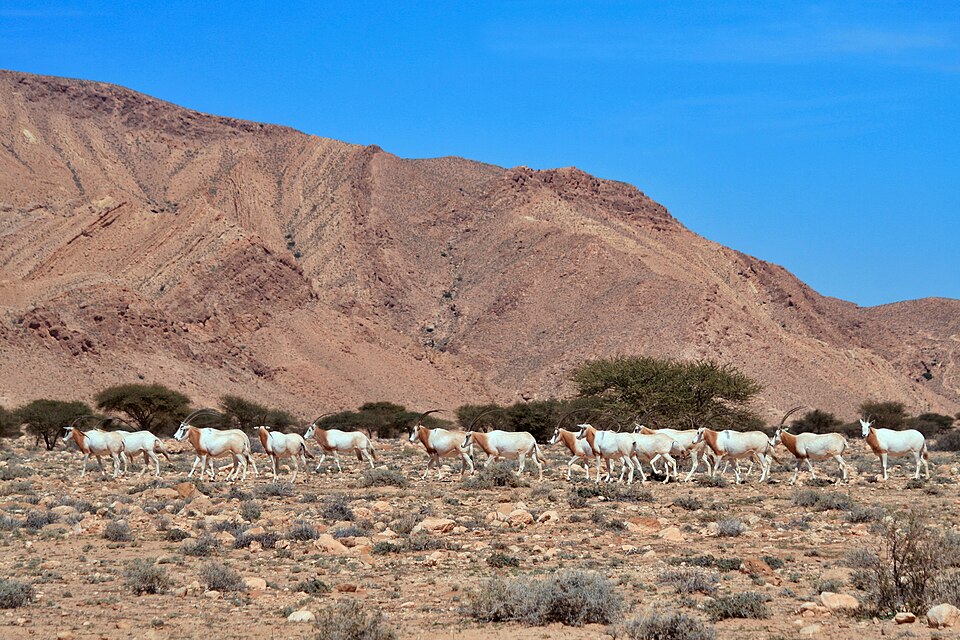
The scimitar oryx (Oryx dammah), also known as the scimitar-horned oryx and the Sahara oryx, is an Oryx species that was once widespread across North Africa and parts of West and Central Africa.
- Kingdom
- Animalia
- Phylum
- Chordata
- Class
- Mammalia
- Order
- Artiodactyla
- Family
- Bovidae
- Genus
- Oryx
- Species
- Oryx dammah
Description
The scimitar oryx (Oryx dammah), also known as the scimitar-horned oryx and the Sahara oryx, is an Oryx species that was once widespread across North Africa and parts of West and Central Africa. In 2000, it was declared extinct in the wild on the IUCN Red List, but in 2023, it was downlisted to endangered, with a reintroduced population in Chad. This particular oryx is adapted to harsh desert conditions and can survive for months without drinking water. A grazing animal, it derives most of its daily moisture intake from plants. The decline of the scimitar oryx population began as a result of climate change during the Neolithic period, and later it was hunted extensively for its horns. Today, it is bred in captivity in special reserves in Tunisia, Morocco, and Senegal, and on private exotic animal ranches in the Texas Hill Country, United States. In 2016, a reintroduction program was launched, and currently a small herd has been successfully reintroduced in Chad. The scimitar oryx was the emblem of the ancient Egyptian Oryx nome and today is the animal symbol of the Sahara Conservation Fund.
Gallery
Ajouter des photos
Partagez vos photos de cette espèce (jusqu'à 20 à la fois) : elles sont vérifiées automatiquement, puis publiées.
Répartition
Occurrences observées (données GBIF). Les zones hors aire d'origine peuvent indiquer une présence introduite ou invasive.
Sources et crédits
Informations provenant de plusieurs sources vérifiées. Dernière mise à jour : .
Crédits photos (6)
- Photo : Slim Alileche · CC BY-SA 4.0
- Photo : Wesley Strong (@wesley_v_strong) · CC BY-NC 4.0 · via iNaturalist
- Photo : Joshua Rapp Learn (@vagabondreports) · CC BY-NC 4.0 · via iNaturalist
- Photo : Stan van Remmerden (@stanvrem) · CC BY-NC 4.0 · via iNaturalist
- Photo : Annika Lindqvist (@annikaml) · CC BY 4.0 · via iNaturalist
- Photo : Cindy Chrisler (@cindychrisler) · CC BY-NC 4.0 · via iNaturalist
Mentions de licence
Texte disponible sous licence CC BY-SA 4.0. Il adapte notamment Oryx algazelle, Wikipedia (CC BY-SA) : Scimitar oryx (Wikipédia, auteurs dans l’historique de l’article).
- Taxonomie : GBIF Backbone Taxonomy (CC BY 4.0)
- Carte : occurrences GBIF, fond © contributeurs OpenStreetMap (ODbL)
Détail : Sources et licences.
Discussion (0)
Aucun message pour l’instant. Lancez la discussion sur cette fiche (sources, précisions, débats éditoriaux).
Connectez-vous pour participer à la discussion.