
Mountain Degu
Octodontomys gliroides
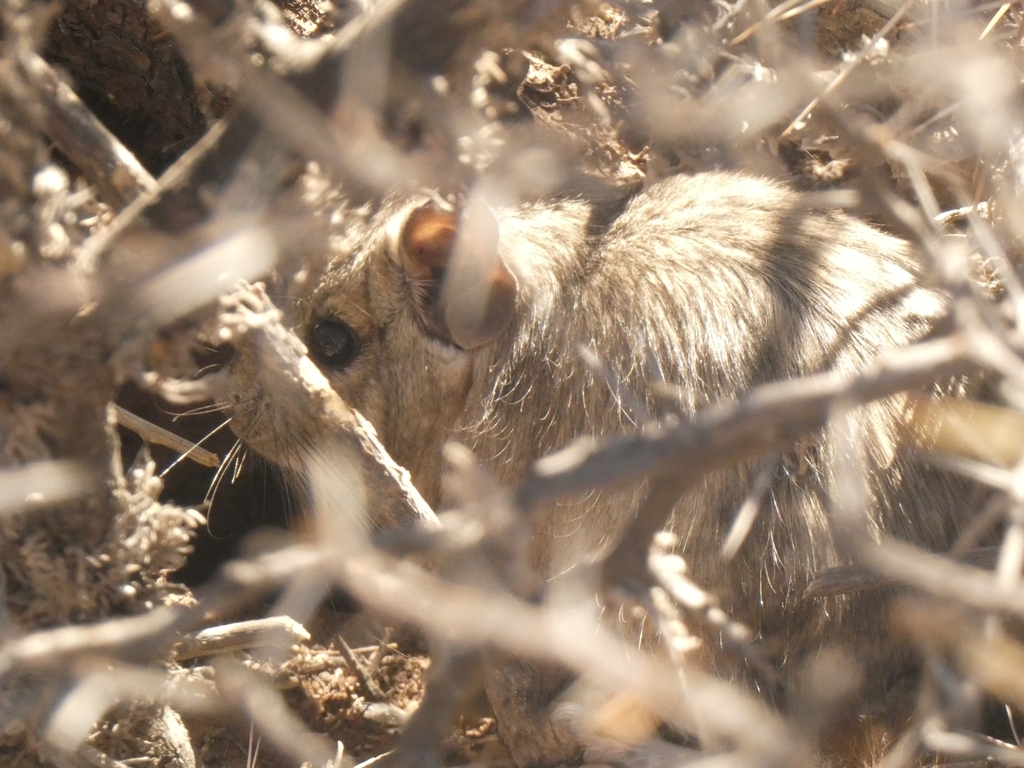
The mountain degu (Octodontomys gliroides), also known as the Andean degu, is a species of rodent in the family Octodontidae.
- Kingdom
- Animalia
- Phylum
- Chordata
- Class
- Mammalia
- Order
- Rodentia
- Family
- Octodontidae
- Genus
- Octodontomys
- Species
- Octodontomys gliroides
Description
The mountain degu (Octodontomys gliroides), also known as the Andean degu, is a species of rodent in the family Octodontidae. It is the only species in the genus Octodontomys. It is a medium-sized rodent with long, silky grey-brown fur, large grey ears, and white-furred chin and underparts. It is found in the foothills of the Andes in Argentina, Bolivia and Chile, and closely resembles the mountain viscacha rat and viscacha rats in the genus Tympanoctomys, all of which are found in Argentina. It is an herbivore, and eats grasses, leaves, bark, and cacti. The mountain degu gets most of its water from eating the tissues of prickly pear cactuses and cactuses in the genus Cereus. The mountain degu is a social animal, though not as much as the related common degu, and lives in family units of two to four individuals that share a burrow, play together, and take dust baths in turn with each other. Mountain degus have no special ability to dig with their claws, and their burrows are often short. They often make their homes in caves and under rocks. Members of a social group communicate through gurgles, twitters and squeaks. The mountain degu's closest relatives are the rodents in the genera Octodon, Spalacopus, and Aconaemys. Mountain degus have little impact on human society. They are a potential carrier of the parasitic species Trypanosoma cruzi, which can cause Chagas disease in humans. They are also host to fleas and lice. The mountain degu population is not threatened by anything, and it can be found in some protected areas, leading the International Union for Conservation of Nature to classify it as a least-concern species.
Gallery
Ajouter des photos
Partagez vos photos de cette espèce (jusqu'à 20 à la fois) : elles sont vérifiées automatiquement, puis publiées.
Répartition
Occurrences observées (données GBIF). Les zones hors aire d'origine peuvent indiquer une présence introduite ou invasive.
Sources et crédits
Informations provenant de plusieurs sources vérifiées. Dernière mise à jour : .
Crédits photos (3)
- Photo : Ben Costamagna (@bencostamagna) · CC BY 4.0 · via iNaturalist
- Photo : María Belén Dri (@belendri) · CC BY-NC 4.0 · via iNaturalist
- Photo : Diego Carús (@diegocarau) · CC0 (domaine public) · via iNaturalist
Mentions de licence
Texte disponible sous licence CC BY-SA 4.0. Il adapte notamment Octodontomys gliroides, Wikipedia (CC BY-SA) : Mountain degu (Wikipédia, auteurs dans l’historique de l’article).
- Taxonomie : GBIF Backbone Taxonomy (CC BY 4.0)
- Carte : occurrences GBIF, fond © contributeurs OpenStreetMap (ODbL)
- Statut de conservation : Liste rouge de l'UICN, via Wikidata (CC0)
Détail : Sources et licences.
Discussion (0)
Aucun message pour l’instant. Lancez la discussion sur cette fiche (sources, précisions, débats éditoriaux).
Connectez-vous pour participer à la discussion.