
Ocelot
Leopardus pardalis
The ocelot (Leopardus pardalis) is a medium-sized spotted wild cat that reaches 40–50 cm (16–20 in) at the shoulders and weighs between 7 and 15.5 kg (15 and 34 lb) on average.
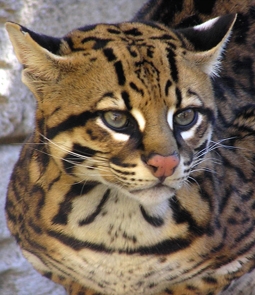
- Kingdom
- Animalia
- Phylum
- Chordata
- Class
- Mammalia
- Order
- Carnivora
- Family
- Felidae
- Genus
- Leopardus
- Species
- Leopardus pardalis
Description
The ocelot (Leopardus pardalis) is a medium-sized spotted wild cat that reaches 40–50 cm (16–20 in) at the shoulders and weighs between 7 and 15.5 kg (15 and 34 lb) on average. It is native to the southwestern United States, Mexico, Central and South America, and the Caribbean islands of Trinidad and Margarita. Carl Linnaeus scientifically described it in 1758. Two subspecies are recognized. The ocelot is efficient at climbing, leaping and swimming. It prefers areas close to water sources with dense vegetation cover and high prey availability. It preys on small terrestrial mammals, such as armadilloes, opossums, and lagomorphs. It is typically active during twilight and at night and tends to be solitary and territorial. Both sexes become sexually mature at around two years of age and can breed throughout the year; peak mating season varies geographically. After a gestation period of two to three months, the female gives birth to a litter of one to three kittens. They stay with their mother for up to two years, after which they leave to establish their own home ranges. The ocelot is listed as Least Concern on the IUCN Red List and is threatened by habitat destruction, hunting, and traffic accidents. While its range is very large, various populations are decreasing in many parts of its range. The association of the ocelot with humans dates back to the Aztec and Incan civilizations; it has occasionally been kept as a pet.
Gallery
Ajouter des photos
Partagez vos photos de cette espèce (jusqu'à 20 à la fois) : elles sont vérifiées automatiquement, puis publiées.
Répartition
Occurrences observées (données GBIF). Les zones hors aire d'origine peuvent indiquer une présence introduite ou invasive.
Sources et crédits
Informations provenant de plusieurs sources vérifiées. Dernière mise à jour : .
Crédits photos (6)
- Photo : Paula Andrea Castaño · CC BY-SA 3.0
- Photo : @conabio-pj010 · CC BY-NC 4.0 · via iNaturalist
- Photo : @vvazquez · CC BY-NC 4.0 · via iNaturalist
- Photo : Juan Carlos Delgado Madrid (@juandelgado_sib) · CC BY-NC 4.0 · via iNaturalist
- Photo : Pablo Preliasco (@preli) · CC BY-NC 4.0 · via iNaturalist
- Photo : José Rogelio Prisciliano Vázquez (@josroger) · CC BY-NC 4.0 · via iNaturalist
Mentions de licence
Texte disponible sous licence CC BY-SA 4.0. Il adapte notamment Wikipedia (CC BY-SA) : Ocelot (Wikipédia, auteurs dans l’historique de l’article).
- Taxonomie : GBIF Backbone Taxonomy (CC BY 4.0)
- Carte : occurrences GBIF, fond © contributeurs OpenStreetMap (ODbL)
- Statut de conservation : Liste rouge de l'UICN, via Wikidata (CC0)
Détail : Sources et licences.
Discussion (0)
Aucun message pour l’instant. Lancez la discussion sur cette fiche (sources, précisions, débats éditoriaux).
Connectez-vous pour participer à la discussion.