
Javan slow loris
Nycticebus javanicus
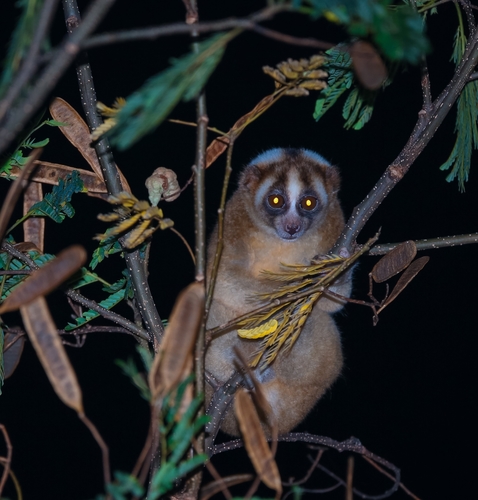
The Javan slow loris (Nycticebus javanicus) is a strepsirrhine primate and a species of slow loris native to the western and central portions of the island of Java, in Indonesia.
- Kingdom
- Animalia
- Phylum
- Chordata
- Class
- Mammalia
- Order
- Primates
- Family
- Lorisidae
- Genus
- Nycticebus
- Species
- Nycticebus javanicus
Description
The Javan slow loris (Nycticebus javanicus) is a strepsirrhine primate and a species of slow loris native to the western and central portions of the island of Java, in Indonesia. Although originally described as a separate species, it was considered a subspecies of the Sunda slow loris (N. coucang) for many years, until reassessments of its morphology and genetics in the 2000s resulted in its promotion to full species status. It is most closely related to the Sunda slow loris and the Bengal slow loris (N. bengalensis). The species has two forms, based on hair length and, to a lesser extent, coloration. Its forehead has a prominent white diamond pattern, which consists of a distinct stripe that runs over its head and forks towards the eyes and ears. The Javan slow loris weighs between 565 and 687 g (1.25 and 1.51 lb) and has a head-body length of about 293 mm (11.5 in). Like all lorises, it is arboreal and moves slowly across vines and lianas instead of jumping from tree to tree. Its habitat includes primary and secondary forests, but it can also be found in bamboo and mangrove forests, and on chocolate plantations. Its diet typically consists of fruit, tree gum, lizards, and eggs. It sleeps on exposed branches, sometimes in groups, and is usually seen alone or in pairs. The Javan slow loris population is in sharp decline because of poaching for the exotic pet trade, and sometimes for traditional medicine. Remaining populations have low densities, and habitat loss is a major threat. For these reasons, the International Union for Conservation of Nature (IUCN) lists its status as critically endangered, and it has also been included on the 2008–2010 list of "The World's 25 Most Endangered Primates". It is protected by Indonesian law and, since June 2007, is listed under CITES Appendix I. Despite these protections, as well as its presence in several protected areas, poaching continues; the wildlife protection laws are rarely enforced at the local level.
Gallery
Ajouter des photos
Partagez vos photos de cette espèce (jusqu'à 20 à la fois) : elles sont vérifiées automatiquement, puis publiées.
Répartition
Occurrences observées (données GBIF). Les zones hors aire d'origine peuvent indiquer une présence introduite ou invasive.
Sources et crédits
Informations provenant de plusieurs sources vérifiées. Dernière mise à jour : .
Crédits photos (6)
- Photo : (c) Diki Muhamad Chaidir, some rights reserved (CC BY-NC), uploaded by Diki Muhamad Chaidir · CC BY-NC 4.0 · via iNaturalist
- Photo : Royle Safaris (@roylesafaris) · CC BY-NC 4.0 · via iNaturalist
- Photo : A. Restu Dwikelana (@resdwikelana) · CC BY-NC 4.0 · via iNaturalist
- Photo : Muh Imam Ramdani (@ramdanimam) · CC BY-NC 4.0 · via iNaturalist
- Photo : @ellarbrown · CC BY-NC 4.0 · via iNaturalist
- Photo : Diki Muhamad Chaidir (@dikimc) · CC BY-NC 4.0 · via iNaturalist
Mentions de licence
Texte disponible sous licence CC BY-SA 4.0. Il adapte notamment Nycticèbe de Java, Wikipedia (CC BY-SA) : Javan slow loris (Wikipédia, auteurs dans l’historique de l’article).
- Taxonomie : GBIF Backbone Taxonomy (CC BY 4.0)
- Carte : occurrences GBIF, fond © contributeurs OpenStreetMap (ODbL)
- Statut de conservation : Liste rouge de l'UICN, via Wikidata (CC0)
Détail : Sources et licences.
Discussion (0)
Aucun message pour l’instant. Lancez la discussion sur cette fiche (sources, précisions, débats éditoriaux).
Connectez-vous pour participer à la discussion.