
Mitchell's Hopping Mouse
Notomys mitchellii
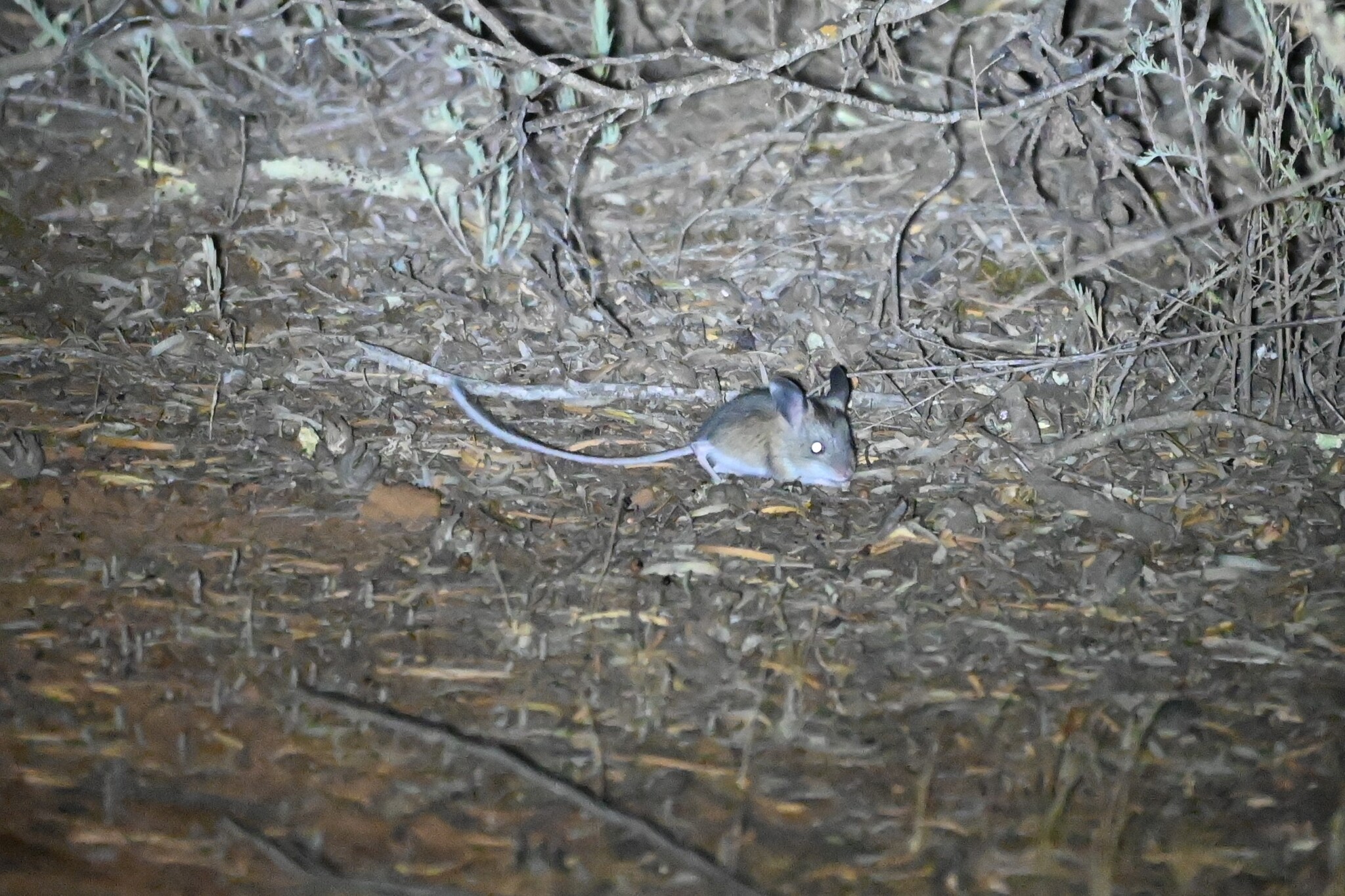
Mitchell's hopping mouse (Notomys mitchellii) also known as the pankot, is the largest extant member of the genus Notomys, weighing between 40 and 60 g (1.4 and 2.1 oz).
- Kingdom
- Animalia
- Phylum
- Chordata
- Class
- Mammalia
- Order
- Rodentia
- Family
- Muridae
- Genus
- Notomys
- Species
- Notomys mitchellii
Description
Mitchell's hopping mouse (Notomys mitchellii) also known as the pankot, is the largest extant member of the genus Notomys, weighing between 40 and 60 g (1.4 and 2.1 oz). N. mitchellii is a bipedal rodent with large back legs, similar to a jerboa or kangaroo rat. The species occurs throughout much of semi-arid Southern Australia, and appears to be particularly common on the Eyre Peninsula, South Australia. Typical habitat for N. mitchellii appears to be mallee shrublands on sandy dune systems. The species is currently considered to be unthreatened, but its range has been reduced through habitat disturbance and destruction associated with European settlement in Australia. Individuals are a sandy grey colour, with white chest hairs and a paler underbelly. The tail of the species is long and has the characteristic hopping mouse brush at the tip. This tail morphology is thought to aid balance when travelling at speed. Being nocturnal, Notomys mitchellii shelters during the day in typical hopping mouse burrows; a small number of interconnected, vertical shafts, burrowing deep into the dune. Up to eight animals, different ages and sex, have been found in a single burrow. Notomys mitchellii is known to have a lifespan of up to five years in the laboratory and this is thought to be a strategy evolved to combat the breeding-constraints of lengthy periods of drought. It has also been found that this species is less able to cope with water deprivation than other species of the genus. Notomys mitchellii produces concentrated urine to conserve water, but in a different way to more arid-dwelling rodents. The diet of N. mitchellii is also thought to consist of more roots and green matter than that of other species of the genus: animals captured in drought conditions had stomach contents consisting of some 85% roots, 11% green leaf and 4% seed.
Gallery
Ajouter des photos
Partagez vos photos de cette espèce (jusqu'à 20 à la fois) : elles sont vérifiées automatiquement, puis publiées.
Répartition
Occurrences observées (données GBIF). Les zones hors aire d'origine peuvent indiquer une présence introduite ou invasive.
Sources et crédits
Informations provenant de plusieurs sources vérifiées. Dernière mise à jour : .
Crédits photos (6)
- Photo : Antoni Camozzato · CC BY-NC 4.0 · via GBIF
- Photo : Nicole Kearney (@nicolekearney) · CC BY 4.0 · via iNaturalist
- Photo : Luke Wagenknecht (@lukewaggs) · CC BY-NC 4.0 · via iNaturalist
- Photo : Antoni Camozzato (@chuditch) · CC BY-NC 4.0 · via iNaturalist
- Photo : Adrian Uren (@adrianuren) · CC BY-NC 4.0 · via iNaturalist
- Photo : aaron (@aaronmc) · CC BY-NC 4.0 · via iNaturalist
Mentions de licence
Texte disponible sous licence CC BY-SA 4.0. Il adapte notamment Notomys mitchellii, Wikipedia (CC BY-SA) : Mitchell's hopping mouse (Wikipédia, auteurs dans l’historique de l’article).
- Taxonomie : GBIF Backbone Taxonomy (CC BY 4.0)
- Carte : occurrences GBIF, fond © contributeurs OpenStreetMap (ODbL)
- Statut de conservation : Liste rouge de l'UICN, via Wikidata (CC0)
Détail : Sources et licences.
Discussion (0)
Aucun message pour l’instant. Lancez la discussion sur cette fiche (sources, précisions, débats éditoriaux).
Connectez-vous pour participer à la discussion.