
Big-eared Woodrat
Neotoma macrotis
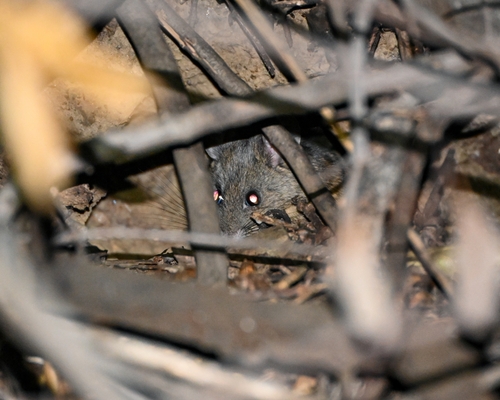
The big-eared woodrat (Neotoma macrotis) is a nocturnal rodent of the woodrat genus Neotoma, in the family Cricetidae.
- Kingdom
- Animalia
- Phylum
- Chordata
- Class
- Mammalia
- Order
- Rodentia
- Family
- Cricetidae
- Genus
- Neotoma
- Species
- Neotoma macrotis
Description
The big-eared woodrat (Neotoma macrotis) is a nocturnal rodent of the woodrat genus Neotoma, in the family Cricetidae. Closely related to, and formerly included in the species Neotoma fuscipes, it is endemic to western North America and occurs west and south of the Salinas Valley from the California Coast Ranges south of Monterey Bay to northern Baja California, as well as in the Sierra Nevada, extending north to the South Fork American River. The big-eared woodrat is light to dark brown in color, often with a lighter underside. It has characteristically large mobile ears, large eyes, and a long, fur covered tail. It is a primarily arboreal herbivore and functions as an important keystone species in oak and other forest ecosystems.
Gallery
Ajouter des photos
Partagez vos photos de cette espèce (jusqu'à 20 à la fois) : elles sont vérifiées automatiquement, puis publiées.
Répartition
Occurrences observées (données GBIF). Les zones hors aire d'origine peuvent indiquer une présence introduite ou invasive.
Sources et crédits
Informations provenant de plusieurs sources vérifiées. Dernière mise à jour : .
Crédits photos (7)
- Photo : Boaz Benaiah Solorio · CC BY-NC 4.0 · via Wikimedia Commons
- Photo : Zack Abbey · CC BY 4.0
- Photo : George Varga (@skylukr) · CC BY-NC 4.0 · via iNaturalist
- Photo : William Mason (@ectothermist) · CC BY-NC 4.0 · via iNaturalist
- Photo : John Shen (@john74177) · CC BY-NC 4.0 · via iNaturalist
- Photo : Adriel Hampton (@adrielhampton) · CC BY-NC 4.0 · via iNaturalist
- Photo : Jerry (@jdinoc) · CC BY-NC 4.0 · via iNaturalist
Mentions de licence
Texte disponible sous licence CC BY-SA 4.0. Il adapte notamment Wikipedia (CC BY-SA) : Big-eared woodrat (Wikipédia, auteurs dans l’historique de l’article).
- Taxonomie : GBIF Backbone Taxonomy (CC BY 4.0)
- Carte : occurrences GBIF, fond © contributeurs OpenStreetMap (ODbL)
- Statut de conservation : Liste rouge de l'UICN, via Wikidata (CC0)
Détail : Sources et licences.
Discussion (0)
Aucun message pour l’instant. Lancez la discussion sur cette fiche (sources, précisions, débats éditoriaux).
Connectez-vous pour participer à la discussion.