
Narwhal
Monodon monoceros
The narwhal (Monodon monoceros) is a species of toothed whale native to the Arctic.
- Kingdom
- Animalia
- Phylum
- Chordata
- Class
- Mammalia
- Order
- Cetacea
- Family
- Monodontidae
- Genus
- Monodon
- Species
- Monodon monoceros
Description
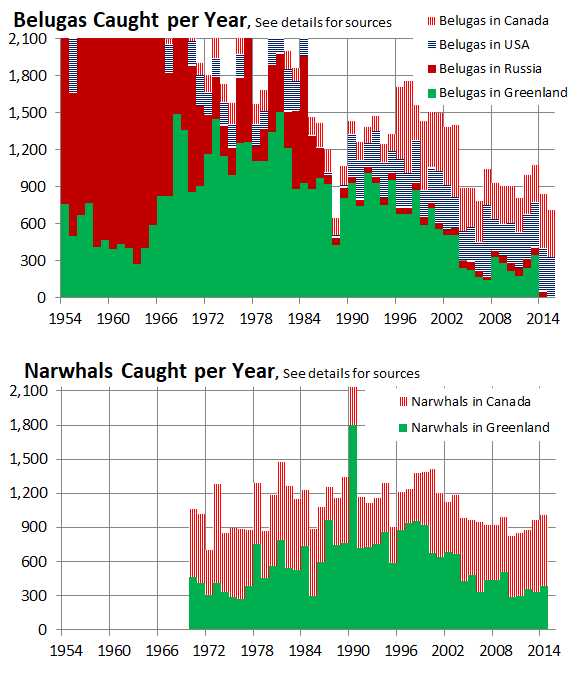
The narwhal (Monodon monoceros) is a species of toothed whale native to the Arctic. It is the only member of the genus Monodon and one of two living representatives of the family Monodontidae. The narwhal is a stocky cetacean with a relatively blunt snout, a large melon, and a shallow ridge in place of a dorsal fin. Males of this species have a spiralled tusk that is 1.5–3.0 m (4.9–9.8 ft) long, which is a protruding left canine thought to function as a weapon, a tool for feeding, in attracting mates or sensing water salinity. Specially adapted slow-twitch muscles, along with the jointed neck vertebrae and shallow dorsal ridge allow for easy movement through the Arctic environment, where the narwhal spends extended periods at great depths. The narwhal's geographic range overlaps with that of the similarly built and closely related beluga whale, and the animals are known to interbreed. Narwhals inhabit the Arctic waters of Canada, Greenland and Russia. Every year, they migrate to ice-free summering grounds, usually in shallow waters, and often return to the same sites in subsequent years. Their diet mainly consists of polar and Arctic cod, Greenland halibut, cuttlefish, shrimp, and armhook squid. Diving to depths of up to 2,370 m (7,780 ft), the narwhal is among the deepest-diving cetaceans. The animals typically travel in groups of three to eight, with aggregations of up to 1,000 occurring in the summer months. Narwhals mate among the offshore pack ice from March to May, and the young are born between July and August of the following year. When communicating amongst themselves, narwhals use a variety of clicks, whistles and knocks. There are an estimated 170,000 living narwhals, and the species is listed as being of least concern by the International Union for Conservation of Nature (IUCN). The population is threatened by the effects of climate change, such as reduction in ice cover and human activities such as pollution and hunting. Narwhals have been hunted for thousands of years by Inuit in northern Canada and Greenland for meat and ivory, and regulated subsistence hunting continues to this day.
Gallery
Ajouter des photos
Partagez vos photos de cette espèce (jusqu'à 20 à la fois) : elles sont vérifiées automatiquement, puis publiées.
Répartition
Occurrences observées (données GBIF). Les zones hors aire d'origine peuvent indiquer une présence introduite ou invasive.
Sources et crédits
Informations provenant de plusieurs sources vérifiées. Dernière mise à jour : .
Crédits photos (6)
- Photo : Numbersinstitute · CC BY-SA 4.0
- Photo : Andrew Simon (@chlorophilia) · CC BY-NC 4.0 · via iNaturalist
- Photo : @goggig · CC BY-NC 4.0 · via iNaturalist
- Photo : Greg Boreham (@treklightly) · CC BY-NC 4.0 · via iNaturalist
- Photo : Noah Strycker (@flammulated) · CC BY-NC 4.0 · via iNaturalist
- Photo : Bradley Rasmussen (@bradleyfishes) · CC BY-NC 4.0 · via iNaturalist
Mentions de licence
Texte disponible sous licence CC BY-SA 4.0. Il adapte notamment Wikipedia (CC BY-SA) : Narwhal (Wikipédia, auteurs dans l’historique de l’article).
- Taxonomie : GBIF Backbone Taxonomy (CC BY 4.0)
- Carte : occurrences GBIF, fond © contributeurs OpenStreetMap (ODbL)
- Statut de conservation : Liste rouge de l'UICN, via Wikidata (CC0)
Détail : Sources et licences.
Discussion (0)
Aucun message pour l’instant. Lancez la discussion sur cette fiche (sources, précisions, débats éditoriaux).
Connectez-vous pour participer à la discussion.