
Dwarf Dog-faced Bat
Molossops temminckii
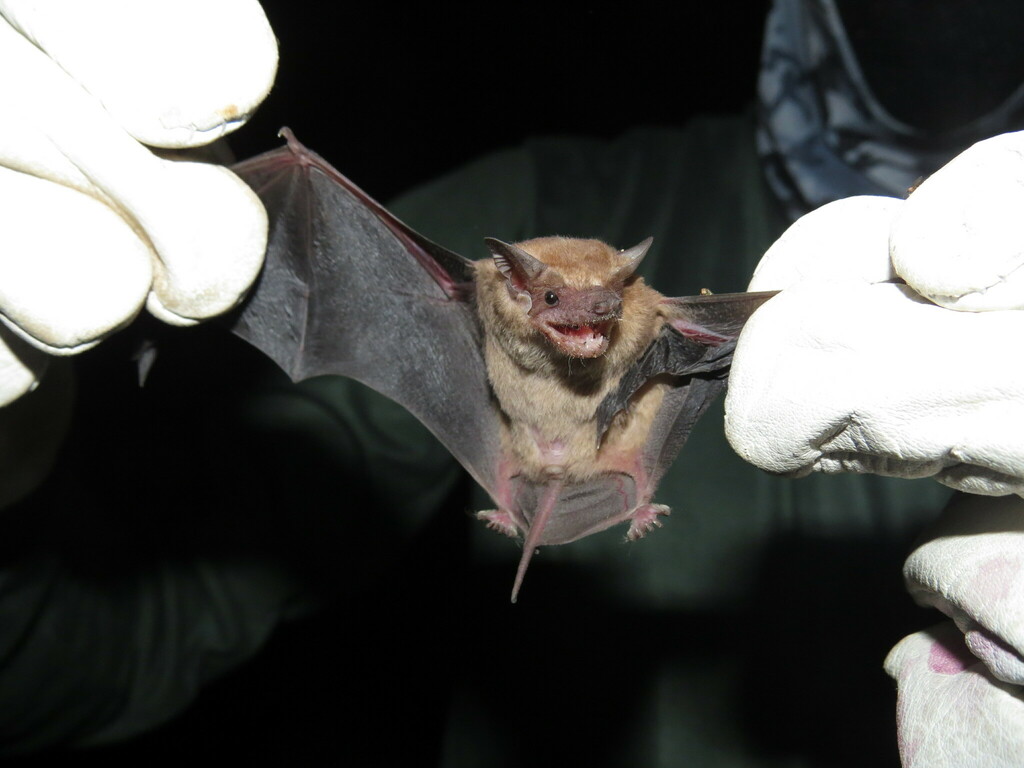
The dwarf dog-faced bat (Molossops temminckii) is a species of free-tailed bat from South America.
- Kingdom
- Animalia
- Phylum
- Chordata
- Class
- Mammalia
- Order
- Chiroptera
- Family
- Molossidae
- Genus
- Molossops
- Species
- Molossops temminckii
Description
The dwarf dog-faced bat (Molossops temminckii) is a species of free-tailed bat from South America. It is found in Argentina, Bolivia, Brazil, Colombia, Ecuador, Guyana, Peru, Paraguay and Uruguay, typically at lower elevations. It is one of two species in the genus Molossops, the other being the rufous dog-faced bat (M. neglectus). Three subspecies are often recognized, though mammalogist Judith Eger considers it monotypic with no subspecies. It is a small free-tailed bat, with a forearm length of 28.9–32.5 mm (1.14–1.28 in) and a weight of 5–8 g (0.18–0.28 oz); males are larger than females. It is brown, with paler belly fur and darker back fur. Its wings are unusual for a free-tailed bat, with exceptionally broad wingtips. Additionally, it has low wing loading, meaning that it has a large wing surface area relative to its body weight. Therefore, it flies more similarly to a vesper bat than to other species in its own family. As it forages at night for its insect prey, including moths, beetles, and others, it uses two kinds of frequency-modulated echolocation calls: one type is to navigate in open areas and to search for prey, while the other type is used for navigating in cluttered areas or while approaching a prey item. Little is known about its reproduction, with pregnant females documented July through December in various parts of its range. Females might be capable of becoming pregnant multiple times per year, unlike some bats which have an annual breeding season. It roosts in small groups, typically three or fewer, which can be found under tree bark, in rocky outcrops or buildings, or even within holes in fence posts. Its predators may include owls, though the extent of owl depredation is unknown. It has a variety of internal and external parasites, including nematodes, cestodes, trematodes, mites, ticks, and bat flies.
Gallery
Ajouter des photos
Partagez vos photos de cette espèce (jusqu'à 20 à la fois) : elles sont vérifiées automatiquement, puis publiées.
Répartition
Occurrences observées (données GBIF). Les zones hors aire d'origine peuvent indiquer une présence introduite ou invasive.
Sources et crédits
Informations provenant de plusieurs sources vérifiées. Dernière mise à jour : .
Crédits photos (7)
- Photo : @gabrielrocha17 · CC BY-NC 4.0 · via iNaturalist
- Photo : Irineu Cunha (@irineu_cunha) · CC BY-NC 4.0 · via iNaturalist
- Photo : Lucas Mantelo Cruz (@lucasmantelo) · CC BY 4.0 · via iNaturalist
- Photo : Leonardo Adrián LEIVA (@leoleiva) · CC BY-NC 4.0 · via iNaturalist
- Photo : Sebastián Gómez Barboza Silveira (@sgomez-barboza) · CC0 (domaine public) · via iNaturalist
- Photo : Maria Hernandez (@maria_hernandez8) · CC BY-NC 4.0 · via iNaturalist
- Photo : @katodaiki · CC BY-NC 4.0 · via iNaturalist
Mentions de licence
Texte disponible sous licence CC BY-SA 4.0. Il adapte notamment Wikipedia (CC BY-SA) : Dwarf dog-faced bat (Wikipédia, auteurs dans l’historique de l’article).
- Taxonomie : GBIF Backbone Taxonomy (CC BY 4.0)
- Carte : occurrences GBIF, fond © contributeurs OpenStreetMap (ODbL)
- Statut de conservation : Liste rouge de l'UICN, via Wikidata (CC0)
Détail : Sources et licences.
Discussion (0)
Aucun message pour l’instant. Lancez la discussion sur cette fiche (sources, précisions, débats éditoriaux).
Connectez-vous pour participer à la discussion.