
Gray Mouse Lemur
Microcebus murinus
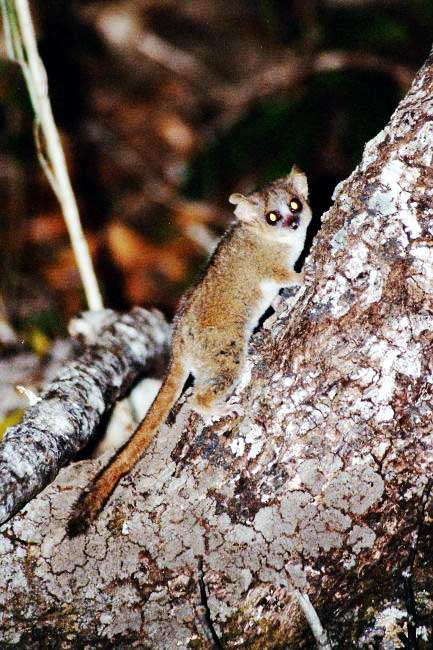
The gray mouse lemur (Microcebus murinus), grey mouse lemur or lesser mouse lemur is a small lemur, a type of strepsirrhine primate, found only on the island of Madagascar.
- Kingdom
- Animalia
- Phylum
- Chordata
- Class
- Mammalia
- Order
- Primates
- Family
- Cheirogaleidae
- Genus
- Microcebus
- Species
- Microcebus murinus
Description
The gray mouse lemur (Microcebus murinus), grey mouse lemur or lesser mouse lemur is a small lemur, a type of strepsirrhine primate, found only on the island of Madagascar. Weighing 58 to 67 grams (2.0 to 2.4 oz), it is the largest of the mouse lemurs (genus Microcebus), a group that includes the smallest primates in the world. The species is named for its mouse-like size and coloration and is known locally (in Malagasy) as tsidy, koitsiky, titilivaha, pondiky, and vakiandry. The gray mouse lemur and all other mouse lemurs are considered cryptic species, as they are nearly indistinguishable from each other by appearance. For this reason, the gray mouse lemur was considered the only mouse lemur species for decades until more recent studies began to distinguish between the species. Like all mouse lemurs, this species is nocturnal and arboreal. It is very active, and though it forages alone, groups of males and females form sleeping groups and share tree holes during the day. It exhibits a form of dormancy called torpor during the cool, dry winter months, and in some cases undergoes seasonal torpor (or hibernation), which is unusual for primates. The gray mouse lemur can be found in several types of forest throughout western and southern Madagascar. Its diet consists primarily of fruit, insects, flowers, and nectar. In the wild, its natural predators include owls, snakes, and endemic mammalian predators. Predation pressure is higher for this species than among any other primate species, with one out of four individuals taken by a predator each year. This is counterbalanced by its high reproductive rate. Breeding is seasonal, and distinct vocalizations are used to prevent hybridization with species that overlap its range. Gestation lasts approximately 60 days, and typically two young are born. The offspring are usually independent in two months, and can reproduce after one year. The gray mouse lemur has a reproductive lifespan of five years, although captive individuals have been reported to live up to 15 years. Although threatened by deforestation, habitat degradation, and live capture for the pet trade, it is considered one of Madagascar's most abundant small native mammals. It can tolerate moderate food shortages by experiencing daily torpor to conserve energy, but extended food shortages due to climate change may pose a significant risk to the species.
Gallery
Ajouter des photos
Partagez vos photos de cette espèce (jusqu'à 20 à la fois) : elles sont vérifiées automatiquement, puis publiées.
Répartition
Occurrences observées (données GBIF). Les zones hors aire d'origine peuvent indiquer une présence introduite ou invasive.
Sources et crédits
Informations provenant de plusieurs sources vérifiées. Dernière mise à jour : .
Crédits photos (6)
- Photo : Petra Lahann · CC BY-SA 2.0
- Photo : @kratzra · CC BY-NC 4.0 · via iNaturalist
- Photo : Dai Herbert (@dherbert) · CC BY-NC 4.0 · via iNaturalist
- Photo : Fionn Ó Marcaigh (@gleoiseach) · CC BY 4.0 · via iNaturalist
- Photo : George Williams (@georgewilliams1) · CC BY 4.0 · via iNaturalist
- Photo : Marcin Wiorek (@marcinwiorek) · CC BY-NC 4.0 · via iNaturalist
Mentions de licence
Texte disponible sous licence CC BY-SA 4.0. Il adapte notamment Wikipedia (CC BY-SA) : Gray mouse lemur (Wikipédia, auteurs dans l’historique de l’article).
- Taxonomie : GBIF Backbone Taxonomy (CC BY 4.0)
- Carte : occurrences GBIF, fond © contributeurs OpenStreetMap (ODbL)
- Statut de conservation : Liste rouge de l'UICN, via Wikidata (CC0)
Détail : Sources et licences.
Discussion (0)
Aucun message pour l’instant. Lancez la discussion sur cette fiche (sources, précisions, débats éditoriaux).
Connectez-vous pour participer à la discussion.