
Woodchuck
Marmota monax
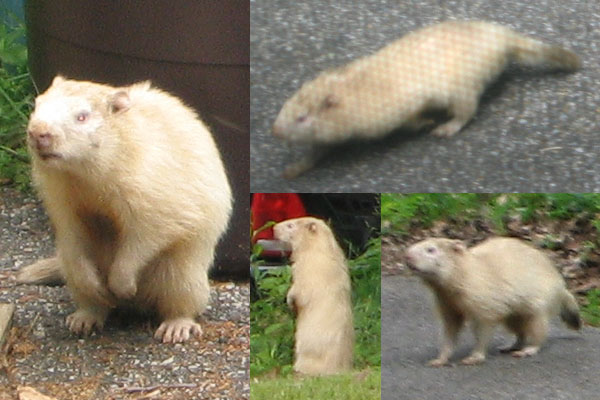
The groundhog (Marmota monax), also known as the woodchuck, is a rodent of the family Sciuridae, belonging to the group of large ground squirrels known as marmots.
- Kingdom
- Animalia
- Phylum
- Chordata
- Class
- Mammalia
- Order
- Rodentia
- Family
- Sciuridae
- Genus
- Marmota
- Species
- Marmota monax
Description
The groundhog (Marmota monax), also known as the woodchuck, is a rodent of the family Sciuridae, belonging to the group of large ground squirrels known as marmots. A lowland creature of North America, it is found through much of the Eastern United States, across Canada and into Alaska. It was given its scientific name as Mus monax by Carl Linnaeus in 1758, based on a description of the animal by George Edwards, published in 1743. The groundhog, being a lowland animal, is exceptional among marmots. Other marmots, such as the yellow-bellied and hoary marmots, live in rocky and mountainous areas. Groundhogs are considered one of the most solitary of marmot species. They live in aggregations, and their social organization and long-term pair bonds varies across populations. The groundhog's male and female interactions are usually limited to the mating season and copulation. However, certain populations of groundhogs have been observed to form long-term adult male-female association throughout the year, and often from year to year. The groundhog is an important contributor to the maintenance of healthy soil in woodlands and plains; as such, the species is considered a crucial habitat engineer. The groundhog is an extremely intelligent animal, forming complex social networks and kinship with its young; it is capable of understanding social behavior, communicating threats through whistling, and working cooperatively to accomplish tasks such as burrowing.
Gallery
Ajouter des photos
Partagez vos photos de cette espèce (jusqu'à 20 à la fois) : elles sont vérifiées automatiquement, puis publiées.
Répartition
Occurrences observées (données GBIF). Les zones hors aire d'origine peuvent indiquer une présence introduite ou invasive.
Sources et crédits
Informations provenant de plusieurs sources vérifiées. Dernière mise à jour : .
Crédits photos (6)
- Photo : Squagmire · CC BY 3.0
- Photo : Carrie Seltzer (@carrieseltzer) · CC BY 4.0 · via iNaturalist
- Photo : Jack Coulter (@jackc210) · CC BY-NC 4.0 · via iNaturalist
- Photo : Corey Husic (@coreyhusic) · CC BY-NC 4.0 · via iNaturalist
- Photo : Madison Reynolds (@madhipp) · CC BY-NC 4.0 · via iNaturalist
- Photo : Reuven Martin (@reuvenm) · CC0 (domaine public) · via iNaturalist
Mentions de licence
Texte disponible sous licence CC BY-SA 4.0. Il adapte notamment Marmota monax, Wikipedia (CC BY-SA) : Groundhog (Wikipédia, auteurs dans l’historique de l’article).
- Taxonomie : GBIF Backbone Taxonomy (CC BY 4.0)
- Carte : occurrences GBIF, fond © contributeurs OpenStreetMap (ODbL)
- Statut de conservation : Liste rouge de l'UICN, via Wikidata (CC0)
Détail : Sources et licences.
Discussion (0)
Aucun message pour l’instant. Lancez la discussion sur cette fiche (sources, précisions, débats éditoriaux).
Connectez-vous pour participer à la discussion.