
Rhesus macaque
Macaca mulatta
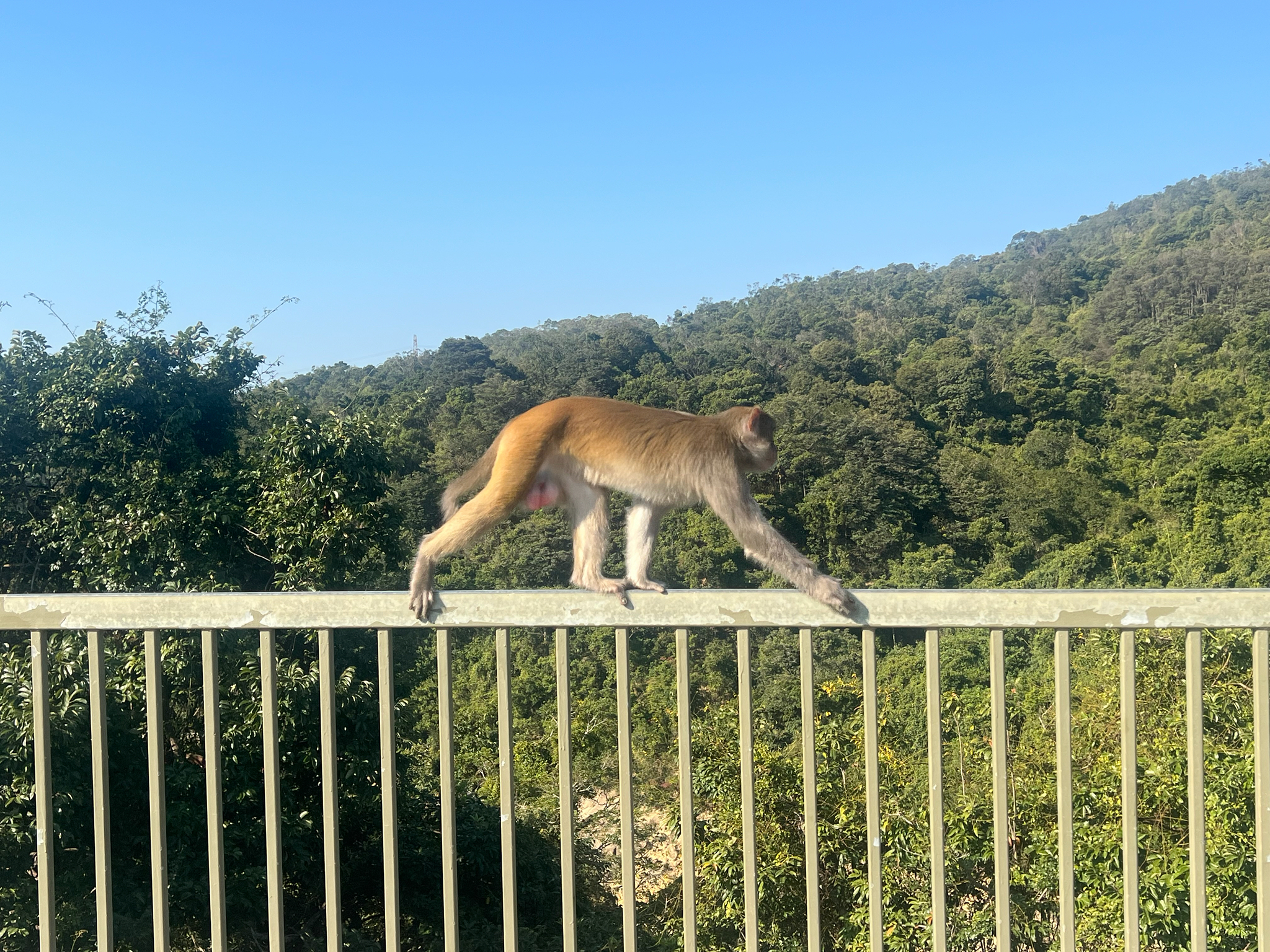
The rhesus macaque (Macaca mulatta), colloquially rhesus monkey, is a species of Old World monkey in the Macaca genus.
- Kingdom
- Animalia
- Phylum
- Chordata
- Class
- Mammalia
- Order
- Primates
- Family
- Cercopithecidae
- Genus
- Macaca
- Species
- Macaca mulatta
Description
The rhesus macaque (Macaca mulatta), colloquially rhesus monkey, is a species of Old World monkey in the Macaca genus. There are between six and nine recognised subspecies split between two groups, the Chinese-derived and the Indian-derived. Generally brown or grey in colour, it is 47–53 cm (19–21 in) in length with a 20.7–22.9 cm (8.1–9.0 in) tail and weighs 5.3–7.7 kg (12–17 lb). It is native to South, Central, and Southeast Asia and has the widest geographic range of all non-human primates, occupying a great diversity of altitudes and habitats. The rhesus macaque is diurnal, arboreal, and terrestrial. It is mostly herbivorous, feeding mainly on fruit, but also eating seeds, roots, buds, bark, and cereals. Rhesus macaques living in cities also eat human food and trash. They are gregarious, with troops comprising 20–200 individuals. The social groups are matrilineal. Individuals communicate with a variety of facial expressions, vocalisations, body postures, and gestures. As a result of the rhesus macaque's relatively easy upkeep, wide availability, and closeness to humans anatomically and physiologically, it has been used extensively in medical and biological research. It has facilitated many scientific breakthroughs including vaccines for rabies, smallpox, polio, and antiretroviral medication to treat HIV/AIDS. A rhesus macaque became the first primate astronaut in 1948. The rhesus is listed as Least Concern in the IUCN Red List.
Gallery
Ajouter des photos
Partagez vos photos de cette espèce (jusqu'à 20 à la fois) : elles sont vérifiées automatiquement, puis publiées.
Répartition
Occurrences observées (données GBIF). Les zones hors aire d'origine peuvent indiquer une présence introduite ou invasive.
Sources et crédits
Informations provenant de plusieurs sources vérifiées. Dernière mise à jour : .
Crédits photos (6)
- Photo : petraripol · CC BY-NC 4.0 · via GBIF
- Photo : Leonardo Mantovani (@leonardomantovani) · CC BY-NC 4.0 · via iNaturalist
- Photo : Next Continent: Wildlife, Photography and Natural History Tours (@nextcontinenttours) · CC BY-NC 4.0 · via iNaturalist
- Photo : @the_taxanaut · CC BY-NC 4.0 · via iNaturalist
- Photo : Ulf Liebal (@ulfliebal) · CC BY 4.0 · via iNaturalist
- Photo : Raasbihari Kumar (@bloombeetles) · CC BY-NC 4.0 · via iNaturalist
Mentions de licence
Texte disponible sous licence CC BY-SA 4.0. Il adapte notamment Wikipedia (CC BY-SA) : Rhesus macaque (Wikipédia, auteurs dans l’historique de l’article).
- Taxonomie : GBIF Backbone Taxonomy (CC BY 4.0)
- Carte : occurrences GBIF, fond © contributeurs OpenStreetMap (ODbL)
- Statut de conservation : Liste rouge de l'UICN, via Wikidata (CC0)
Détail : Sources et licences.
Discussion (0)
Aucun message pour l’instant. Lancez la discussion sur cette fiche (sources, précisions, débats éditoriaux).
Connectez-vous pour participer à la discussion.