
Ethiopian Wolf
Canis simensis
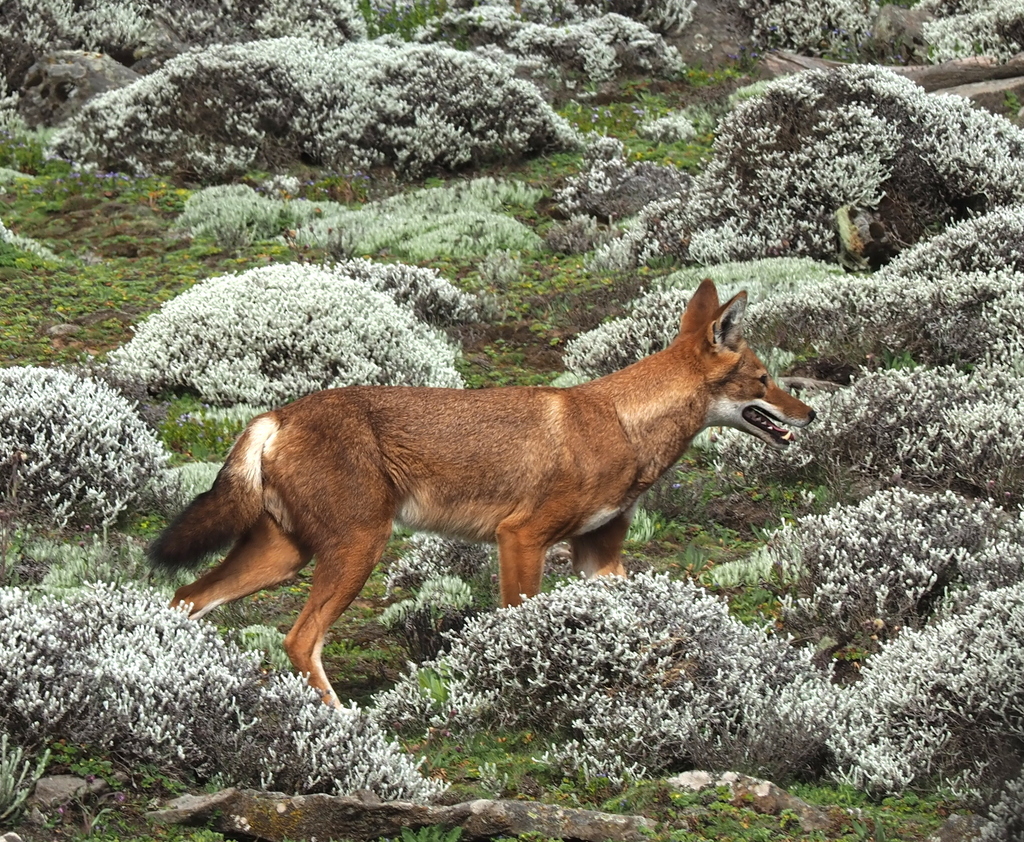
The Ethiopian wolf (Canis simensis), also called the red jackal, the Simien jackal or Simien fox, is a canine native to the Ethiopian Highlands, including the Simien Mountains.
- Kingdom
- Animalia
- Phylum
- Chordata
- Class
- Mammalia
- Order
- Carnivora
- Family
- Canidae
- Genus
- Canis
- Species
- Canis simensis
Description
The Ethiopian wolf (Canis simensis), also called the red jackal, the Simien jackal or Simien fox, is a canine native to the Ethiopian Highlands, including the Simien Mountains. In southeastern Ethiopia, it is also known as the horse jackal. It is similar to the coyote in size and build, and is distinguished by its long and narrow skull, and its red and white fur. Unlike most large canids, which are widespread, generalist feeders, the Ethiopian wolf is a highly specialised feeder of Afroalpine rodents with very specific habitat requirements. It is one of the world's rarest canids, and Africa's most endangered carnivore. The species's current range is limited to seven isolated mountain ranges at altitudes of 3,000–4,500 m, with the overall adult population estimated at 360–440 individuals in 2011, more than half of them in the Bale Mountains. The Ethiopian wolf is listed as endangered by the IUCN, on account of its small numbers and fragmented range. Threats include increasing pressure from expanding human populations, resulting in habitat degradation through overgrazing, and disease transference and interbreeding from free-ranging dogs. Its conservation is headed by Oxford University's Ethiopian Wolf Conservation Programme, which seeks to protect the wolves through vaccination and community outreach programs.
Gallery
Ajouter des photos
Partagez vos photos de cette espèce (jusqu'à 20 à la fois) : elles sont vérifiées automatiquement, puis publiées.
Répartition
Occurrences observées (données GBIF). Les zones hors aire d'origine peuvent indiquer une présence introduite ou invasive.
Sources et crédits
Informations provenant de plusieurs sources vérifiées. Dernière mise à jour : .
Crédits photos (8)
- Photo : Ron Frumkin (@ronf) · CC BY-NC 4.0 · via iNaturalist
- Photo : Barna Takats (@beavisnail) · CC BY-NC 4.0 · via iNaturalist
- Photo : @inlandbirder · CC BY-NC 4.0 · via iNaturalist
- Photo : @suebsa · CC BY-NC 4.0 · via iNaturalist
- Photo : Jeff Chapman (@woodridgejeff) · CC BY-NC 4.0 · via iNaturalist
- Photo : Cathy Pasterczyk (@cathyp) · CC BY-NC 4.0 · via iNaturalist
- Photo : @gillbsydney · CC BY-NC 4.0 · via iNaturalist
- Photo : Marc Henrion (@lemoncul) · CC BY-NC 4.0 · via iNaturalist
Mentions de licence
Texte disponible sous licence CC BY-SA 4.0. Il adapte notamment Loup d'Abyssinie, Wikipedia (CC BY-SA) : Ethiopian wolf (Wikipédia, auteurs dans l’historique de l’article).
- Taxonomie : GBIF Backbone Taxonomy (CC BY 4.0)
- Carte : occurrences GBIF, fond © contributeurs OpenStreetMap (ODbL)
Détail : Sources et licences.
Discussion (0)
Aucun message pour l’instant. Lancez la discussion sur cette fiche (sources, précisions, débats éditoriaux).
Connectez-vous pour participer à la discussion.