
Bengal slow loris
Nycticebus bengalensis
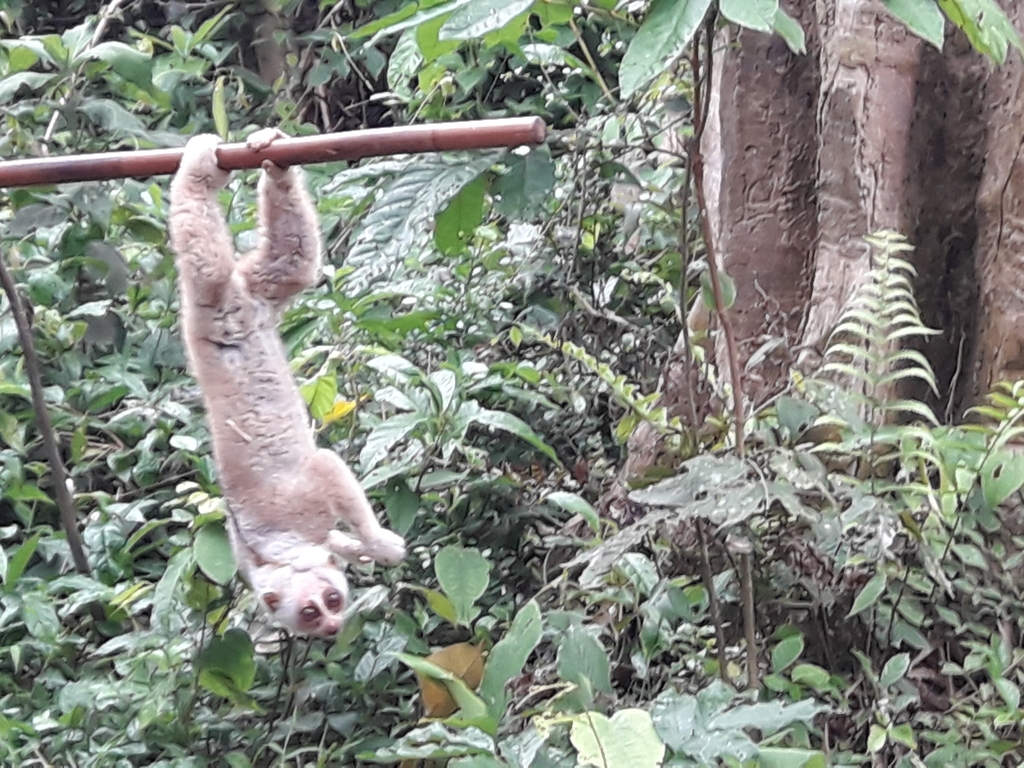
The Bengal slow loris (Nycticebus bengalensis) or northern slow loris is a strepsirrhine primate and a species of slow loris native to the Bangladesh, Northeast India, Cambodia, Laos, Burma, Vietnam, southern China, and Thailand.
- Kingdom
- Animalia
- Phylum
- Chordata
- Class
- Mammalia
- Order
- Primates
- Family
- Lorisidae
- Genus
- Nycticebus
- Species
- Nycticebus bengalensis
Description
The Bengal slow loris (Nycticebus bengalensis) or northern slow loris is a strepsirrhine primate and a species of slow loris native to the Bangladesh, Northeast India, Cambodia, Laos, Burma, Vietnam, southern China, and Thailand. Its geographic range is larger than that of any other slow loris species. Considered a subspecies of the Sunda slow loris (N. coucang) until 2001, phylogenetic analysis suggests that the Bengal slow loris is most closely related to the Sunda slow loris. However, some individuals in both species have mitochondrial DNA sequences that resemble those of the other species, due to introgressive hybridization. It is the largest species of slow loris, measuring 26 to 38 cm (10 to 15 in) from head to tail and weighing between 1 and 2.1 kg (2.2 and 4.6 lb). Like other slow lorises, it has a wet nose (rhinarium), a round head, flat face, large eyes, small ears, a vestigial tail, and dense, woolly fur. The toxin it secretes from its brachial gland (a scent gland in its arm) differs chemically from that of other slow loris species and may be used to communicate information about sex, age, health, and social status. The Bengal slow loris is nocturnal and arboreal, occurring in both evergreen and deciduous forests. It prefers rainforests with dense canopies, and its presence in its native habitat indicates a healthy ecosystem. It is a seed disperser and pollinator, as well as a prey item for carnivores. Its diet primarily consists of fruit, but also includes insects, tree gum, snails, and small vertebrates. In winter, it relies on plant exudates, such as sap and tree gum. The species lives in small family groups, marks its territory with urine, and sleeps during the day by curling up in dense vegetation or in tree holes. It is not a seasonal breeder, reproducing once every 12–18 months and usually giving birth to a single offspring. For the first three months, mothers carry their offspring, which reach sexual maturity at around 20 months. The Bengal slow loris can live up to 20 years. The species is listed as endangered on the IUCN Red List, and is threatened with extinction due to growing demand in the exotic pet trade and traditional medicine. It is one of the most common animals sold in local animal markets. In traditional medicine, it is primarily used by wealthy to middle-class, urban women following childbirth, but also to treat stomach problems, broken bones, and sexually transmitted diseases. It is also hunted for food and suffers from habitat loss. Wild populations have declined severely, and it is locally extinct in several regions. It is found within many protected areas throughout its range, but this does not protect them from rampant poaching and illegal logging. Critical conservation issues for this species include enhancing protection measures, stricter enforcement of wildlife protection laws, and increased connectivity between fragmented protected areas.
Gallery
Ajouter des photos
Partagez vos photos de cette espèce (jusqu'à 20 à la fois) : elles sont vérifiées automatiquement, puis publiées.
Répartition
Occurrences observées (données GBIF). Les zones hors aire d'origine peuvent indiquer une présence introduite ou invasive.
Sources et crédits
Informations provenant de plusieurs sources vérifiées. Dernière mise à jour : .
Crédits photos (8)
- Photo : Md. Sabbir Ahammed (@md_sabbir_ahammed) · CC BY-NC 4.0 · via iNaturalist
- Photo : Utain Pummarin (@utain) · CC BY 4.0 · via iNaturalist
- Photo : Hassan Al-Razi (@harazi) · CC BY-NC 4.0 · via iNaturalist
- Photo : Jason Vassallo (@jasonvassallo) · CC BY-NC 4.0 · via iNaturalist
- Photo : @eakachai · CC BY-NC 4.0 · via iNaturalist
- Photo : Zhang Xiaojie (@jeromerz) · CC BY-NC 4.0 · via iNaturalist
- Photo : @bangtran · CC BY-NC 4.0 · via iNaturalist
- Photo : Parinya Pawangkhanant (@parinyaherp) · CC BY-NC 4.0 · via iNaturalist
Mentions de licence
Texte disponible sous licence CC BY-SA 4.0. Il adapte notamment Loris lent du Bengale, Wikipedia (CC BY-SA) : Bengal slow loris (Wikipédia, auteurs dans l’historique de l’article).
- Taxonomie : GBIF Backbone Taxonomy (CC BY 4.0)
- Carte : occurrences GBIF, fond © contributeurs OpenStreetMap (ODbL)
Détail : Sources et licences.
Discussion (0)
Aucun message pour l’instant. Lancez la discussion sur cette fiche (sources, précisions, débats éditoriaux).
Connectez-vous pour participer à la discussion.