
Desert Hare
Lepus tibetanus
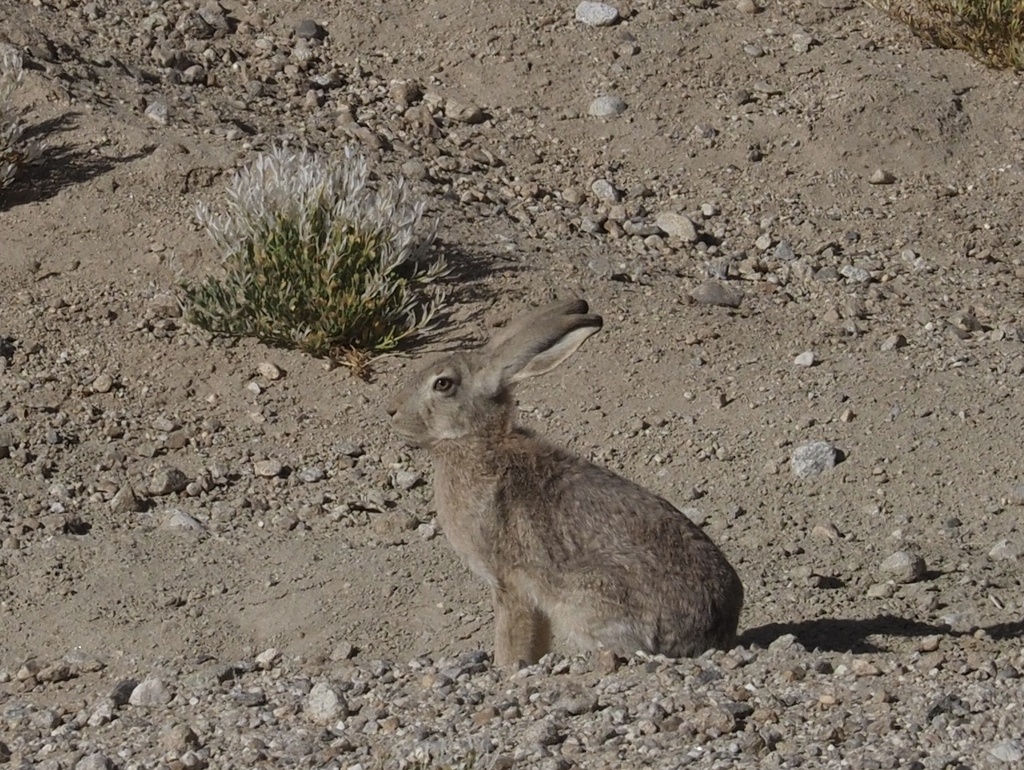
The desert hare (Lepus tibetanus) is a species of hare found in Central Asia, Northwest China, and the western Indian subcontinent.
- Kingdom
- Animalia
- Phylum
- Chordata
- Class
- Mammalia
- Order
- Lagomorpha
- Family
- Leporidae
- Genus
- Lepus
- Species
- Lepus tibetanus
Description
The desert hare (Lepus tibetanus) is a species of hare found in Central Asia, Northwest China, and the western Indian subcontinent. It is a slender, sandy brown hare with black-tipped, tufted ears. It is an herbivore that feeds on roots, seeds, foliage, stems, berries, and the occasional cactus. It inhabits grassland, scrub areas of desert and semi-desert, and steppe habitats. The desert hare is most active during dusk, otherwise resting in a shallow depression or the burrow of another animal. Females produce 3 to 10 young in each litter, of which they may have up to three annually. It is closely related to the Yarkand hare, with which it interbreeds and forms a hybrid species in regions near the Pamir Mountains. There has been much confusion regarding the taxonomy of the desert hare from the 1930s onwards due to the species complex present in the Cape hare species. China and the International Union for Conservation of Nature has assessed the desert hare as a least-concern species due to its wide distribution and a lack of evidence that its population is declining. Potential threats include human population expansion and hunting for food.
Gallery
Ajouter des photos
Partagez vos photos de cette espèce (jusqu'à 20 à la fois) : elles sont vérifiées automatiquement, puis publiées.
Répartition
Occurrences observées (données GBIF). Les zones hors aire d'origine peuvent indiquer une présence introduite ou invasive.
Sources et crédits
Informations provenant de plusieurs sources vérifiées. Dernière mise à jour : .
Crédits photos (7)
- Photo : Michael Bierbaumer (@michael_bierbaumer) · CC BY-NC 4.0 · via iNaturalist
- Photo : Matthieu Gauvain (@matthieu_gauvain) · CC BY-NC 4.0 · via iNaturalist
- Photo : 灯管儿 (@lin_tube) · CC BY 4.0 · via iNaturalist
- Photo : Azan Khan (@azankhan) · CC BY-NC 4.0 · via iNaturalist
- Photo : Andrew Bazdyrev (@andrewbazdyrev) · CC BY 4.0 · via iNaturalist
- Photo : @falco_amurensis · CC BY-NC 4.0 · via iNaturalist
- Photo : Andrew Bazdyrev (@andrewbazdyrev) · CC BY 4.0 · via iNaturalist
Mentions de licence
Texte disponible sous licence CC BY-SA 4.0. Il adapte notamment Lièvre du désert, Wikipedia (CC BY-SA) : Desert hare (Wikipédia, auteurs dans l’historique de l’article).
- Taxonomie : GBIF Backbone Taxonomy (CC BY 4.0)
- Carte : occurrences GBIF, fond © contributeurs OpenStreetMap (ODbL)
- Statut de conservation : Liste rouge de l'UICN, via Wikidata (CC0)
Détail : Sources et licences.
Discussion (0)
Aucun message pour l’instant. Lancez la discussion sur cette fiche (sources, précisions, débats éditoriaux).
Connectez-vous pour participer à la discussion.