
Black-tailed jackrabbit
Lepus californicus
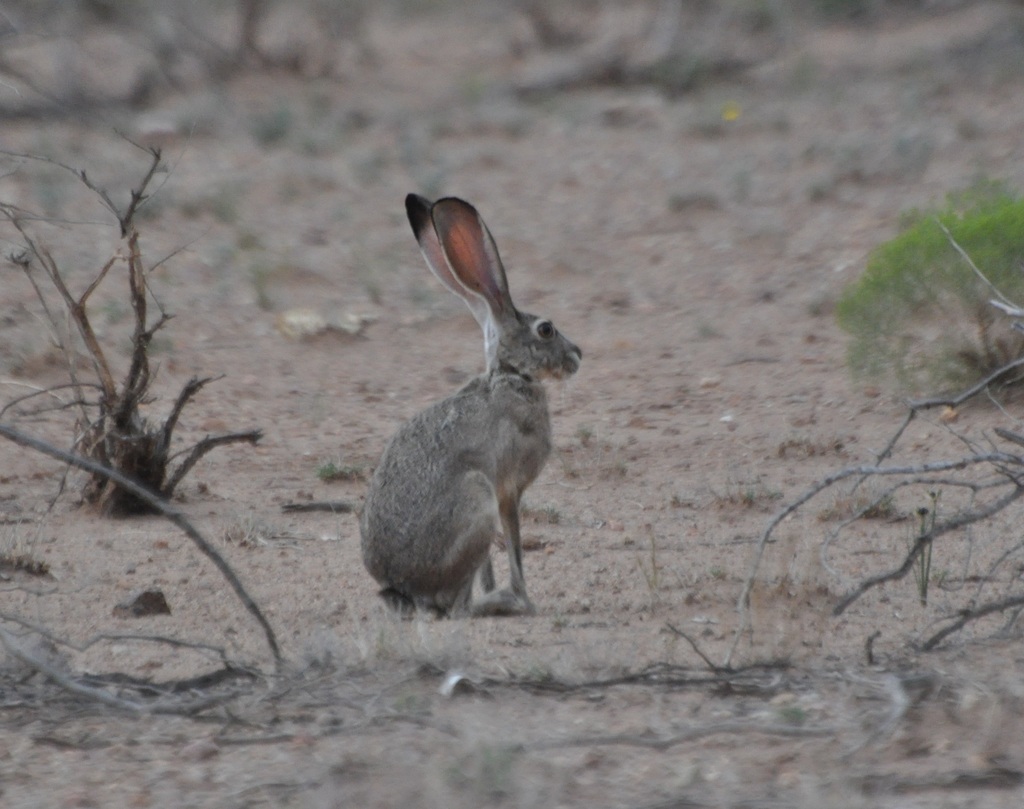
The black-tailed jackrabbit (Lepus californicus), also known as the American desert hare, is a common hare of the western United States and Mexico, where it is found at elevations from sea level up to 10,000 ft (3,000 m).
- Kingdom
- Animalia
- Phylum
- Chordata
- Class
- Mammalia
- Order
- Lagomorpha
- Family
- Leporidae
- Genus
- Lepus
- Species
- Lepus californicus
Description
The black-tailed jackrabbit (Lepus californicus), also known as the American desert hare, is a common hare of the western United States and Mexico, where it is found at elevations from sea level up to 10,000 ft (3,000 m). Reaching a length around 2 ft (61 cm), and a weight from 3 to 6 lb (1.4 to 2.7 kg), the black-tailed jackrabbit is one of the largest North American hares. Black-tailed jackrabbits occupy mixed shrub-grassland terrains. Their breeding depends on the location; it typically peaks in spring, but may continue all year round in warm climates. Young are born fully furred with eyes open; they are well camouflaged and are mobile within minutes of birth, thus females do not protect or even stay with the young except during nursing. The average litter size is around four, but may be as low as two and as high as seven in warm regions. The black-tailed jackrabbit does not migrate or hibernate during winter and uses the same habitat of 0.4–1.2 mi2 (1.0–3.1 km2) year-round. Its diet is composed of various shrubs, small trees, grasses, and forbs. Shrubs generally comprise the bulk of fall and winter diets, while grasses and forbs are used in spring and early summer, but the pattern and plant species vary with climate. The black-tailed jackrabbit is an important prey species for raptors and carnivorous mammals, such as eagles, hawks, owls, coyotes, foxes, and wild cats. The hares host many ectoparasites including fleas, ticks, lice, and mites; for this reason, hunters often avoid collecting them.
Gallery
Ajouter des photos
Partagez vos photos de cette espèce (jusqu'à 20 à la fois) : elles sont vérifiées automatiquement, puis publiées.
Répartition
Occurrences observées (données GBIF). Les zones hors aire d'origine peuvent indiquer une présence introduite ou invasive.
Sources et crédits
Informations provenant de plusieurs sources vérifiées. Dernière mise à jour : .
Crédits photos (8)
- Photo : Tim Healy (@timhealy) · CC BY-NC 4.0 · via iNaturalist
- Photo : @sbeep · CC BY-NC 4.0 · via iNaturalist
- Photo : George Afghan (@georgeafghan) · CC BY-NC 4.0 · via iNaturalist
- Photo : James M. Maley (@jmaley) · CC BY 4.0 · via iNaturalist
- Photo : Howard Friedman (@howardfriedman1) · CC BY-NC 4.0 · via iNaturalist
- Photo : @rprovost · CC BY-NC 4.0 · via iNaturalist
- Photo : @alltheanimals · CC BY-NC 4.0 · via iNaturalist
- Photo : @juliejary · CC BY-NC 4.0 · via iNaturalist
Mentions de licence
Texte disponible sous licence CC BY-SA 4.0. Il adapte notamment Lièvre de Californie, Wikipedia (CC BY-SA) : Black-tailed jackrabbit (Wikipédia, auteurs dans l’historique de l’article).
- Taxonomie : GBIF Backbone Taxonomy (CC BY 4.0)
- Carte : occurrences GBIF, fond © contributeurs OpenStreetMap (ODbL)
- Statut de conservation : Liste rouge de l'UICN, via Wikidata (CC0)
Détail : Sources et licences.
Discussion (0)
Aucun message pour l’instant. Lancez la discussion sur cette fiche (sources, précisions, débats éditoriaux).
Connectez-vous pour participer à la discussion.