
White-sided jackrabbit
Lepus callotis
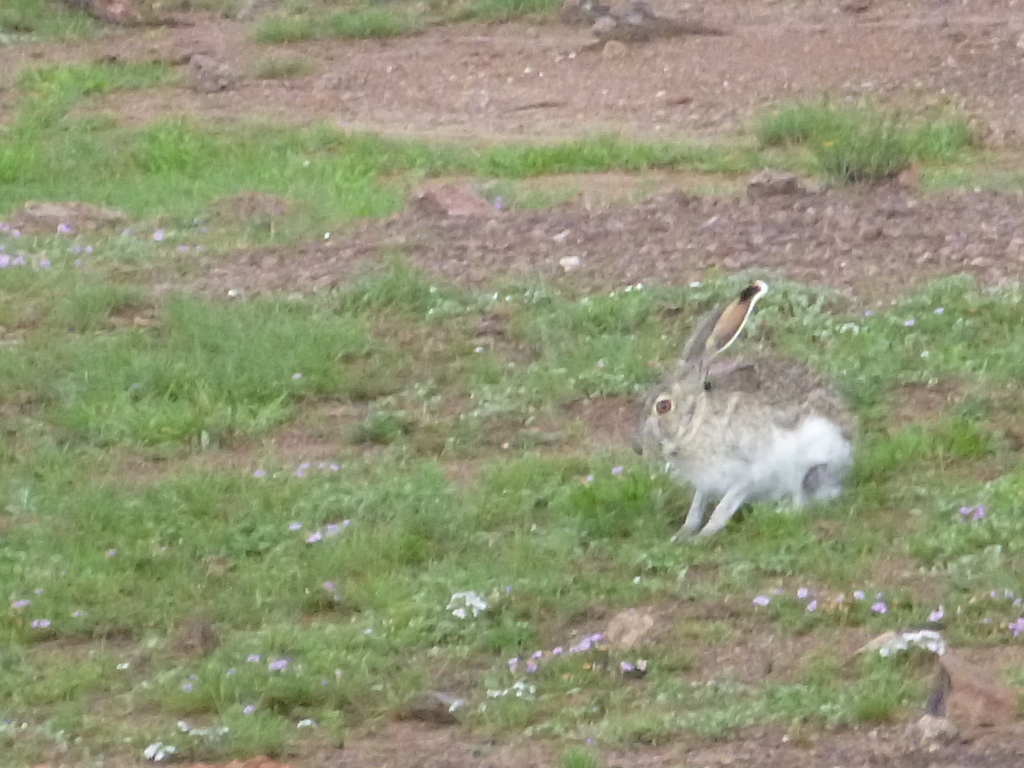
The white-sided jackrabbit (Lepus callotis) (Spanish: liebre torda), also known as the Mexican hare, beautiful-eared jackrabbit, Gaillard jackrabbit, or snow sides, is a medium-sized hare native to the United States and Mexico.
- Kingdom
- Animalia
- Phylum
- Chordata
- Class
- Mammalia
- Order
- Lagomorpha
- Family
- Leporidae
- Genus
- Lepus
- Species
- Lepus callotis
Description
The white-sided jackrabbit (Lepus callotis) (Spanish: liebre torda), also known as the Mexican hare, beautiful-eared jackrabbit, Gaillard jackrabbit, or snow sides, is a medium-sized hare native to the United States and Mexico. It has cinnamon, ochre, and black fur on its head and body and notably white-furred sides. The hare is found in a limited range in North America, from southern New Mexico to northwestern and central Mexico. It avoids hilly habitats and is often found in grasslands, with preferred areas being flush in tobosagrass and blue grama, among other grasses the hare uses for food. The hare is also found in savanna and pasture habitats, particularly in the more southerly parts of its distribution. White-sided jackrabbits make shelters out of depressions dug in the earth, known as forms, which is a common behavior among hares. The forms made by the white-sided jackrabbit are somewhat more elaborate than those of other hare species, though, and are often surrounded by dense grasses. This hare is most active during the night and at dusk. While most hares will run immediately upon sensing a predator, this species will often remain still or try to escape through grasses undetected; otherwise, it will make high, long jumps away from a threat, flashing its white sides. White-sided jackrabbits are often found in pairs, and during the breeding season, a male and female jackrabbit will form a pair bond and remain by each others' side, the male protecting the female from other competing males. Predators of the jackrabbit include bobcats, coyotes, kit foxes, Swainson's hawks and red-tailed hawks. The animal is considered threatened in New Mexico, with its numbers in decline in recent years; its presence is uncertain in Arizona. Individuals in New Mexico are frequently killed by United States Border Patrol vehicles. Throughout the rest of its range, the white-sided jackrabbit is hunted for food and for sport, though it has been considered a rare species since at least the 1950s. The International Union for Conservation of Nature considers it to be a vulnerable species, and it is assessed as an "apparently secure" species by NatureServe. Information on the white-sided jackrabbit's ecology is limited by a lack of studies. The species' range as measured in 2018 is expected to see an 80% reduction by 2050 due to climate change.
Gallery
Ajouter des photos
Partagez vos photos de cette espèce (jusqu'à 20 à la fois) : elles sont vérifiées automatiquement, puis publiées.
Répartition
Occurrences observées (données GBIF). Les zones hors aire d'origine peuvent indiquer une présence introduite ou invasive.
Sources et crédits
Informations provenant de plusieurs sources vérifiées. Dernière mise à jour : .
Crédits photos (8)
- Photo : Carlos Jafeth Díaz Gallardo (@cadiga27) · CC BY-NC 4.0 · via iNaturalist
- Photo : Gregorio Cruz Aja (@goyo) · CC BY-NC 4.0 · via iNaturalist
- Photo : Gilberto Ponce Tejeda (@poncetejedai) · CC BY-NC 4.0 · via iNaturalist
- Photo : @luisfuentes · CC BY-NC 4.0 · via iNaturalist
- Photo : Héctor Ávila Villegas (@havilav) · CC BY-NC 4.0 · via iNaturalist
- Photo : RODOLFO PINEDA PÉREZ (@pinedaperez) · CC BY-NC 4.0 · via iNaturalist
- Photo : Iván Trinidad Ahumada Carrillo (@lepidus320) · CC BY-NC 4.0 · via iNaturalist
- Photo : Kevin Meza (@ehecatlheloderm) · CC BY-NC 4.0 · via iNaturalist
Mentions de licence
Texte disponible sous licence CC BY-SA 4.0. Il adapte notamment Wikipedia (CC BY-SA) : White-sided jackrabbit (Wikipédia, auteurs dans l’historique de l’article).
- Taxonomie : GBIF Backbone Taxonomy (CC BY 4.0)
- Carte : occurrences GBIF, fond © contributeurs OpenStreetMap (ODbL)
- Statut de conservation : Liste rouge de l'UICN, via Wikidata (CC0)
Détail : Sources et licences.
Discussion (0)
Aucun message pour l’instant. Lancez la discussion sur cette fiche (sources, précisions, débats éditoriaux).
Connectez-vous pour participer à la discussion.