
Red-tailed Sportive Lemur
Lepilemur ruficaudatus
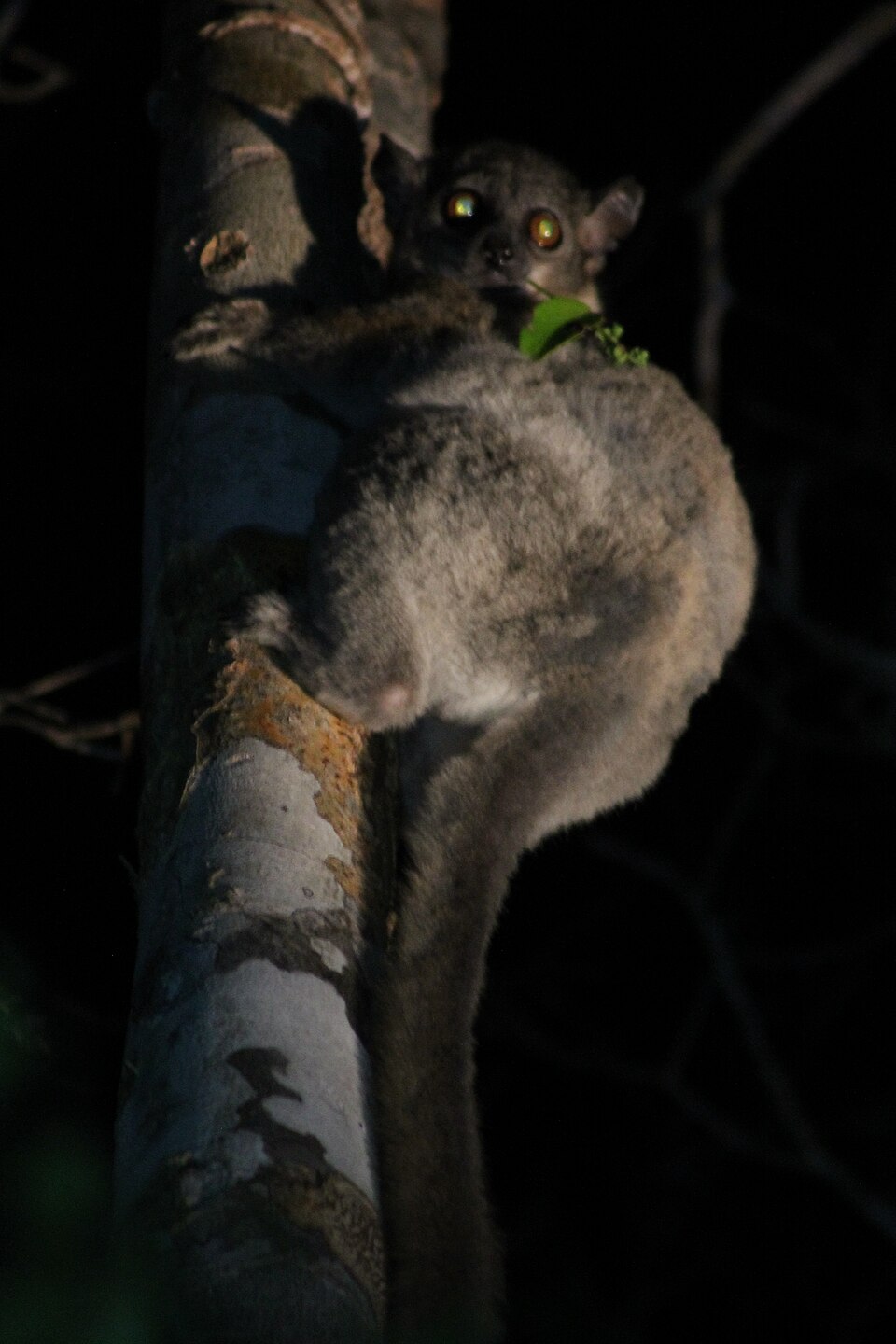
The red-tailed sportive lemur (Lepilemur ruficaudatus), or red-tailed weasel lemur, is native to Madagascar like all lemurs.
- Kingdom
- Animalia
- Phylum
- Chordata
- Class
- Mammalia
- Order
- Primates
- Family
- Lepilemuridae
- Genus
- Lepilemur
- Species
- Lepilemur ruficaudatus
Description
The red-tailed sportive lemur (Lepilemur ruficaudatus), or red-tailed weasel lemur, is native to Madagascar like all lemurs. It is a nocturnal species feeding largely on leaves, though they also eat some fruit. Individuals weigh around 800 g (1.8 lb), and there is little sexual dimorphism. In general they live in mated pairs, with a home range of about 10,000 square metres. Both members of the pair use the same home range, and there is little overlap between the home ranges of neighbouring pairs. Travel distances each night are between 100 m (330 ft) and 1 km (0.6 mi), making this a relatively inactive species. This species can be found in the Madagascar dry deciduous forests. Red-tailed sportive lemurs travel in these pairs because it can be difficult for a male to produce roaming strategies and move further away from the homeland. Therefore, they typically pair up with only one female for reproduction, hence their "partner". Additionally, these Lemurs don't typically have a strong early warning system, making it difficult for them to warn others or send a signal. Instead, they have grown to develop strong escape mechanisms for them to flee danger. Many studies and experiments have been conducted to produce this information.
Gallery
Ajouter des photos
Partagez vos photos de cette espèce (jusqu'à 20 à la fois) : elles sont vérifiées automatiquement, puis publiées.
Répartition
Occurrences observées (données GBIF). Les zones hors aire d'origine peuvent indiquer une présence introduite ou invasive.
Sources et crédits
Informations provenant de plusieurs sources vérifiées. Dernière mise à jour : .
Crédits photos (6)
- Photo : Heinonlein · CC BY-SA 4.0
- Photo : Sheelagh Halsey (@sahalsey) · CC BY 4.0 · via iNaturalist
- Photo : Kai Squires (@squiresk) · CC BY 4.0 · via iNaturalist
- Photo : Royle Safaris (@roylesafaris) · CC BY-NC 4.0 · via iNaturalist
- Photo : @thewildgtrv · CC BY-NC 4.0 · via iNaturalist
- Photo : Jean Jacques Godon (@jeanjacquesgodon) · CC BY 4.0 · via iNaturalist
Mentions de licence
Texte disponible sous licence CC BY-SA 4.0. Il adapte notamment Lepilemur ruficaudatus, Wikipedia (CC BY-SA) : Red-tailed sportive lemur (Wikipédia, auteurs dans l’historique de l’article).
- Taxonomie : GBIF Backbone Taxonomy (CC BY 4.0)
- Carte : occurrences GBIF, fond © contributeurs OpenStreetMap (ODbL)
- Statut de conservation : Liste rouge de l'UICN, via Wikidata (CC0)
Détail : Sources et licences.
Discussion (0)
Aucun message pour l’instant. Lancez la discussion sur cette fiche (sources, précisions, débats éditoriaux).
Connectez-vous pour participer à la discussion.