
Blue-eyed black lemur
Eulemur flavifrons
The blue-eyed black lemur (Eulemur flavifrons), also known as the Sclater's lemur, is a species of true lemur.
- Kingdom
- Animalia
- Phylum
- Chordata
- Class
- Mammalia
- Order
- Primates
- Family
- Lemuridae
- Genus
- Eulemur
- Species
- Eulemur flavifrons
Description
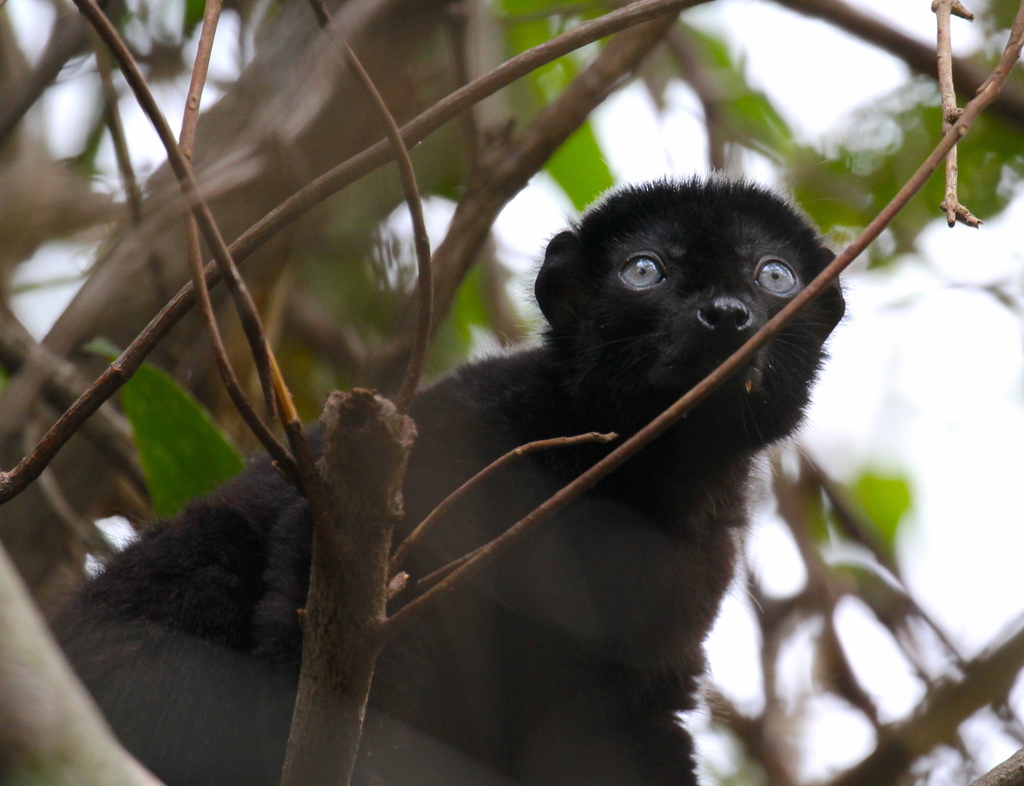
The blue-eyed black lemur (Eulemur flavifrons), also known as the Sclater's lemur, is a species of true lemur. It can attain a body length of 39–45 cm (15–18 in), a tail length of 51–65 cm (20–26 in), a total length of 90–100 cm (35–39 in), and a weight of 1.8–1.9 kg (4.0–4.2 lb). Being a primate, it has strong hands with palms like a human, which have a rubbery texture to give it a firm grip on branches. Its tail is longer than its body and is non-prehensile. Like many of the species in the genus Eulemur, the blue-eyed black lemur is sexually dichromatic. Males are solid black in color, with the hairs sometimes tinged brown at the roots. Females are reddish-brown in color with their underside and outline of their face a lighter tan. They have a dark brown or gray muzzle and the back of their hands and feet are a similar dark color. Both sexes have blue eyes, hence the common name, and are one of the only primates other than humans to consistently have blue eyes. The eyes can range in color from a shocking electric blue, a light sky-blue, or a softer gray-blue. Although the blue-eyed black lemur and the black lemur look similar, they can be differentiated by the blue eyes and lack of prominent ear tufts of this species, while the black lemur has orange-red eyes and long, spiky cheek hairs. In the Manongarivo Special reserve, where the range of the two species overlap, there is a report of hybridization between the two species, but the resulting offspring always have orange eyes. Until 2008, the blue-eyed black lemur was considered a subspecies, E. macaco flavifrons, of the black lemur.
Gallery
Ajouter des photos
Partagez vos photos de cette espèce (jusqu'à 20 à la fois) : elles sont vérifiées automatiquement, puis publiées.
Répartition
Occurrences observées (données GBIF). Les zones hors aire d'origine peuvent indiquer une présence introduite ou invasive.
Sources et crédits
Informations provenant de plusieurs sources vérifiées. Dernière mise à jour : .
Crédits photos (8)
- Photo : Phil Boyle (@philboyle) · CC BY-NC 4.0 · via iNaturalist
- Photo : @globalherping · CC BY-NC 4.0 · via iNaturalist
- Photo : Andrianiaina Angelo (@angelomg) · CC BY-NC 4.0 · via iNaturalist
- Photo : Darrell Parsons (@dpparsons) · CC BY-NC 4.0 · via iNaturalist
- Photo : @bnchapple · CC BY-NC 4.0 · via iNaturalist
- Photo : Andy Frank (@andyfrank) · CC BY-NC 4.0 · via iNaturalist
- Photo : @sapayoa · CC BY-NC 4.0 · via iNaturalist
- Photo : @mschneider · CC BY-NC 4.0 · via iNaturalist
Mentions de licence
Texte disponible sous licence CC BY-SA 4.0. Il adapte notamment Lémur aux yeux turquoise, Wikipedia (CC BY-SA) : Blue-eyed black lemur (Wikipédia, auteurs dans l’historique de l’article).
- Taxonomie : GBIF Backbone Taxonomy (CC BY 4.0)
- Carte : occurrences GBIF, fond © contributeurs OpenStreetMap (ODbL)
- Statut de conservation : Liste rouge de l'UICN, via Wikidata (CC0)
Détail : Sources et licences.
Discussion (0)
Aucun message pour l’instant. Lancez la discussion sur cette fiche (sources, précisions, débats éditoriaux).
Connectez-vous pour participer à la discussion.