
Llama
Lama glama
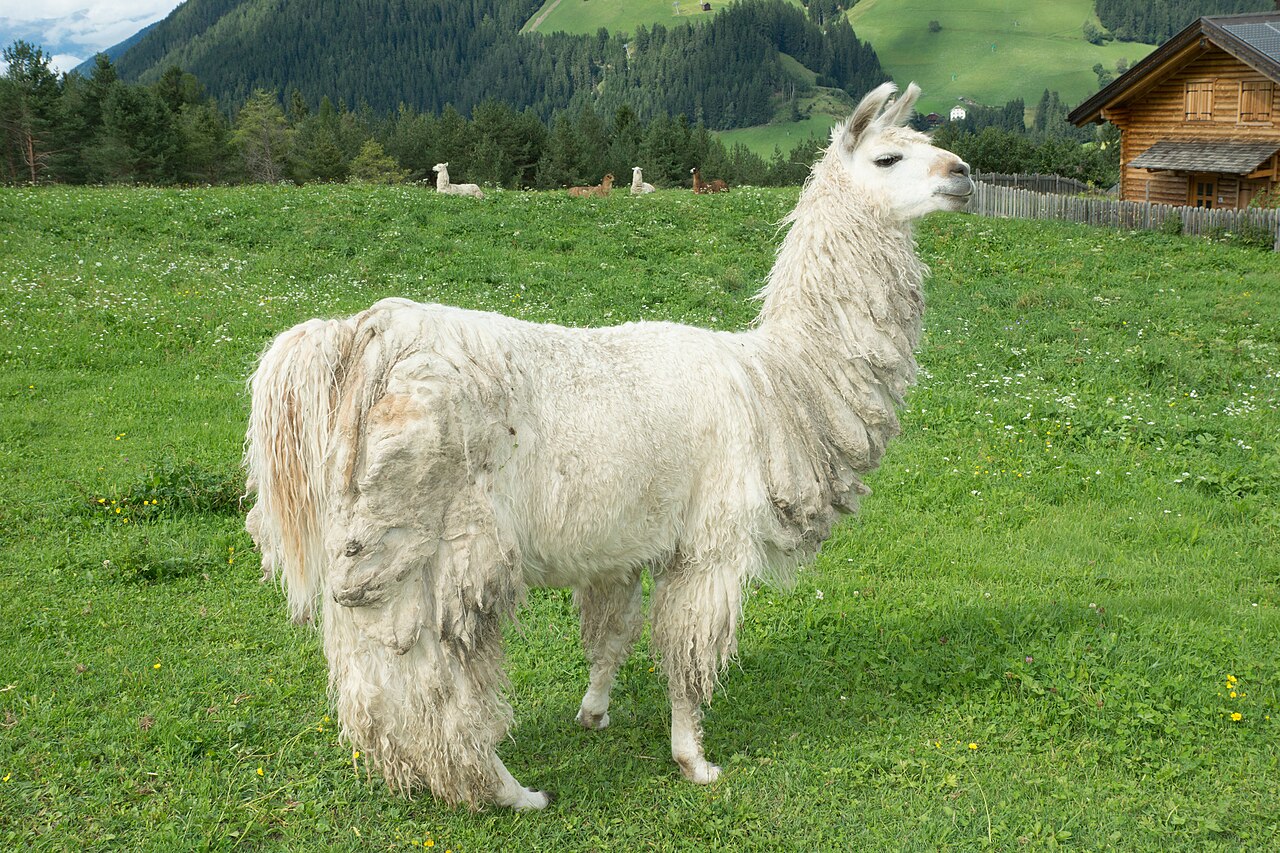
The llama (; Spanish pronunciation: [ˈʎama] or [ˈʝama]; Lama glama) is a domesticated South American camelid, widely used as a meat and pack animal by Andean cultures since the pre-Columbian era.
- Kingdom
- Animalia
- Phylum
- Chordata
- Class
- Mammalia
- Order
- Artiodactyla
- Family
- Camelidae
- Genus
- Lama
- Species
- Lama glama
Description
The llama (; Spanish pronunciation: [ˈʎama] or [ˈʝama]; Lama glama) is a domesticated South American camelid, widely used as a meat and pack animal by Andean cultures since the pre-Columbian era. Llamas are social animals and live with others as a herd. Their wool is soft and contains only a small amount of lanolin. Llamas can learn simple tasks after a few repetitions. When using a pack, they can carry about 25 to 30% of their body weight for 8 to 13 km (5–8 miles). The name llama (also historically spelled "lama" or "glama") was adopted by European settlers from native Peruvian Quechua. The ancestors of llamas are thought to have originated on the Great Plains of North America about 40 million years ago and subsequently migrated to South America about three million years ago during the Great American Interchange. By the end of the last ice age (10,000–12,000 years ago), camelids were extinct in North America. As of 2007, there were over seven million llamas and alpacas in South America. Some were imported to the United States and Canada late in the 20th century; their descendants now number more than 158,000 llamas and 100,000 alpacas. In Aymara mythology, llamas are important beings. The Heavenly Llama is said to drink water from the ocean and urinates as it rains. According to Aymara eschatology, llamas will return to the water springs and ponds where they come from at the end of time.
Gallery
Ajouter des photos
Partagez vos photos de cette espèce (jusqu'à 20 à la fois) : elles sont vérifiées automatiquement, puis publiées.
Répartition
Occurrences observées (données GBIF). Les zones hors aire d'origine peuvent indiquer une présence introduite ou invasive.
Sources et crédits
Informations provenant de plusieurs sources vérifiées. Dernière mise à jour : .
Crédits photos (7)
- Photo : Bramans · CC BY-SA 4.0 · via Wikimedia Commons
- Photo : Yoshi.28 · CC BY-SA 3.0
- Photo : Luca Galuzzi (Lucag) · CC BY-SA 2.5 · via Wikimedia Commons
- Photo : Bernard Gagnon · CC BY-SA 3.0 · via Wikimedia Commons
- Photo : Frank Vincentz · CC BY-SA 3.0 · via Wikimedia Commons
- Photo : Sanjay Acharya · CC BY-SA 4.0 · via Wikimedia Commons
- Photo : Paul Keleher from Mass, US, photoshopped by Zanaq · CC BY 2.0 · via Wikimedia Commons
Mentions de licence
Texte disponible sous licence CC BY-SA 4.0. Il adapte notamment Wikipedia (CC BY-SA) : Llama (Wikipédia, auteurs dans l’historique de l’article).
- Taxonomie : GBIF Backbone Taxonomy (CC BY 4.0)
- Carte : occurrences GBIF, fond © contributeurs OpenStreetMap (ODbL)
Détail : Sources et licences.
Discussion (0)
Aucun message pour l’instant. Lancez la discussion sur cette fiche (sources, précisions, débats éditoriaux).
Connectez-vous pour participer à la discussion.