
Rufous Hare-wallaby
Lagorchestes hirsutus
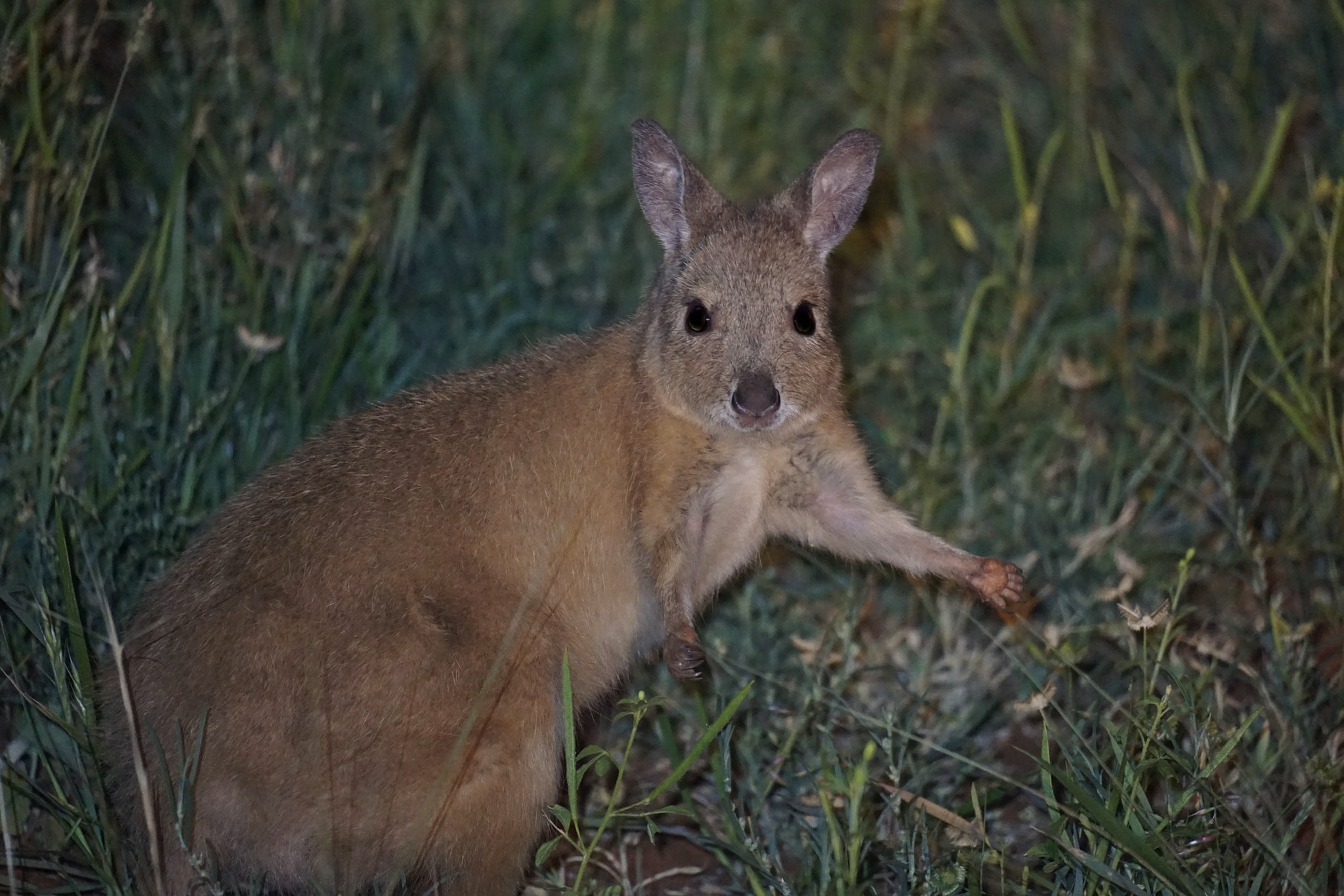
The rufous hare-wallaby (Lagorchestes hirsutus), also known as the mala or wurrup, is a small macropod found in Australia.
- Kingdom
- Animalia
- Phylum
- Chordata
- Class
- Mammalia
- Order
- Diprotodontia
- Family
- Macropodidae
- Genus
- Lagorchestes
- Species
- Lagorchestes hirsutus
Description
The rufous hare-wallaby (Lagorchestes hirsutus), also known as the mala or wurrup, is a small macropod found in Australia. It was formerly widely distributed across the western half of the continent, but naturally occurring populations are now confined to Bernier Island and Dorre Island off Western Australia. Although once widespread in the central and western deserts, predation by feral cats and foxes, and destructive wildfires, caused the last wild population on mainland Australia to go extinct in the early 1990s. Despite its extinction in the wild, the mainland subspecies persisted in captivity. The species, which is currently classified as vulnerable, has rufous-grey fur and is the smallest hare-wallaby, weighing just 800-1,600 grams. It is a solitary nocturnal herbivore that feeds on herbs, leaves and seeds. Mala prefer spinifex sandplain habitat; the animals build burrows under large spinifex hummocks. The burrows are tunnel-like structures with a spinifex roof. This provides a cool refuge during the heat of the day. In summer, they are likely to dig deeper burrows to withstand searing desert temperatures. Captive stocks of the mainland subspecies are currently being reintroduced in the Tanami Desert in the Northern Territory. In July 2019, the first reintroductions into the Newhaven Sanctuary were conducted, with the release of 30 individuals into the 9,400 hectare, feral predator-free area. Animals from both Bernier Island and Dorre Island have recently been translocated to Dirk Hartog Island following the complete removal of livestock and feral cats from the landscape.
Gallery
Ajouter des photos
Partagez vos photos de cette espèce (jusqu'à 20 à la fois) : elles sont vérifiées automatiquement, puis publiées.
Répartition
Occurrences observées (données GBIF). Les zones hors aire d'origine peuvent indiquer une présence introduite ou invasive.
Sources et crédits
Informations provenant de plusieurs sources vérifiées. Dernière mise à jour : .
Crédits photos (6)
- Photo : delanyd · CC BY-NC 4.0 · via GBIF
- Photo : Charley Rayner (@charleyrayner) · CC BY-NC 4.0 · via iNaturalist
- Photo : @delanyd · CC BY-NC 4.0 · via iNaturalist
- Photo : David Hancock (@hardyhancock) · CC BY-NC 4.0 · via iNaturalist
- Photo : Michael Hains (@crapgame) · CC BY-NC 4.0 · via iNaturalist
- Photo : @kentdalekelpies · CC BY-NC 4.0 · via iNaturalist
Mentions de licence
Texte disponible sous licence CC BY-SA 4.0. Il adapte notamment Wikipedia (CC BY-SA) : Rufous hare-wallaby (Wikipédia, auteurs dans l’historique de l’article).
- Taxonomie : GBIF Backbone Taxonomy (CC BY 4.0)
- Carte : occurrences GBIF, fond © contributeurs OpenStreetMap (ODbL)
- Statut de conservation : Liste rouge de l'UICN, via Wikidata (CC0)
Détail : Sources et licences.
Discussion (0)
Aucun message pour l’instant. Lancez la discussion sur cette fiche (sources, précisions, débats éditoriaux).
Connectez-vous pour participer à la discussion.