
Jaguarundi
Puma yagouaroundi
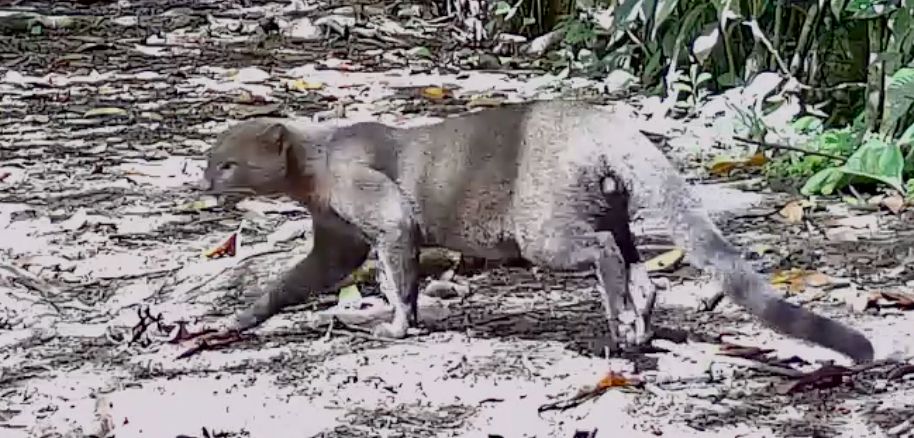
The jaguarundi (Herpailurus yagouaroundi); or is a wild cat native to the Americas.
- Kingdom
- Animalia
- Phylum
- Chordata
- Class
- Mammalia
- Order
- Carnivora
- Family
- Felidae
- Genus
- Puma
- Species
- Puma yagouaroundi
Description
The jaguarundi (Herpailurus yagouaroundi); or is a wild cat native to the Americas. Its range extends from central Argentina in the south and much of South America east of the Andes, through Central America, and into northern Mexico. It occurred in the Lower Rio Grande Valley in south Texas as recently as the early 1990s but is now believed to be extirpated from the US. The jaguarundi is a medium-sized cat of slender build. Its coloration is uniform with two color morphs, gray and red. It has an elongated body, with relatively short legs, a small, narrow head, small, round ears, a short snout, and a long tail, resembling mustelids in these respects. It is about twice as large as a domestic cat (Felis catus), reaching nearly 360 mm (14 in) at the shoulder, and weighs 3.5–7 kg (7.7–15.4 lb). Secretive and alert, the jaguarundi is typically solitary or forms pairs in the wild; however, captive individuals are more gregarious. Unlike other sympatric cats such as the ocelot, the jaguarundi is more active during the day and hunts mainly during daytime and evening hours. Individuals live in large home ranges, and are sparsely distributed within a region. The jaguarundi is an efficient climber, but typically prefers hunting on ground. It feeds on various kinds of prey, especially ground-feeding birds, reptiles, rodents and small mammals. Mating occurs throughout the year, with peaks at different times of the year across the range. After a gestation period of 70 to 75 days, a litter of one to four kittens is born. Lifespans of up to 15 years have been recorded in captivity. The jaguarundi inhabits a broad array of both closed and open habitats ranging from tropical rainforests and deciduous forests to deserts and thorn scrubs. It is fairly common in Brazil, Peru, and Venezuela, but may be extirpated from the United States. It is listed as least concern on the IUCN Red List, but populations are in decline in many parts of its range due to loss and fragmentation of habitat, as well as persecution for killing poultry.
Gallery
Ajouter des photos
Partagez vos photos de cette espèce (jusqu'à 20 à la fois) : elles sont vérifiées automatiquement, puis publiées.
Répartition
Occurrences observées (données GBIF). Les zones hors aire d'origine peuvent indiquer une présence introduite ou invasive.
Sources et crédits
Informations provenant de plusieurs sources vérifiées. Dernière mise à jour : .
Crédits photos (10)
- Photo : f_fleming-ochoverde · CC BY-NC 4.0 · via GBIF
- Photo : Isabella Pieroni Sanches · CC BY-NC 4.0 · via GBIF
- Photo : jarianamora · CC BY-NC 4.0 · via GBIF
- Photo : Benjamin Navas · CC BY-NC 4.0 · via GBIF
- Photo : Benjamin Navas · CC BY-NC 4.0 · via GBIF
- Photo : Ibis Lourenço · CC BY-NC 4.0 · via GBIF
- Photo : INVERSIONES PALMAROSA,VILLANUEVA CASANARE · CC BY-NC 4.0 · via GBIF
- Photo : lylovesbirds · CC BY-NC 4.0 · via GBIF
- Photo : InverBosques · CC BY-NC 4.0 · via GBIF
- Photo : rupununiwildlife · CC BY-NC 4.0 · via GBIF
Mentions de licence
Texte disponible sous licence CC BY-SA 4.0. Il adapte notamment Jaguarondi, Wikipedia (CC BY-SA) : Jaguarundi (Wikipédia, auteurs dans l’historique de l’article).
- Taxonomie : GBIF Backbone Taxonomy (CC BY 4.0)
- Carte : occurrences GBIF, fond © contributeurs OpenStreetMap (ODbL)
Détail : Sources et licences.
Discussion (0)
Aucun message pour l’instant. Lancez la discussion sur cette fiche (sources, précisions, débats éditoriaux).
Connectez-vous pour participer à la discussion.