
Jaguar
Panthera onca
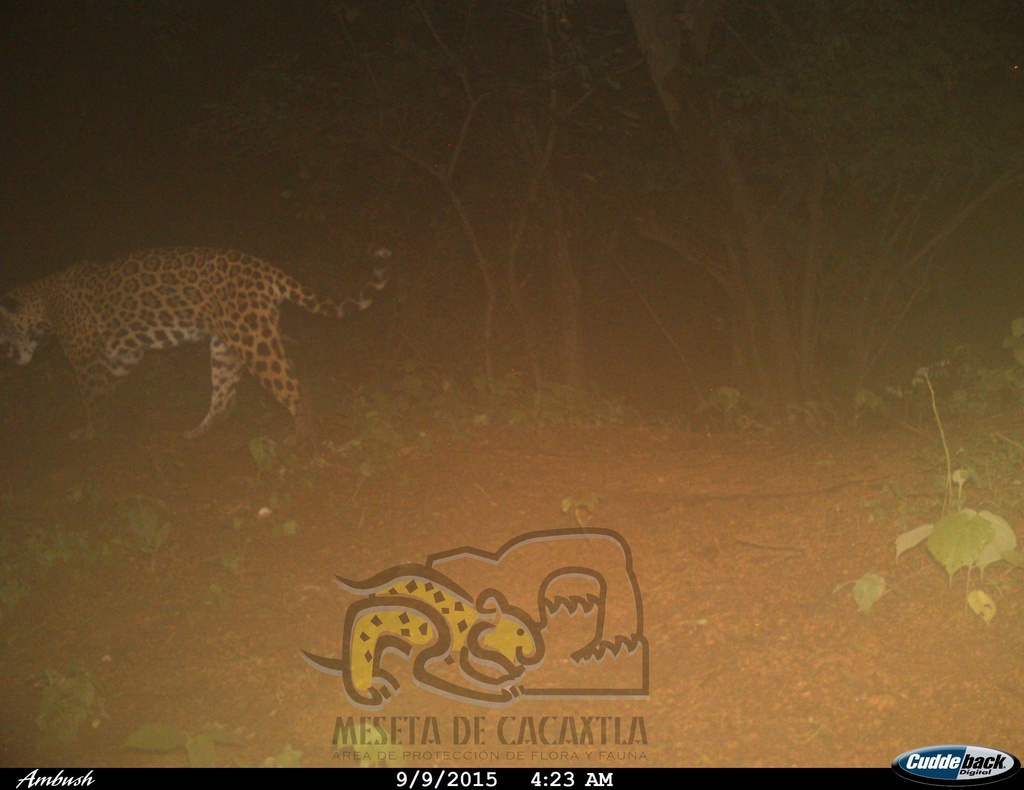
The jaguar (Panthera onca) is a large cat species and the only living member of the genus Panthera that is native to the Americas.
- Kingdom
- Animalia
- Phylum
- Chordata
- Class
- Mammalia
- Order
- Carnivora
- Family
- Felidae
- Genus
- Panthera
- Species
- Panthera onca
Description
The jaguar (Panthera onca) is a large cat species and the only living member of the genus Panthera that is native to the Americas. Its distinctively marked coat features pale yellow to tan colored fur covered by spots that transition to rosettes on the sides, although a melanistic black coat appears in some individuals. With a body length of up to 1.85 m (6 ft 1 in) and a weight of up to 158 kg (348 lb), it is the biggest cat species in the Americas and the third largest in the world. The jaguar's powerful bite allows it to pierce the carapaces of turtles and tortoises, and to employ an unusual killing method: it bites directly through the skull of mammalian prey between the ears to deliver a fatal blow to the brain. The modern jaguar's ancestors probably entered the Americas from Eurasia during the Early Pleistocene via the land bridge that once spanned the Bering Strait. The oldest jaguar fossils found in North America date to between 0.85 to 0.82 million years ago. Today, the jaguar's range extends from the Southwestern United States across Mexico and much of Central America, the Amazon rainforest and south to Paraguay and northern Argentina. It inhabits a variety of forested and open terrains, but its preferred habitat is tropical and subtropical moist broadleaf forest, wetlands and wooded regions. It is adept at swimming and is largely a solitary, opportunistic, stalk-and-ambush apex predator. As a keystone species, it plays an important role in stabilizing ecosystems and in regulating prey populations. The jaguar is threatened by habitat loss, habitat fragmentation, poaching for trade with its body parts and killings in human–wildlife conflict situations, particularly with ranchers in Central and South America. It has been listed as Near Threatened on the IUCN Red List since 2002. The wild population is thought to have declined since the late 1990s. Priority areas for jaguar conservation comprise 51 large areas inhabited by at least 50 breeding individuals, called Jaguar Conservation Units. They are located in 36 geographic regions from Mexico to Argentina. The jaguar has featured prominently in the mythology of indigenous peoples of the Americas, including those of the Aztec and Maya civilizations.
Gallery
Ajouter des photos
Partagez vos photos de cette espèce (jusqu'à 20 à la fois) : elles sont vérifiées automatiquement, puis publiées.
Répartition
Occurrences observées (données GBIF). Les zones hors aire d'origine peuvent indiquer une présence introduite ou invasive.
Sources et crédits
Informations provenant de plusieurs sources vérifiées. Dernière mise à jour : .
Crédits photos (5)
- Photo : APFF Meseta de Cacaxtla (@apffmesetadecacaxtla) · CC BY-NC 4.0 · via iNaturalist
- Photo : @rancholaspalomas · CC BY-NC 4.0 · via iNaturalist
- Photo : @vvazquez · CC BY-NC 4.0 · via iNaturalist
- Photo : @nachovallarta · CC BY-NC 4.0 · via iNaturalist
- Photo : Galo Zapata Ríos (@galozapatarios) · CC BY-NC 4.0 · via iNaturalist
Mentions de licence
Texte disponible sous licence CC BY-SA 4.0. Il adapte notamment Wikipedia (CC BY-SA) : Jaguar (Wikipédia, auteurs dans l’historique de l’article).
- Taxonomie : GBIF Backbone Taxonomy (CC BY 4.0)
- Carte : occurrences GBIF, fond © contributeurs OpenStreetMap (ODbL)
- Statut de conservation : Liste rouge de l'UICN, via Wikidata (CC0)
Détail : Sources et licences.
Discussion (0)
Aucun message pour l’instant. Lancez la discussion sur cette fiche (sources, précisions, débats éditoriaux).
Connectez-vous pour participer à la discussion.