
Indri indri
Indri indri
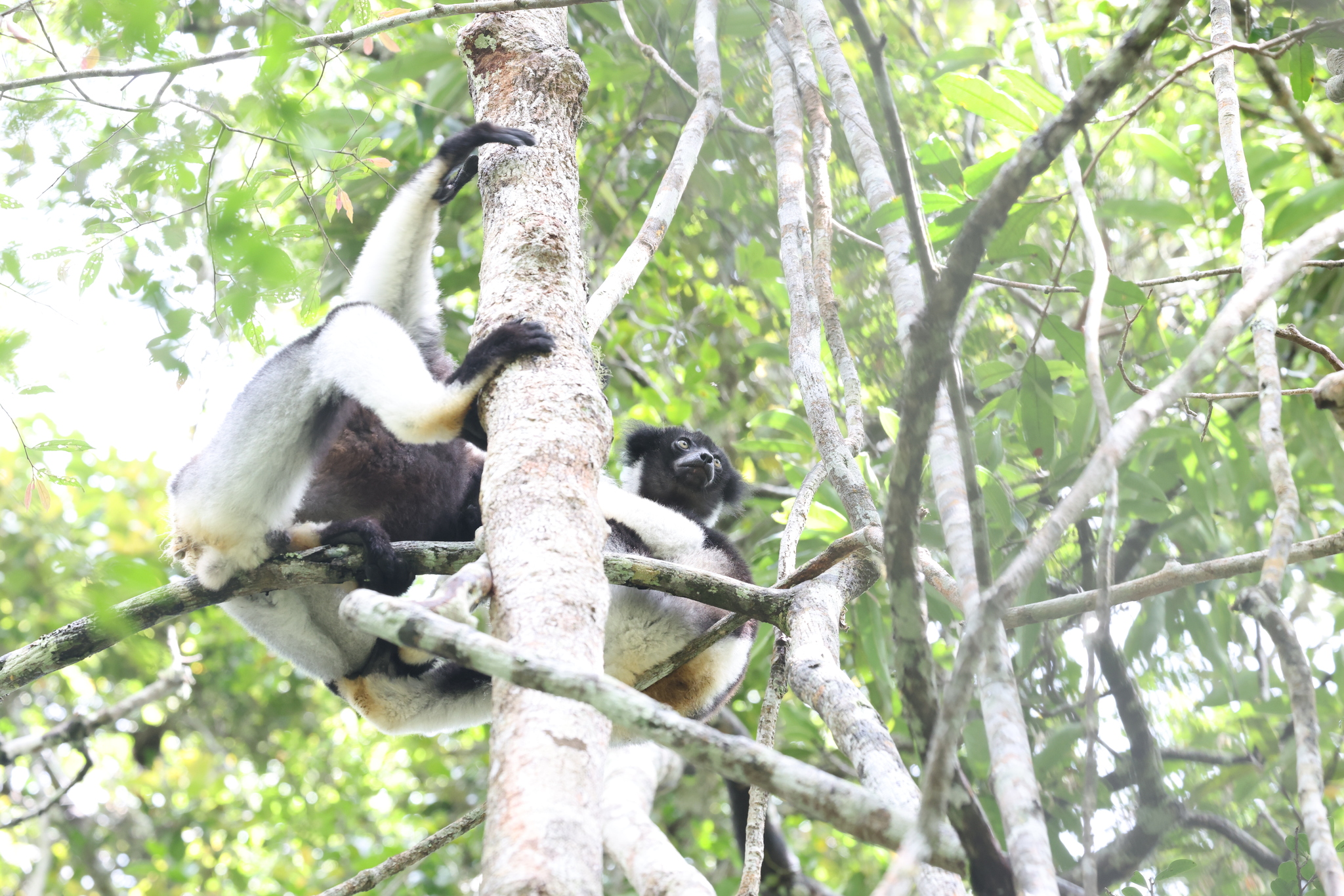
The indri ( ; Indri indri), also called the babakoto, is one of the largest living lemurs, with a head-body length of about 64–72 cm (25–28+1⁄2 in) and a weight of between 6 and 9.5 kg (13 and 21 lb).
- Kingdom
- Animalia
- Phylum
- Chordata
- Class
- Mammalia
- Order
- Primates
- Family
- Indriidae
- Genus
- Indri
- Species
- Indri indri
Description
The indri ( ; Indri indri), also called the babakoto, is one of the largest living lemurs, with a head-body length of about 64–72 cm (25–28+1⁄2 in) and a weight of between 6 and 9.5 kg (13 and 21 lb). It has a black and white coat and maintains an upright posture when climbing or clinging. It is monogamous and lives in small family groups, moving through the canopy, and is herbivorous, feeding mainly on leaves but also seeds, fruits, and flowers. The groups are quite vocal, communicating with other groups by singing, roaring and other vocalisations. It is a diurnal tree-dweller related to the sifakas and, like all lemurs, it is native to Madagascar. It is revered by the Malagasy people and plays an important part in their myths and legends with various stories in existence accounting for its origin. The main threats faced by the indri are habitat destruction and fragmentation due to slash and burn agriculture, fuelwood gathering, and logging. It is also hunted despite taboos against this. The International Union for Conservation of Nature has rated its conservation status as "critically endangered".
Gallery
Ajouter des photos
Partagez vos photos de cette espèce (jusqu'à 20 à la fois) : elles sont vérifiées automatiquement, puis publiées.
Répartition
Occurrences observées (données GBIF). Les zones hors aire d'origine peuvent indiquer une présence introduite ou invasive.
Sources et crédits
Informations provenant de plusieurs sources vérifiées. Dernière mise à jour : .
Crédits photos (6)
- Photo : hollythefrog · CC BY-NC 4.0 · via GBIF
- Photo : Kai Squires (@squiresk) · CC BY 4.0 · via iNaturalist
- Photo : @elias_93 · CC BY-NC 4.0 · via iNaturalist
- Photo : Suzu Sato (@merec0) · CC BY-NC 4.0 · via iNaturalist
- Photo : @alanvannorman · CC BY-NC 4.0 · via iNaturalist
- Photo : Kai Squires (@squiresk) · CC BY 4.0 · via iNaturalist
Mentions de licence
Texte disponible sous licence CC BY-SA 4.0. Il adapte notamment Indri indri, Wikipedia (CC BY-SA) : Indri (Wikipédia, auteurs dans l’historique de l’article).
- Taxonomie : GBIF Backbone Taxonomy (CC BY 4.0)
- Carte : occurrences GBIF, fond © contributeurs OpenStreetMap (ODbL)
- Statut de conservation : Liste rouge de l'UICN, via Wikidata (CC0)
Détail : Sources et licences.
Discussion (0)
Aucun message pour l’instant. Lancez la discussion sur cette fiche (sources, précisions, débats éditoriaux).
Connectez-vous pour participer à la discussion.