
Long-eared Flying Squirrel
Idiurus macrotis
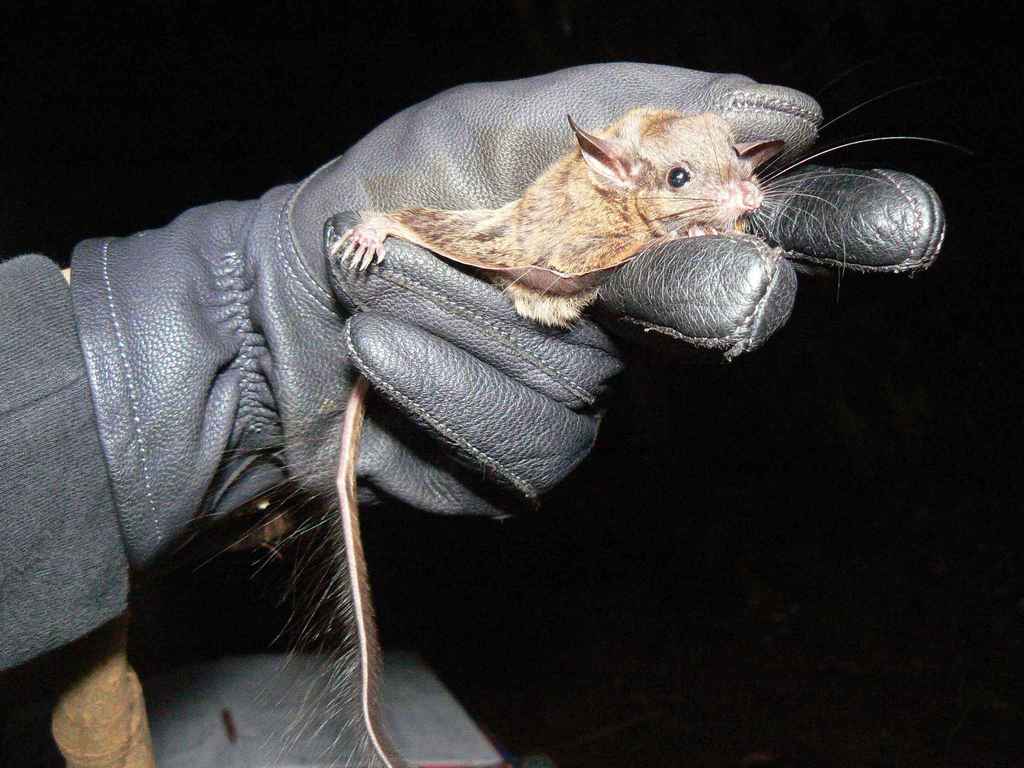
The long-eared flying mouse (Idiurus macrotis) or long-eared scaly-tailed flying squirrel, is a species of flying mouse from western and central Africa.
- Kingdom
- Animalia
- Phylum
- Chordata
- Class
- Mammalia
- Order
- Rodentia
- Family
- Anomaluridae
- Genus
- Idiurus
- Species
- Idiurus macrotis
Description
The long-eared flying mouse (Idiurus macrotis) or long-eared scaly-tailed flying squirrel, is a species of flying mouse from western and central Africa. It is not actually a squirrel, nor a mouse, though it is a rodent. Not much is known about them because they are very hard to keep alive in captivity. To achieve gliding flight, it uses two membranes (patagia) which fold up when not in use. When the limbs are stretched wide in a star-shape, the membranes become taut and allow the rodent to glide from tree to tree. Being arboreal, Idiurus spends all of its time in the trees, living in hollow trunks in groups of 2 to 40. Limited information suggests that it is mainly frugivorous. It has a long tail in proportion to its body, sporting two lines of raised scales, and patches of scaly skin to help it grip trees, but the rest of its body is furry. The tail is longer than the body and is also used to balance, like a primate's tail. Long-eared scaly-tailed flying squirrels are about 20 centimetres (7.9 in) long and weigh 30g. In comparison, the body of a common household mouse is approximately 10 centimetres (3.9 in) long and its tail is approximately 5 centimetres (2.0 in).
Gallery
Ajouter des photos
Partagez vos photos de cette espèce (jusqu'à 20 à la fois) : elles sont vérifiées automatiquement, puis publiées.
Répartition
Occurrences observées (données GBIF). Les zones hors aire d'origine peuvent indiquer une présence introduite ou invasive.
Sources et crédits
Informations provenant de plusieurs sources vérifiées. Dernière mise à jour : .
Crédits photos (4)
- Photo : Natalie Weber (@natalie) · CC BY-NC 4.0 · via iNaturalist
- Photo : KSHoffman (@kshoffman) · CC BY-NC 4.0 · via iNaturalist
- Photo : @rvasudevan · CC BY-NC 4.0 · via iNaturalist
- Photo : Jonathan Rossouw (@jonathan_rossouw) · CC BY-NC 4.0 · via iNaturalist
Mentions de licence
Texte disponible sous licence CC BY-SA 4.0. Il adapte notamment Idiurus macrotis, Wikipedia (CC BY-SA) : Long-eared flying mouse (Wikipédia, auteurs dans l’historique de l’article).
- Taxonomie : GBIF Backbone Taxonomy (CC BY 4.0)
- Carte : occurrences GBIF, fond © contributeurs OpenStreetMap (ODbL)
- Statut de conservation : Liste rouge de l'UICN, via Wikidata (CC0)
Détail : Sources et licences.
Discussion (0)
Aucun message pour l’instant. Lancez la discussion sur cette fiche (sources, précisions, débats éditoriaux).
Connectez-vous pour participer à la discussion.