
Hammer-headed Fruit Bat
Hypsignathus monstrosus
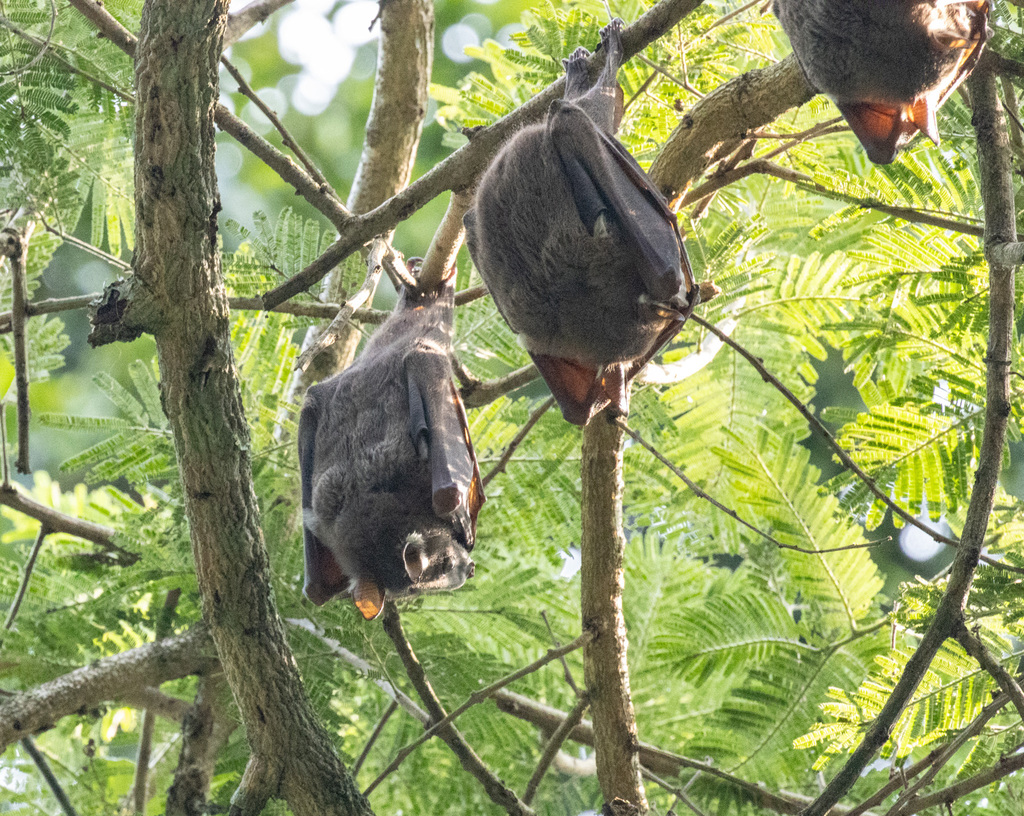
The hammer-headed bat (Hypsignathus monstrosus), also known as hammer-headed fruit bat, big-lipped bat, and hammerhead bat, is a megabat widely distributed in West and Central Africa.
- Kingdom
- Animalia
- Phylum
- Chordata
- Class
- Mammalia
- Order
- Chiroptera
- Family
- Pteropodidae
- Genus
- Hypsignathus
- Species
- Hypsignathus monstrosus
Description
The hammer-headed bat (Hypsignathus monstrosus), also known as hammer-headed fruit bat, big-lipped bat, and hammerhead bat, is a megabat widely distributed in West and Central Africa. It is the only member of the genus Hypsignathus, which is part of the tribe Epomophorini along with four other genera. It is the largest bat in continental Africa, with wingspans approaching 1 m (3.3 ft), and males are almost twice as heavy as females. Males and females also greatly differ in appearance, making it the most sexually dimorphic bat species in the world. These differences include several adaptations that help males produce and amplify vocalizations: the males' larynges (vocal cords) are about three times as large as those of females, and they have large resonating chambers on their faces. Females appear more like a typical megabat, with foxlike faces. The hammer-headed bat is frugivorous, consuming a variety of fruits such as figs, bananas, and mangoes, though a few instances of carnivory have been noted. Females tend to travel a consistent route to find predictable fruits, whereas males travel more to find the highest quality fruit. It forages at night, sleeping during the day in tree roosts. Individuals may roost alone or in small groups. Unlike many other bat species that segregate based on sex, males and females will roost together during the day. It has two mating seasons each year during the dry seasons. It is believed to be the only bat species with a classical lek mating system, wherein males gather on a "lek", which in this case is a long and thin stretch of land, such as along a river. There, they produce loud, honking vocalizations to attract females. Females visit the lek and select a male to mate with; the most successful 6% of males are involved in 79% of matings. Offspring are born five or six months later, typically a singleton, though twins have been documented. Its predators are not well-known, but may include hawks. Adults are commonly affected by parasites such as flies and mites. The hammer-headed bat is sometimes considered a pest due to its frugivorous diet and its extremely loud honking noises at night. In Nigeria and the Democratic Republic of the Congo, it is consumed as bushmeat. It has been investigated as a potential reservoir of the Ebola virus, with several testing positive for antibodies against the virus. It is not considered a species of conservation concern due to its large range and presumably large population size.
Gallery
Ajouter des photos
Partagez vos photos de cette espèce (jusqu'à 20 à la fois) : elles sont vérifiées automatiquement, puis publiées.
Répartition
Occurrences observées (données GBIF). Les zones hors aire d'origine peuvent indiquer une présence introduite ou invasive.
Sources et crédits
Informations provenant de plusieurs sources vérifiées. Dernière mise à jour : .
Crédits photos (8)
- Photo : @avocat · CC BY 4.0 · via iNaturalist
- Photo : Anne Heyerly (@tanager912) · CC BY-NC 4.0 · via iNaturalist
- Photo : Phoebe Shubin (@pshubin) · CC BY-NC 4.0 · via iNaturalist
- Photo : Anne Laudisoit (@annelaudisoit) · CC BY-NC 4.0 · via iNaturalist
- Photo : Mateusz Ciechanowski (@axies_the_collector) · CC BY-NC 4.0 · via iNaturalist
- Photo : Dérozier Violette (@violettederozier) · CC BY-NC 4.0 · via iNaturalist
- Photo : Martin Kennewell (@kenny_well) · CC BY-NC 4.0 · via iNaturalist
- Photo : @giant_eland · CC BY-NC 4.0 · via iNaturalist
Mentions de licence
Texte disponible sous licence CC BY-SA 4.0. Il adapte notamment Hypsignathus monstrosus, Wikipedia (CC BY-SA) : Hammer-headed bat (Wikipédia, auteurs dans l’historique de l’article).
- Taxonomie : GBIF Backbone Taxonomy (CC BY 4.0)
- Carte : occurrences GBIF, fond © contributeurs OpenStreetMap (ODbL)
- Statut de conservation : Liste rouge de l'UICN, via Wikidata (CC0)
Détail : Sources et licences.
Discussion (0)
Aucun message pour l’instant. Lancez la discussion sur cette fiche (sources, précisions, débats éditoriaux).
Connectez-vous pour participer à la discussion.