
Striped Hyena
Hyaena hyaena
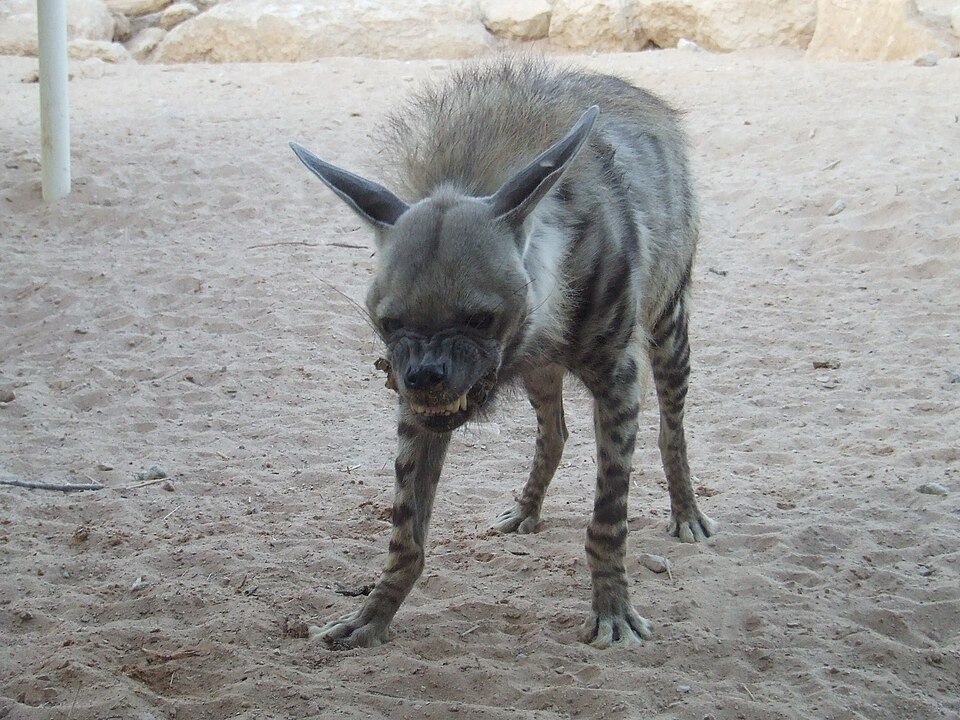
The striped hyena (Hyaena hyaena) is a species of hyena native to North and East Africa, the Middle East, the Caucasus, Central Asia, and the Indian subcontinent.
- Kingdom
- Animalia
- Phylum
- Chordata
- Class
- Mammalia
- Order
- Carnivora
- Family
- Hyaenidae
- Genus
- Hyaena
- Species
- Hyaena hyaena
Description
The striped hyena (Hyaena hyaena) is a species of hyena native to North and East Africa, the Middle East, the Caucasus, Central Asia, and the Indian subcontinent. It is the only extant species in the genus Hyaena. It is listed on the IUCN Red List as near-threatened, as the global population is estimated to be under 10,000 mature individuals which continues to experience deliberate and incidental persecution along with a decrease in its prey base such that it may come close to meeting a continuing decline of 10% over the next three generations. It is the smallest of the bone-cracking hyenas and retains many primitive viverrid-like characteristics lost in larger species, having a smaller and less specialised skull. Though primarily a scavenger, large specimens have been known to kill their own prey, and attacks on humans have occurred in rare instances. The striped hyena is a monogamous animal, with both males and females assisting one another in raising their cubs. A nocturnal animal, the striped hyena typically only emerges in complete darkness, and is quick to return to its lair before sunrise. Although it has a habit of feigning death when attacked, it has been known to stand its ground against larger predators in disputes over food. The striped hyena features prominently in Middle Eastern and Asian folklore. In some areas, its body parts are considered magical, and are used as charms or talismans. It is mentioned in the Hebrew Bible, where it is referred to as tzebua or zevoa, though it is absent in some Bible translations into English. Ancient Greeks knew it as γλάνος (glános) and ύαινα (húaina) and were familiar with it from the Aegean coast of Asia Minor. The striped hyena is the national animal of Lebanon.
Gallery
Ajouter des photos
Partagez vos photos de cette espèce (jusqu'à 20 à la fois) : elles sont vérifiées automatiquement, puis publiées.
Répartition
Occurrences observées (données GBIF). Les zones hors aire d'origine peuvent indiquer une présence introduite ou invasive.
Sources et crédits
Informations provenant de plusieurs sources vérifiées. Dernière mise à jour : .
Crédits photos (6)
- Photo : עמוס חכמון · CC BY-SA 3.0
- Photo : Hana Raza (@hanaraza) · CC BY-NC 4.0 · via iNaturalist
- Photo : @metalquip · CC BY-NC 4.0 · via iNaturalist
- Photo : @emoq · CC BY-NC 4.0 · via iNaturalist
- Photo : Fábio Olmos (@fabio_olmos) · CC BY 4.0 · via iNaturalist
- Photo : Hana Raza (@hanaraza) · CC BY-NC 4.0 · via iNaturalist
Mentions de licence
Texte disponible sous licence CC BY-SA 4.0. Il adapte notamment Wikipedia (CC BY-SA) : Striped hyena (Wikipédia, auteurs dans l’historique de l’article).
- Taxonomie : GBIF Backbone Taxonomy (CC BY 4.0)
- Carte : occurrences GBIF, fond © contributeurs OpenStreetMap (ODbL)
- Statut de conservation : Liste rouge de l'UICN, via Wikidata (CC0)
Détail : Sources et licences.
Discussion (0)
Aucun message pour l’instant. Lancez la discussion sur cette fiche (sources, précisions, débats éditoriaux).
Connectez-vous pour participer à la discussion.