
Capybara
Hydrochoerus hydrochaeris
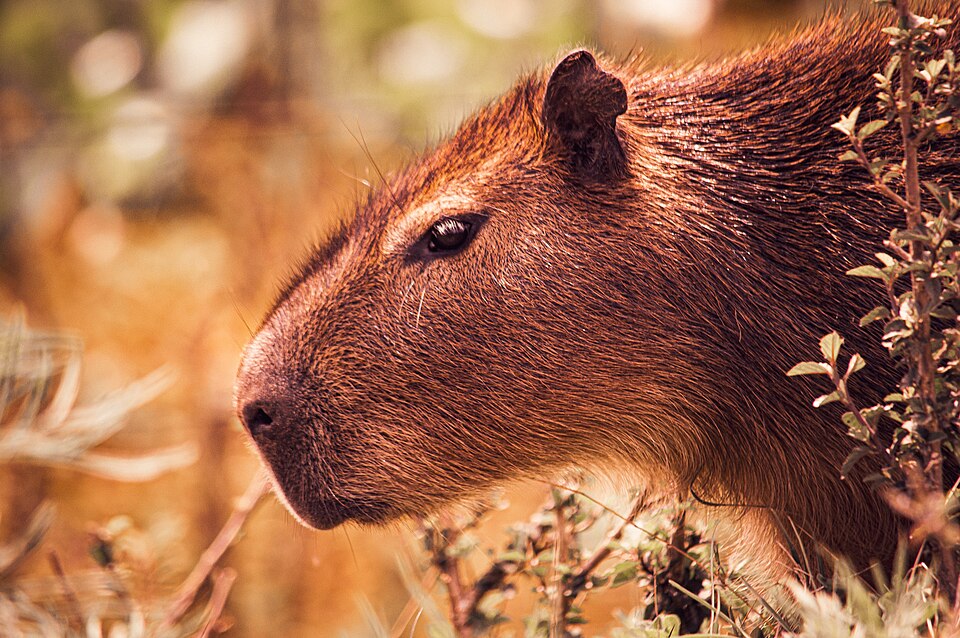
The capybara (/kæp.ɪˈbɑːr.ə, -băr′ə/ kap-uh-BAR-uh) or greater capybara (Hydrochoerus hydrochaeris) is the largest living rodent, native to all countries in South America except Chile.
- Kingdom
- Animalia
- Phylum
- Chordata
- Class
- Mammalia
- Order
- Rodentia
- Family
- Caviidae
- Genus
- Hydrochoerus
- Species
- Hydrochoerus hydrochaeris
Description
The capybara (/kæp.ɪˈbɑːr.ə, -băr′ə/ kap-uh-BAR-uh) or greater capybara (Hydrochoerus hydrochaeris) is the largest living rodent, native to all countries in South America except Chile. It is a semiaquatic herbivore that inhabits savannas and dense forests, living near and in bodies of freshwater and feeding mainly on grasses and aquatic plants. Together with the lesser capybara, it constitutes the genus Hydrochoerus. Its other close relatives include guinea pigs and rock cavies, and it is more distantly related to the agouti, the chinchilla, and the nutria. The capybara is a highly social species that usually lives in groups of 10–20 individuals, but can be found in groups as large as 100. It is hunted for its meat and hide and for grease from its thick fatty skin.
Gallery
Ajouter des photos
Partagez vos photos de cette espèce (jusqu'à 20 à la fois) : elles sont vérifiées automatiquement, puis publiées.
Répartition
Occurrences observées (données GBIF). Les zones hors aire d'origine peuvent indiquer une présence introduite ou invasive.
Sources et crédits
Informations provenant de plusieurs sources vérifiées. Dernière mise à jour : .
Crédits photos (8)
- Photo : Gabriel Sparrenberger · CC BY-SA 4.0
- Photo : saf2285 · CC BY 2.0
- Photo : Maria Pilar Etxebarria · Domaine public
- Photo : @vinicius_s_domingues · CC BY 4.0 · via iNaturalist
- Photo : Guille Ivan Spajic (@giramone) · CC BY-NC 4.0 · via iNaturalist
- Photo : Diego Gallotti (@diegogallotti) · CC BY-NC 4.0 · via iNaturalist
- Photo : Pablo Preliasco (@preli) · CC BY-NC 4.0 · via iNaturalist
- Photo : Paulo Gonçalves Carvalho (@paulogcarvalho) · CC BY-NC 4.0 · via iNaturalist
Mentions de licence
Texte disponible sous licence CC BY-SA 4.0. Il adapte notamment Wikipedia (CC BY-SA) : Capybara (Wikipédia, auteurs dans l’historique de l’article).
- Taxonomie : GBIF Backbone Taxonomy (CC BY 4.0)
- Carte : occurrences GBIF, fond © contributeurs OpenStreetMap (ODbL)
- Statut de conservation : Liste rouge de l'UICN, via Wikidata (CC0)
Détail : Sources et licences.
Discussion (0)
Aucun message pour l’instant. Lancez la discussion sur cette fiche (sources, précisions, débats éditoriaux).
Connectez-vous pour participer à la discussion.