
Roan antelope
Hippotragus equinus
The roan antelope (Hippotragus equinus) is a large, savanna-dwelling antelope found in Western, Southern, and parts of Central and Eastern Africa.
- Kingdom
- Animalia
- Phylum
- Chordata
- Class
- Mammalia
- Order
- Artiodactyla
- Family
- Bovidae
- Genus
- Hippotragus
- Species
- Hippotragus equinus
Description
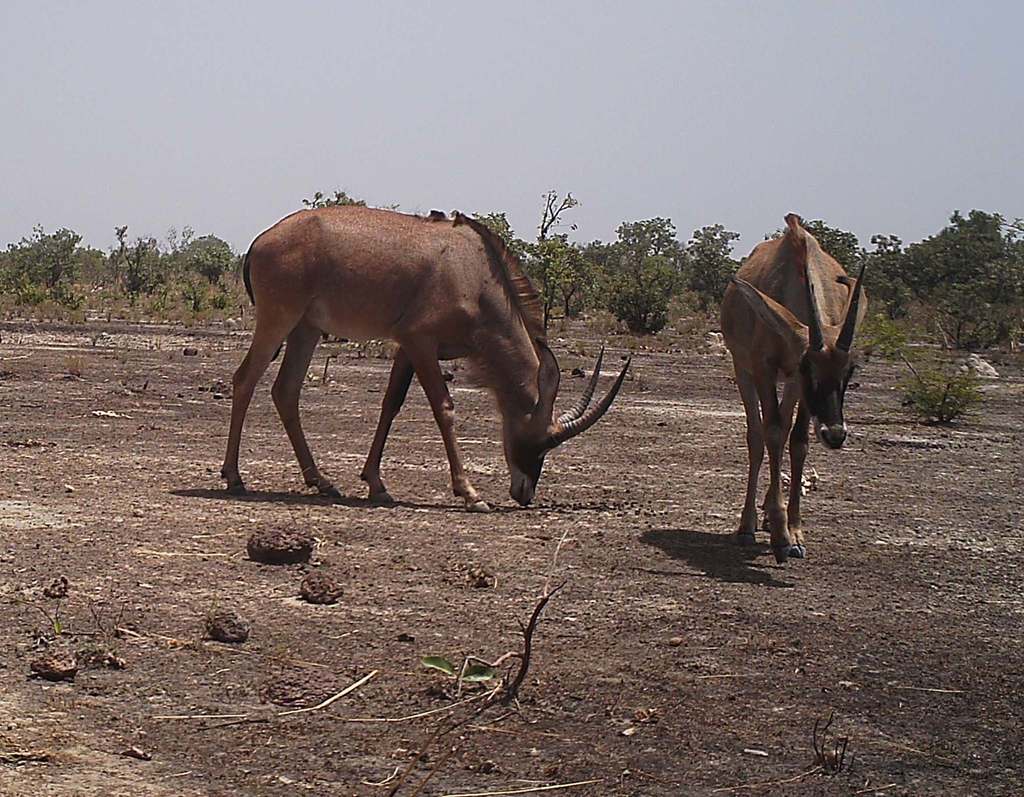
The roan antelope (Hippotragus equinus) is a large, savanna-dwelling antelope found in Western, Southern, and parts of Central and Eastern Africa. Named for its roan colour (a slightly reddish, sandy-brown), it has a lighter-toned underbelly and a (mostly) white face and snout, but with a black "mask" around the eyes and on the bridge of the snout, being somewhat lighter in females. Additionally, a pair of formidable, recurved horns (made of keratin-covered bone) are present on the heads of both males and females, albeit larger on the males, growing up to 100 cm (39 in) long. Males and females have short, erect, mohawk-like manes running down their back and very light, shaggy neckbeards, both of which are more pronounced in males. Both mane and neckbeard are tinted with darker tips, which run the length of the animal's back and belly, ending in a dark-coloured tail. The ears are long, erect, and donkey-like. The roan is among the world's largest antelopes, after the elands (Taurotragus sp.) and the nilgai (Boselaphus tragocamelus), measuring 190–240 cm (75–94 in) from the head to the base of the tail, with a 37–48 cm (15–19 in)-long tail. Males weigh upwards of 242–300 kg (534–661 lb) and females 223–280 kg (492–617 lb), with a shoulder height of around 130–140 cm (51–55 in).
Gallery
Ajouter des photos
Partagez vos photos de cette espèce (jusqu'à 20 à la fois) : elles sont vérifiées automatiquement, puis publiées.
Répartition
Occurrences observées (données GBIF). Les zones hors aire d'origine peuvent indiquer une présence introduite ou invasive.
Sources et crédits
Informations provenant de plusieurs sources vérifiées. Dernière mise à jour : .
Crédits photos (8)
- Photo : ONG OeBenin (@oebenin) · CC BY-NC 4.0 · via iNaturalist
- Photo : Berit Gehrke (@beritgehrke) · CC BY-NC 4.0 · via iNaturalist
- Photo : ONG OeBenin (@oebenin) · CC BY-NC 4.0 · via iNaturalist
- Photo : Eric Leeuwerck (@eleeuw) · CC BY-NC 4.0 · via iNaturalist
- Photo : Ted Floyd (@floydted) · CC BY-NC 4.0 · via iNaturalist
- Photo : @exegerb · CC BY-NC 4.0 · via iNaturalist
- Photo : Marc Thibault (@marcthibault) · CC BY-NC 4.0 · via iNaturalist
- Photo : Elise Bakker (@elisebakker) · CC BY-NC 4.0 · via iNaturalist
Mentions de licence
Texte disponible sous licence CC BY-SA 4.0. Il adapte notamment Hippotragus equinus, Wikipedia (CC BY-SA) : Roan antelope (Wikipédia, auteurs dans l’historique de l’article).
- Taxonomie : GBIF Backbone Taxonomy (CC BY 4.0)
- Carte : occurrences GBIF, fond © contributeurs OpenStreetMap (ODbL)
- Statut de conservation : Liste rouge de l'UICN, via Wikidata (CC0)
Détail : Sources et licences.
Discussion (0)
Aucun message pour l’instant. Lancez la discussion sur cette fiche (sources, précisions, débats éditoriaux).
Connectez-vous pour participer à la discussion.