
Onager
Equus hemionus
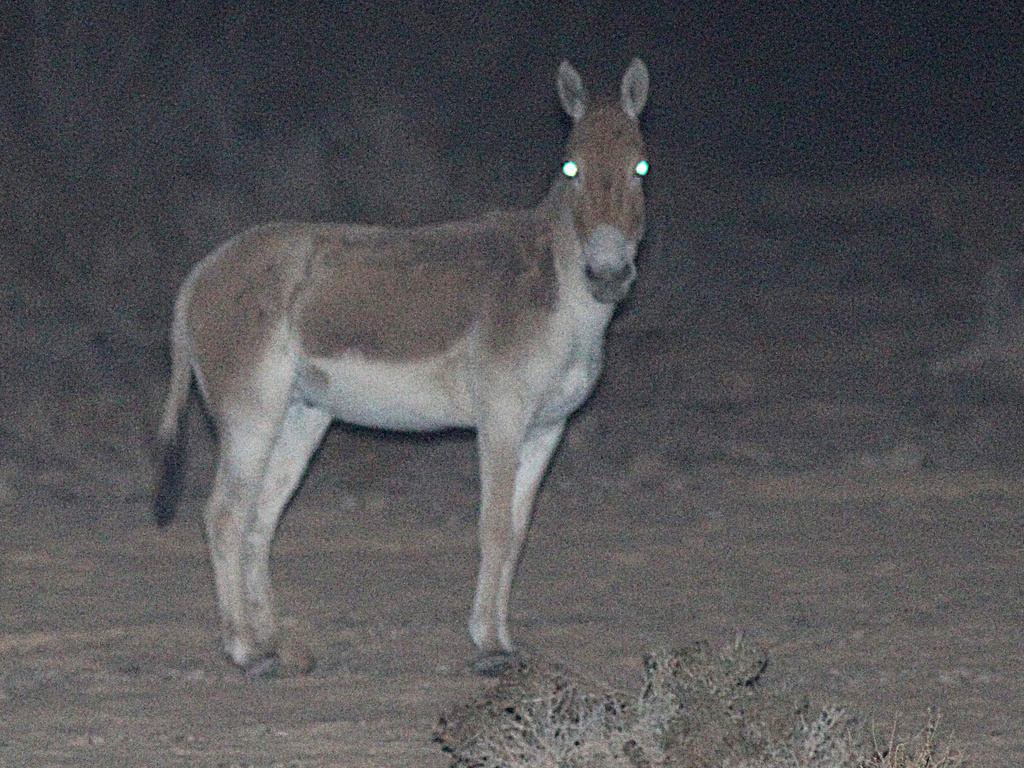
The onager (, ) (Equus hemionus), also known as hemione or Asiatic wild ass, is a species of the family Equidae native to Asia.
- Kingdom
- Animalia
- Phylum
- Chordata
- Class
- Mammalia
- Order
- Perissodactyla
- Family
- Equidae
- Genus
- Equus
- Species
- Equus hemionus
Description
The onager (, ) (Equus hemionus), also known as hemione or Asiatic wild ass, is a species of the family Equidae native to Asia. A member of the subgenus Asinus, the onager was described and given its binomial name by German zoologist Peter Simon Pallas in 1775. Six subspecies are accepted. The onager is reddish-brown or yellowish-brown and has a broad dorsal stripe on the middle of the back. It weighs about 200–260 kg (440–570 lb) and reaches about 2.1 m (6 ft 11 in) head-body length. It is among the fastest mammals, capable of running 64–70 km/h (40–43 mph). The onager had a wider range from southwest and central to northern Asia including the Levant region, Arabian Peninsula, Afghanistan and Siberia; the prehistoric European wild ass subspecies ranged through Europe until the Bronze Age. During the early 20th century, it lost most of its range in the Middle East and Eastern Asia and lives today in Iran, Kazakhstan, Uzbekistan, Turkmenistan, India, Mongolia and China. It inhabits deserts and arid regions, grasslands, plains, steppes, and savannahs. Like many other large grazing animals, its range has contracted greatly under the pressures of poaching and habitat loss. It has been classified as Near Threatened on the IUCN Red List in 2015. Two subspecies are extinct, two are endangered, and two are near threatened; its status in China is not well known.
Gallery
Ajouter des photos
Partagez vos photos de cette espèce (jusqu'à 20 à la fois) : elles sont vérifiées automatiquement, puis publiées.
Répartition
Occurrences observées (données GBIF). Les zones hors aire d'origine peuvent indiquer une présence introduite ou invasive.
Sources et crédits
Informations provenant de plusieurs sources vérifiées. Dernière mise à jour : .
Crédits photos (8)
- Photo : Jan Ebr & Ivana Ebrová (@opisska) · CC BY 4.0 · via iNaturalist
- Photo : משה נאמן (@moshe_neeman) · CC BY-NC 4.0 · via iNaturalist
- Photo : @naresha · CC BY-NC 4.0 · via iNaturalist
- Photo : @ariellebh · CC BY-NC 4.0 · via iNaturalist
- Photo : Matěj Tvarůžka (@jacana007) · CC BY-NC 4.0 · via iNaturalist
- Photo : Helmut Pfeifenberger (@pfeifehe) · CC BY-NC 4.0 · via iNaturalist
- Photo : @bbres · CC BY-NC 4.0 · via iNaturalist
- Photo : @einati125 · CC BY-NC 4.0 · via iNaturalist
Mentions de licence
Texte disponible sous licence CC BY-SA 4.0. Il adapte notamment Hémione, Wikipedia (CC BY-SA) : Onager (Wikipédia, auteurs dans l’historique de l’article).
- Taxonomie : GBIF Backbone Taxonomy (CC BY 4.0)
- Carte : occurrences GBIF, fond © contributeurs OpenStreetMap (ODbL)
- Statut de conservation : Liste rouge de l'UICN, via Wikidata (CC0)
Détail : Sources et licences.
Discussion (0)
Aucun message pour l’instant. Lancez la discussion sur cette fiche (sources, précisions, débats éditoriaux).
Connectez-vous pour participer à la discussion.