
Bharal
Pseudois nayaur
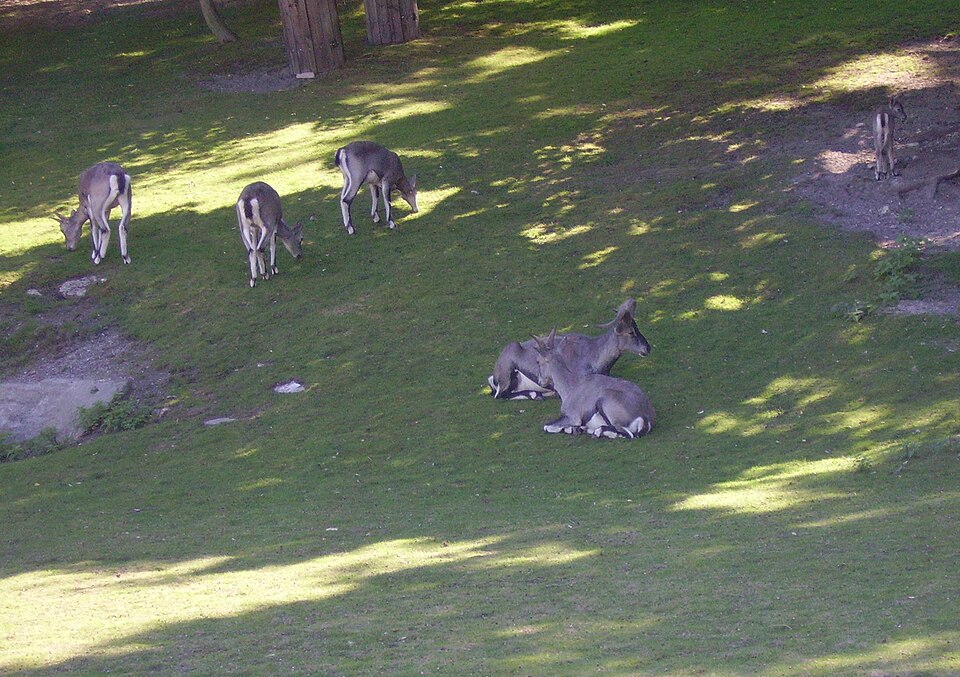
The bharal (Pseudois nayaur), also called the blue sheep, is a caprine native to the high Himalayas.
- Kingdom
- Animalia
- Phylum
- Chordata
- Class
- Mammalia
- Order
- Artiodactyla
- Family
- Bovidae
- Genus
- Pseudois
- Species
- Pseudois nayaur
Description
The bharal (Pseudois nayaur), also called the blue sheep, is a caprine native to the high Himalayas. It inhabits the Himalayan alpine meadows and rocky slopes across Bhutan, China, India, Myanmar, Nepal, and Pakistan, typically at altitudes of 2,200–5,500 m (7,200–18,000 ft). The bharal is the only member of its genus Pseudois and is genetically closer to goats (Capra) than sheep (Ovis). Two main subspecies are recognized: the Himalayan blue sheep (P. n. nayaur) and the Chinese blue sheep (P. n. szechuanensis), with recent studies suggesting the Helanshan blue sheep may be a distinct subspecies. The dwarf blue sheep was once considered a separate species but is now classified as a variant of the Chinese blue sheep. The bharal is a medium-sized caprine, measuring 115–165 cm (45–65 in) in length, and weighing 35–75 kg (77–165 lb). It has a slate-grey fur with white underparts. Both sexes have horns, with the males having larger curved horns measuring up to 80 cm (31 in). The Helanshan variant is smaller in size, with less pronounced sexual dimorphism and straighter horns. The bharal is mainly a grazer, feeding on grasses, but also browses shrubs when food is scarce. It relies on camouflage and shelter under the cliffs to evade predators. Rutting occurs from late November to mid-January, with males usually engaging in various maneuvers to mate. Though it is classified as Least Concern by the IUCN, it face threats from poaching and competition with livestock, but these impacts are limited due to their often isolated and rugged habitats.
Gallery
Ajouter des photos
Partagez vos photos de cette espèce (jusqu'à 20 à la fois) : elles sont vérifiées automatiquement, puis publiées.
Répartition
Occurrences observées (données GBIF). Les zones hors aire d'origine peuvent indiquer une présence introduite ou invasive.
Sources et crédits
Informations provenant de plusieurs sources vérifiées. Dernière mise à jour : .
Crédits photos (6)
- Photo : Dellex · CC BY-SA 3.0
- Photo : @wsyxbcl · CC BY-NC 4.0 · via iNaturalist
- Photo : @fhvc · CC BY-NC 4.0 · via iNaturalist
- Photo : @nuage_jie · CC BY-NC 4.0 · via iNaturalist
- Photo : @akerwin70 · CC BY-NC 4.0 · via iNaturalist
- Photo : @cnarraway · CC BY-NC 4.0 · via iNaturalist
Mentions de licence
Texte disponible sous licence CC BY-SA 4.0. Il adapte notamment Wikipedia (CC BY-SA) : Bharal (Wikipédia, auteurs dans l’historique de l’article).
- Taxonomie : GBIF Backbone Taxonomy (CC BY 4.0)
- Carte : occurrences GBIF, fond © contributeurs OpenStreetMap (ODbL)
- Statut de conservation : Liste rouge de l'UICN, via Wikidata (CC0)
Détail : Sources et licences.
Discussion (0)
Aucun message pour l’instant. Lancez la discussion sur cette fiche (sources, précisions, débats éditoriaux).
Connectez-vous pour participer à la discussion.