
Black wildebeest
Connochaetes gnou
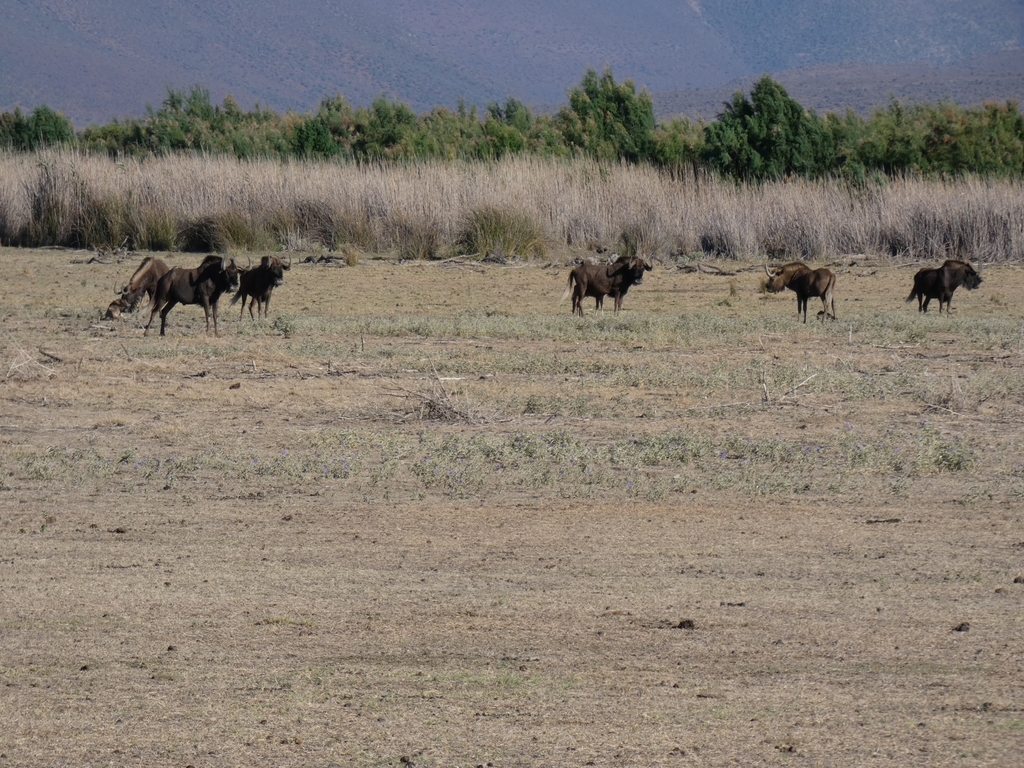
The black wildebeest or white-tailed gnu (Connochaetes gnou) is one of the two closely related wildebeest species.
- Kingdom
- Animalia
- Phylum
- Chordata
- Class
- Mammalia
- Order
- Artiodactyla
- Family
- Bovidae
- Genus
- Connochaetes
- Species
- Connochaetes gnou
Description
The black wildebeest or white-tailed gnu (Connochaetes gnou) is one of the two closely related wildebeest species. It is a member of the genus Connochaetes and family Bovidae. It was first described in 1780 by Eberhard August Wilhelm von Zimmermann. The black wildebeest is typically 1.7–2.2 m (5 ft 7 in – 7 ft 3 in) in head-and-body length, and the typical weight is 110–180 kg (240–400 lb). Males stand about 1.11–1.21 m (3 ft 8 in – 4 ft 0 in) at the shoulder, while the height of the females is 1.06–1.16 m (3 ft 6 in – 3 ft 10 in). The black wildebeest is characterised by its white, long, horse-like tail. It also has a dark brown to black coat and long, dark-coloured hair between its forelegs and under its belly. The black wildebeest is an herbivore, and almost the whole diet consists of grasses. Water is an essential requirement. The three distinct social groups are the female herds, the bachelor herds, and the territorial bulls. They are fast runners and communicate using a variety of visual and vocal communications. The primary breeding season for the black wildebeest is from February to April. A single calf is usually born after a gestational period of about 8.5 months. The calf remains with its mother until her next calf is born a year later. The black wildebeest inhabits open plains, grasslands, and karoo shrublands. The natural populations of black wildebeest, endemic in the southern part of Africa, were almost completely exterminated in the 19th century, due to their reputation as pests and the value of their hides and meat, but the species has been reintroduced widely from captive specimens, both in private areas and nature reserves throughout most of Lesotho, Eswatini, and South Africa. The species has also been introduced outside its natural range in Namibia and Kenya.
Gallery
Ajouter des photos
Partagez vos photos de cette espèce (jusqu'à 20 à la fois) : elles sont vérifiées automatiquement, puis publiées.
Répartition
Occurrences observées (données GBIF). Les zones hors aire d'origine peuvent indiquer une présence introduite ou invasive.
Sources et crédits
Informations provenant de plusieurs sources vérifiées. Dernière mise à jour : .
Crédits photos (8)
- Photo : Dewald du Plessis (@dewald2) · CC BY-NC 4.0 · via iNaturalist
- Photo : Christoph Moning (@christoph_moning) · CC BY 4.0 · via iNaturalist
- Photo : @nmoorhatch · CC BY 4.0 · via iNaturalist
- Photo : Andrew Massyn (@andrewm) · CC BY-NC 4.0 · via iNaturalist
- Photo : Dewald du Plessis (@dewald2) · CC BY-NC 4.0 · via iNaturalist
- Photo : Shaun Swanepoel (@shauns) · CC BY 4.0 · via iNaturalist
- Photo : Tobias P. (@tobsn7) · CC BY-NC 4.0 · via iNaturalist
- Photo : @joggie · CC BY-NC 4.0 · via iNaturalist
Mentions de licence
Texte disponible sous licence CC BY-SA 4.0. Il adapte notamment Gnou noir, Wikipedia (CC BY-SA) : Black wildebeest (Wikipédia, auteurs dans l’historique de l’article).
- Taxonomie : GBIF Backbone Taxonomy (CC BY 4.0)
- Carte : occurrences GBIF, fond © contributeurs OpenStreetMap (ODbL)
- Statut de conservation : Liste rouge de l'UICN, via Wikidata (CC0)
Détail : Sources et licences.
Discussion (0)
Aucun message pour l’instant. Lancez la discussion sur cette fiche (sources, précisions, débats éditoriaux).
Connectez-vous pour participer à la discussion.