
Short-finned pilot whale
Globicephala macrorhynchus
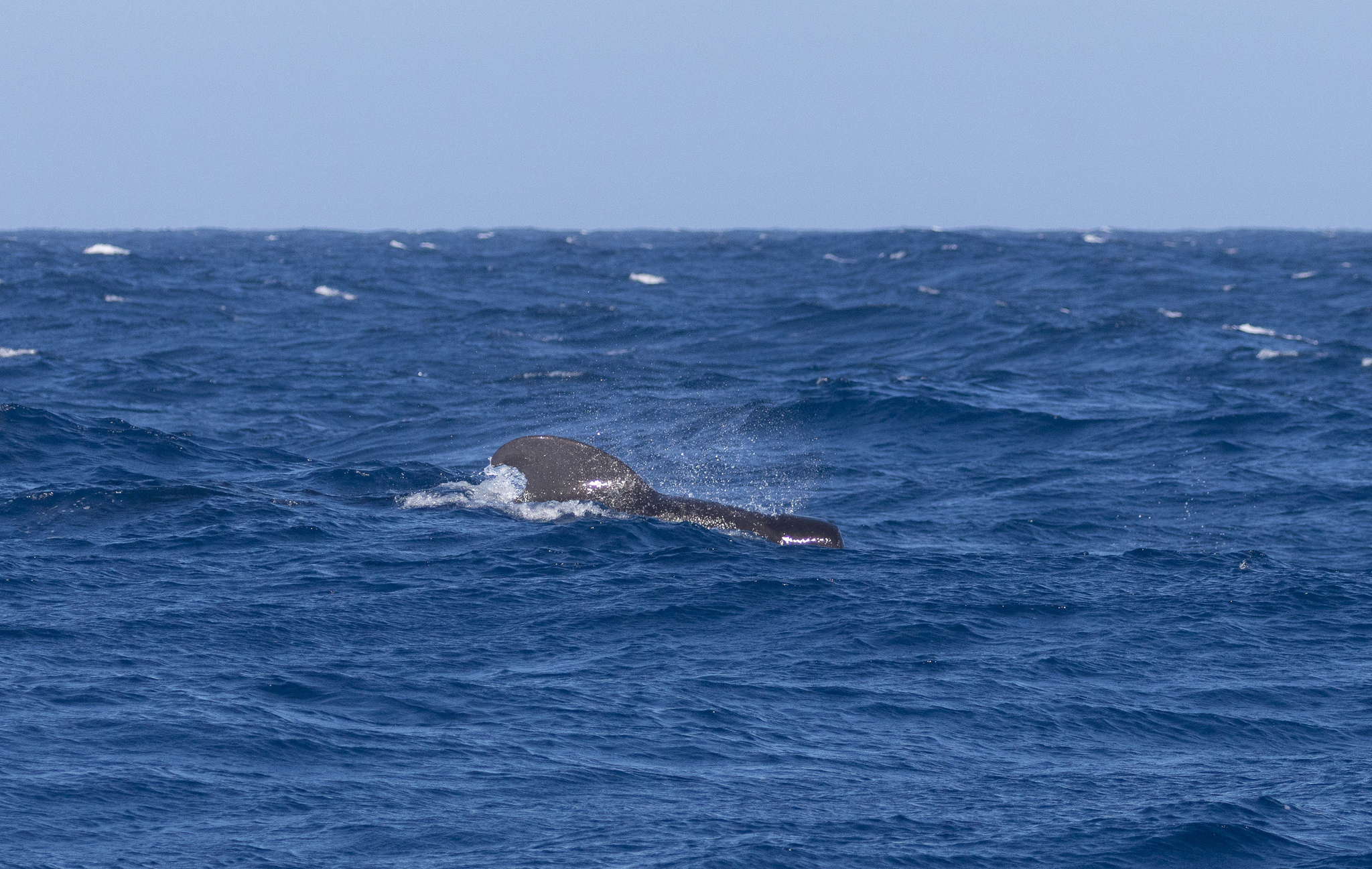
The short-finned pilot whale (Globicephala macrorhynchus) is one of the two species of cetaceans in the genus Globicephala, which it shares with the long-finned pilot whale (G. melas).
- Kingdom
- Animalia
- Phylum
- Chordata
- Class
- Mammalia
- Order
- Cetacea
- Family
- Delphinidae
- Genus
- Globicephala
- Species
- Globicephala macrorhynchus
Description
The short-finned pilot whale (Globicephala macrorhynchus) is one of the two species of cetaceans in the genus Globicephala, which it shares with the long-finned pilot whale (G. melas). It is part of the oceanic dolphin family (Delphinidae). It has a worldwide distribution with a global population of about 700,000, and there may be 3 or 4 distinct populations-two in the Pacific and one in the Atlantic and Indian Oceans. Its range is moving northward due to global warming. In the Pacific, males average 4–6 m (13–20 ft) and females 3–5 m (9.8–16.4 ft). It generally has a stocky build with black to dark gray or brown skin, and can be distinguished from its counterpart by shorter flippers, fewer teeth, and a shorter beak. It is thought to pursue fast-moving squid typically at a depth of 700 m (2,300 ft), but the maximum recorded depth is 1,018 m (3,340 ft). The short-finned pilot whale has been reported as being highly playful and social. It typically travels in pods of 10–30 members, usually family, but has been observed moving in groups of several hundred. Like killer whales, it has a matrilineal social hierarchy with an elder female at the head and a sizable post-reproductive lifespan. It is polygynous; females often outnumber males 8:1 in a pod. Pods are known to mass strand, possibly due to sheer accident, biosonars confused by geomagnetic anomalies, injury from loud military sonar, or disease. It was historically whaled, and is still whaled today by Japan and the Lesser Antilles, but it is protected by several international treaties.
Gallery
Ajouter des photos
Partagez vos photos de cette espèce (jusqu'à 20 à la fois) : elles sont vérifiées automatiquement, puis publiées.
Répartition
Occurrences observées (données GBIF). Les zones hors aire d'origine peuvent indiquer une présence introduite ou invasive.
Sources et crédits
Informations provenant de plusieurs sources vérifiées. Dernière mise à jour : .
Crédits photos (6)
- Photo : Jacob Crisp · CC BY-NC 4.0 · via GBIF
- Photo : John Karges (@johnkarges) · CC BY-NC 4.0 · via iNaturalist
- Photo : Jonny Campbell (@jonathancampbell) · CC BY-NC 4.0 · via iNaturalist
- Photo : @gabohq · CC BY-NC 4.0 · via iNaturalist
- Photo : Miguel Berkemeier (@miguelberkemeier) · CC BY-NC 4.0 · via iNaturalist
- Photo : @cw246 · CC BY-NC 4.0 · via iNaturalist
Mentions de licence
Texte disponible sous licence CC BY-SA 4.0. Il adapte notamment Wikipedia (CC BY-SA) : Short-finned pilot whale (Wikipédia, auteurs dans l’historique de l’article).
- Taxonomie : GBIF Backbone Taxonomy (CC BY 4.0)
- Carte : occurrences GBIF, fond © contributeurs OpenStreetMap (ODbL)
- Statut de conservation : Liste rouge de l'UICN, via Wikidata (CC0)
Détail : Sources et licences.
Discussion (0)
Aucun message pour l’instant. Lancez la discussion sur cette fiche (sources, précisions, débats éditoriaux).
Connectez-vous pour participer à la discussion.