
Gelada
Theropithecus gelada
The gelada (Theropithecus gelada, Amharic: ጭላዳ, romanized: č̣əlada, Oromo: Jaldeessa daabee), sometimes called the bleeding-heart monkey or the gelada baboon, is a species of Old World monkey found only in the Ethiopian Highlands,…
- Kingdom
- Animalia
- Phylum
- Chordata
- Class
- Mammalia
- Order
- Primates
- Family
- Cercopithecidae
- Genus
- Theropithecus
- Species
- Theropithecus gelada
Description
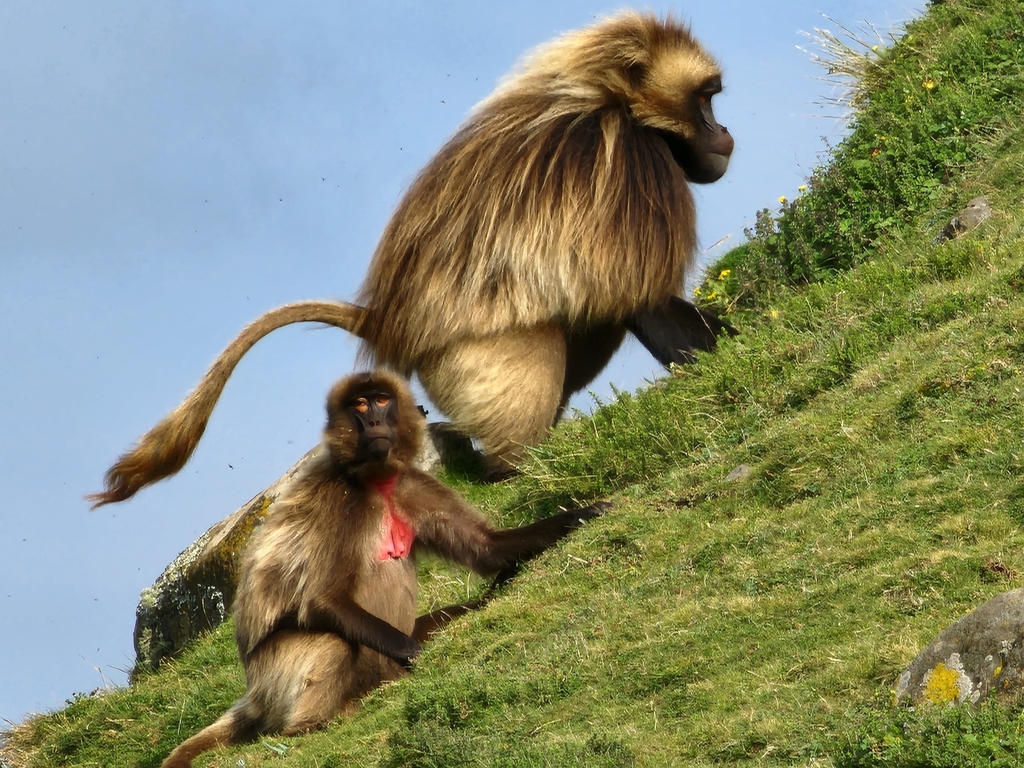
The gelada (Theropithecus gelada, Amharic: ጭላዳ, romanized: č̣əlada, Oromo: Jaldeessa daabee), sometimes called the bleeding-heart monkey or the gelada baboon, is a species of Old World monkey found only in the Ethiopian Highlands, living at elevations of 1,800–4,400 m (5,900–14,400 ft) above sea level. It is the only living member of the genus Theropithecus, a name derived from the Greek root words for "beast-ape" (θηρο-πίθηκος : thēro-píthēkos). Like its close relatives in genus Papio, the baboons, it is largely terrestrial, spending much of its time foraging in grasslands, with grasses comprising up to 90% of its diet. It has buff to dark brown hair with a dark face and pale eyelids. Adult males have longer hair on their backs and a conspicuous bright red patch of skin shaped like an hourglass on their chests. Females also have a bare patch of skin but it is less pronounced, except during estrus, when it brightens and exhibits a "necklace" of fluid-filled blisters. Males average 18.5 kg (41 lb) and females average 11 kg (24 lb) in weight. The head-body length is 50–75 cm (20–30 in) with a tail of 30–50 cm (12–20 in). The gelada has a complex multilevel social structure. Reproductive units and male units are the two basic groupings. A band comprises a mix of multiple reproductive units and male units; a community is made up of one to four bands. Within the reproductive units the females are commonly closely related. Males will move from their natal group to try to control a unit of their own and females within the unit can choose to support or oppose the new male. When more than one male is in the unit, only one can mate with the females. The gelada has a diverse repertoire of vocalizations thought to be near in complexity to that of humans. The population of geladas is thought to have dropped from 440,000 in the 1970s to 200,000 in 2008. Despite the heavy loss, it is listed as least concern by the International Union for Conservation of Nature.
Gallery
Ajouter des photos
Partagez vos photos de cette espèce (jusqu'à 20 à la fois) : elles sont vérifiées automatiquement, puis publiées.
Répartition
Occurrences observées (données GBIF). Les zones hors aire d'origine peuvent indiquer une présence introduite ou invasive.
Sources et crédits
Informations provenant de plusieurs sources vérifiées. Dernière mise à jour : .
Crédits photos (8)
- Photo : Aklilu Negussie Mekuria (@aklilu) · CC BY-NC 4.0 · via iNaturalist
- Photo : Loren K (@lkliewer) · CC BY-NC 4.0 · via iNaturalist
- Photo : Hailu Tilahun Argaw (@hailu_horn_of_africa) · CC BY-NC 4.0 · via iNaturalist
- Photo : @thewildgtrv · CC BY-NC 4.0 · via iNaturalist
- Photo : Cathy Pasterczyk (@cathyp) · CC BY-NC 4.0 · via iNaturalist
- Photo : Александра Ивушкина (@alex_willow) · CC BY-NC 4.0 · via iNaturalist
- Photo : @ajpembo · CC BY-NC 4.0 · via iNaturalist
- Photo : Chris G Earley (@chrisearley) · CC BY-NC 4.0 · via iNaturalist
Mentions de licence
Texte disponible sous licence CC BY-SA 4.0. Il adapte notamment Gélada, Wikipedia (CC BY-SA) : Gelada (Wikipédia, auteurs dans l’historique de l’article).
- Taxonomie : GBIF Backbone Taxonomy (CC BY 4.0)
- Carte : occurrences GBIF, fond © contributeurs OpenStreetMap (ODbL)
- Statut de conservation : Liste rouge de l'UICN, via Wikidata (CC0)
Détail : Sources et licences.
Discussion (0)
Aucun message pour l’instant. Lancez la discussion sur cette fiche (sources, précisions, débats éditoriaux).
Connectez-vous pour participer à la discussion.