
False killer whale
Pseudorca crassidens
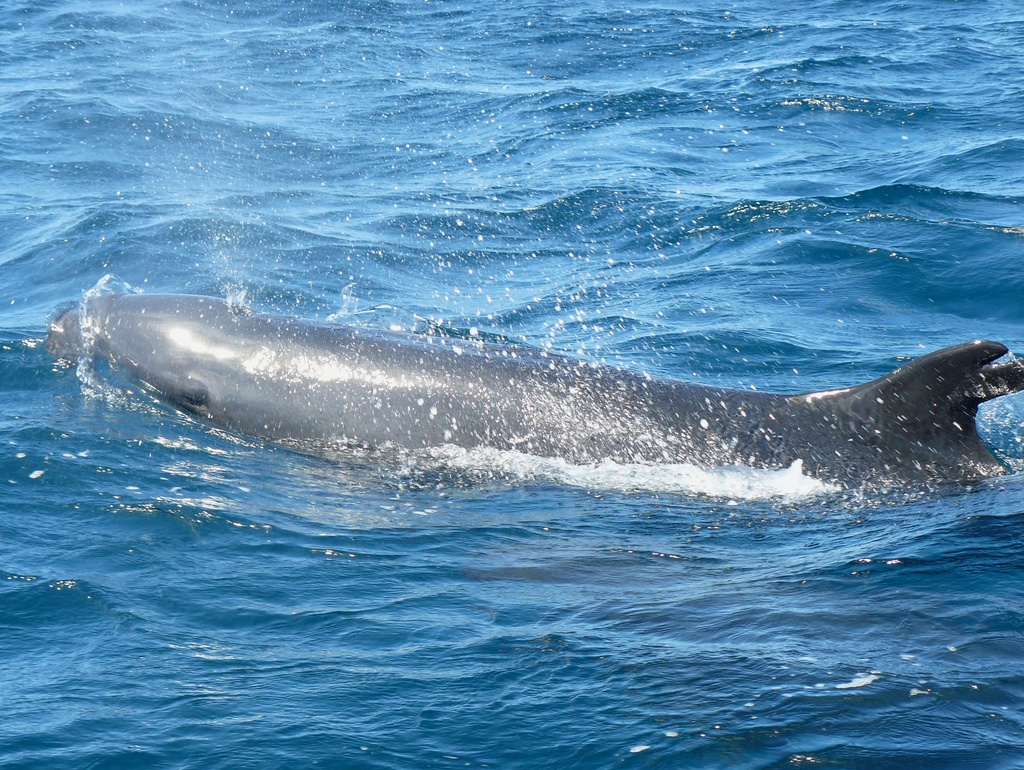
The false killer whale (Pseudorca crassidens) is a species of oceanic dolphin that is the only extant representative of the genus Pseudorca.
- Kingdom
- Animalia
- Phylum
- Chordata
- Class
- Mammalia
- Order
- Cetacea
- Family
- Delphinidae
- Genus
- Pseudorca
- Species
- Pseudorca crassidens
Description
The false killer whale (Pseudorca crassidens) is a species of oceanic dolphin that is the only extant representative of the genus Pseudorca. It is found in oceans worldwide but mainly in tropical regions. It was first described in 1846 as a species of porpoise based on a skull, which was revised when the first carcasses were observed in 1861. The name "false killer whale" comes from having a skull similar to the orca or killer whale (Orcinus orca). The false killer whale reaches a maximum length of 6 m (20 ft), though size can vary around the world. It is highly sociable, known to form pods of up to 50 members, and can also form pods with other dolphin species, such as the common bottlenose dolphin (Tursiops truncatus). It can form close bonds with other species, as well as have sexual interactions with them. But the false killer whale has also been known to eat other dolphins, though it typically eats squid and fish. It is a deep-diver; maximum known depth is 927.5 m (3,043 ft); maximum speed is around 30 km/h (19 mph). Several aquariums around the world keep one or more false killer whales, though its aggression toward other dolphins makes it less desirable. It is threatened by fishing operations, as it can entangle in fishing gear. It is drive hunted in some Japanese villages. The false killer whale has a tendency to mass-strand given its highly social nature; the largest stranding consisted of over 800 beached at Mar del Plata, Argentina, in 1946. Most of what is known of this species comes from examining stranded individuals.
Gallery
Ajouter des photos
Partagez vos photos de cette espèce (jusqu'à 20 à la fois) : elles sont vérifiées automatiquement, puis publiées.
Répartition
Occurrences observées (données GBIF). Les zones hors aire d'origine peuvent indiquer une présence introduite ou invasive.
Sources et crédits
Informations provenant de plusieurs sources vérifiées. Dernière mise à jour : .
Crédits photos (7)
- Photo : Douglas J. Long (@douglasglobal) · CC BY-NC 4.0 · via iNaturalist
- Photo : Steve Mech (@sgmech) · CC BY-NC 4.0 · via iNaturalist
- Photo : @sewings · CC BY-NC 4.0 · via iNaturalist
- Photo : Thomas Tam (@thomastam) · CC BY-NC 4.0 · via iNaturalist
- Photo : Sergio Martínez (@sergiomtz) · CC BY-NC 4.0 · via iNaturalist
- Photo : Islas Secas Resort (@islassecasresort) · CC BY-NC 4.0 · via iNaturalist
- Photo : Gisela Dionisio (@giseladionisio) · CC BY-NC 4.0 · via iNaturalist
Mentions de licence
Texte disponible sous licence CC BY-SA 4.0. Il adapte notamment Fausse orque, Wikipedia (CC BY-SA) : False killer whale (Wikipédia, auteurs dans l’historique de l’article).
- Taxonomie : GBIF Backbone Taxonomy (CC BY 4.0)
- Carte : occurrences GBIF, fond © contributeurs OpenStreetMap (ODbL)
- Statut de conservation : Liste rouge de l'UICN, via Wikidata (CC0)
Détail : Sources et licences.
Discussion (0)
Aucun message pour l’instant. Lancez la discussion sur cette fiche (sources, précisions, débats éditoriaux).
Connectez-vous pour participer à la discussion.