
Six-banded Armadillo
Euphractus sexcinctus
The six-banded armadillo (Euphractus sexcinctus), also known as the yellow armadillo, is an armadillo found in South America.
- Kingdom
- Animalia
- Phylum
- Chordata
- Class
- Mammalia
- Order
- Cingulata
- Family
- Dasypodidae
- Genus
- Euphractus
- Species
- Euphractus sexcinctus
Description
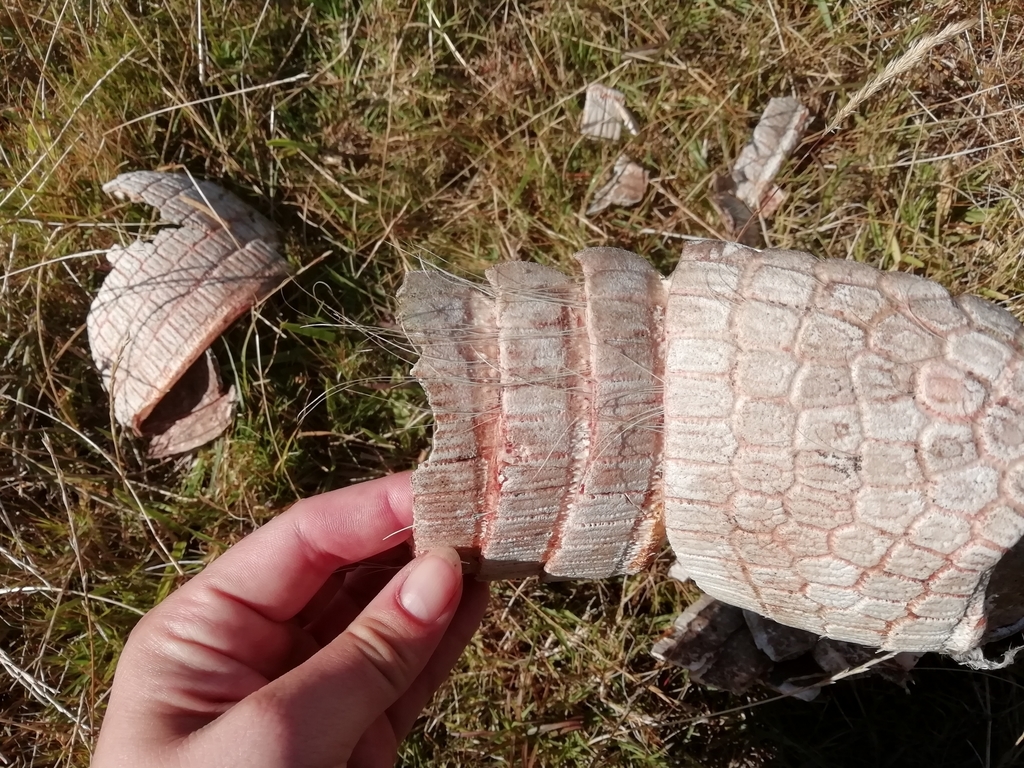
The six-banded armadillo (Euphractus sexcinctus), also known as the yellow armadillo, is an armadillo found in South America. The sole extant member of its genus, it was first described by Swedish zoologist Carl Linnaeus in 1758. The six-banded armadillo is typically between 40 and 50 centimeters (16 and 20 in) in head-and-body length, and weighs 3.2 to 6.5 kilograms (7.1 to 14.3 lb). The carapace (hard shell on the back) is pale yellow to reddish brown, marked by scales of equal length, and scantily covered by buff to white bristle-like hairs. The forefeet have five distinct toes, each with moderately developed claws. Six-banded armadillos are efficient diggers and form burrows to live in and search for prey. The armadillo is alert and primarily solitary. An omnivore, it feeds on insects, ants, carrion, and plant material. Due to their poor eyesight, armadillos rely on their sense of smell to detect prey and predators. Births take place throughout the year; gestation is 60 to 64 days long, after which a litter of one to three is born. Weaning occurs at one month, and juveniles mature by nine months. The six-banded armadillo inhabits savannas, primary and secondary forests, cerrados, shrublands, and deciduous forests. Fairly common, its range spans from Brazil and southern Suriname in the northeast through Bolivia, Paraguay, and Uruguay into northern Argentina in the southeast. The International Union for the Conservation of Nature and Natural Resources (IUCN) classifies it as least concern, and there are no major threats to its survival.
Gallery
Ajouter des photos
Partagez vos photos de cette espèce (jusqu'à 20 à la fois) : elles sont vérifiées automatiquement, puis publiées.
Répartition
Occurrences observées (données GBIF). Les zones hors aire d'origine peuvent indiquer une présence introduite ou invasive.
Sources et crédits
Informations provenant de plusieurs sources vérifiées. Dernière mise à jour : .
Crédits photos (7)
- Photo : Agustina Medina (@ornitoloca) · CC BY 4.0 · via iNaturalist
- Photo : @fabiologopro · CC BY-NC 4.0 · via iNaturalist
- Photo : Pablo Preliasco (@preli) · CC BY-NC 4.0 · via iNaturalist
- Photo : Vincent A. Vos (@vincentvosriberalta) · CC BY 4.0 · via iNaturalist
- Photo : Ana Luiza Piacentin (@analuizapiacentin) · CC BY-NC 4.0 · via iNaturalist
- Photo : Thomaz de Carvalho Callado (@thomazcallado) · CC BY 4.0 · via iNaturalist
- Photo : Fernando Igor de Godoy (@fernandoigorgodoy) · CC BY-NC 4.0 · via iNaturalist
Mentions de licence
Texte disponible sous licence CC BY-SA 4.0. Il adapte notamment Euphractus sexcinctus, Wikipedia (CC BY-SA) : Six-banded armadillo (Wikipédia, auteurs dans l’historique de l’article).
- Taxonomie : GBIF Backbone Taxonomy (CC BY 4.0)
- Carte : occurrences GBIF, fond © contributeurs OpenStreetMap (ODbL)
- Statut de conservation : Liste rouge de l'UICN, via Wikidata (CC0)
Détail : Sources et licences.
Discussion (0)
Aucun message pour l’instant. Lancez la discussion sur cette fiche (sources, précisions, débats éditoriaux).
Connectez-vous pour participer à la discussion.