
Yunnan woolly flying squirrel
Eupetaurus nivamons
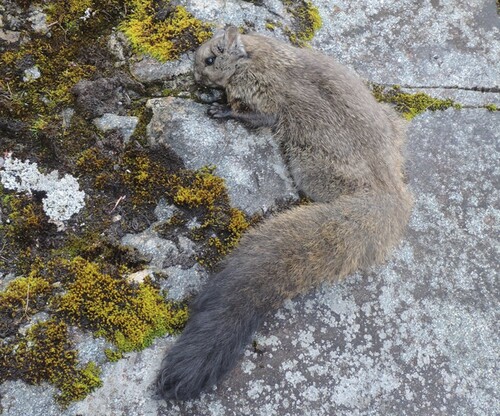
The Yunnan woolly flying squirrel (Eupetaurus nivamons) is a species of very large flying squirrel in the genus Eupetaurus.
- Kingdom
- Animalia
- Phylum
- Chordata
- Class
- Mammalia
- Order
- Rodentia
- Family
- Sciuridae
- Genus
- Eupetaurus
- Species
- Eupetaurus nivamons
Description
The Yunnan woolly flying squirrel (Eupetaurus nivamons) is a species of very large flying squirrel in the genus Eupetaurus. It is found on the southeastern margin of the Himalayas, namely in northwestern Yunnan and potentially Myanmar. It is thought to be the sister species to the Tibetan woolly flying squirrel (E. tibetensis), from which it likely diverged during the Pliocene-Pleistocene boundary. It differs from the western woolly flying squirrel (E. cinereus) in its more saturated brown dorsal pelage, and differs from E. tibetensis in its much shorter black tail tip. It also has a much wider rostrum than the other two Eupetaurus species. It has been documented (through both specimens and camera trap images) from two localities; Mount Gaoligong, the highest peak of the Gaoligong Mountains and a nationally protected nature reserve, and Biluo Snow Mountain, which is currently unprotected. In 2020, during a biodiversity survey conducted in northwestern Bhutan, images of a woolly flying squirrel closely resembling E. nivamons were captured via camera trap within the confines of Jigme Dorji National Park, though further research is necessary to positively identify the photographed specimen. It is thought to inhabit steep cliffs on alpine tundra, where it feeds on Juniperus squamata. Evidence for species activity is known even in the coldest and snowiest months of the year, indicating that it does not hibernate or migrate from the area. Due to its rarity and small habitat area, as well as the potential threats its alpine habitat faces from climate change, it has been recommended it be classified as Near Threatened on the IUCN Red List.
Gallery
Ajouter des photos
Partagez vos photos de cette espèce (jusqu'à 20 à la fois) : elles sont vérifiées automatiquement, puis publiées.
Répartition
Occurrences observées (données GBIF). Les zones hors aire d'origine peuvent indiquer une présence introduite ou invasive.
Sources et crédits
Informations provenant de plusieurs sources vérifiées. Dernière mise à jour : .
Crédits photos (2)
- Photo : (c) Jackson, Stephen M; Li, Quan; Wan, Tao; Li, Xue-You; Yu, Fa-Hong; Gao, Ge; He, Li-Kun; Helgen, Kristofer M; Jiang, Xue-Long., some rights reserved (CC BY) · CC BY 4.0
- Photo : Jackson, Stephen M; Li, Quan; Wan, Tao; Li, Xue-You; Yu, Fa-Hong; Gao, Ge; He, Li-Kun; Helgen, Kristofer M; Jiang, Xue-Long. · CC BY 4.0
Mentions de licence
Texte disponible sous licence CC BY-SA 4.0. Il adapte notamment Wikipedia (CC BY-SA) : Yunnan woolly flying squirrel (Wikipédia, auteurs dans l’historique de l’article).
- Taxonomie : GBIF Backbone Taxonomy (CC BY 4.0)
- Carte : occurrences GBIF, fond © contributeurs OpenStreetMap (ODbL)
Détail : Sources et licences.
Discussion (0)
Aucun message pour l’instant. Lancez la discussion sur cette fiche (sources, précisions, débats éditoriaux).
Connectez-vous pour participer à la discussion.