
Common Eland
Taurotragus oryx
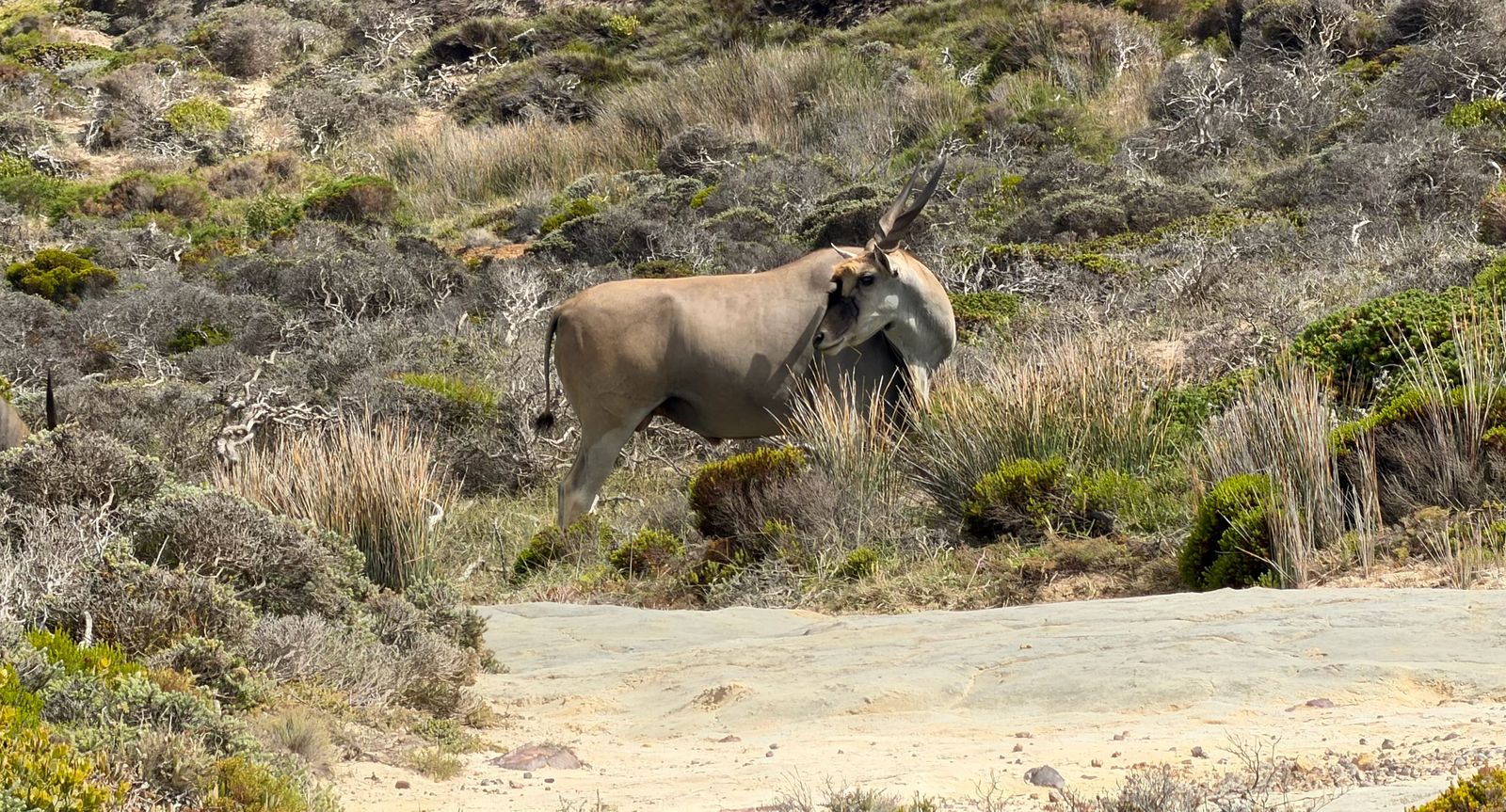
The common eland (Taurotragus oryx), also known as the southern eland or eland antelope, is a large savannah and plains antelope found in East and Southern Africa.
- Kingdom
- Animalia
- Phylum
- Chordata
- Class
- Mammalia
- Order
- Artiodactyla
- Family
- Bovidae
- Genus
- Taurotragus
- Species
- Taurotragus oryx
Description
The common eland (Taurotragus oryx), also known as the southern eland or eland antelope, is a large savannah and plains antelope found in East and Southern Africa. An adult male is around 1.6 m (5.2 ft) tall at the shoulder and can weigh up to 942 kg (2,077 lb) with a typical range of 500–600 kg (1,100–1,300 lb). Females are around 1.4 m (4.6 ft) tall and weigh 340–445 kg (750–981 lb). It was scientifically described by Peter Simon Pallas in 1766. Mainly a herbivore, its diet is primarily grasses and leaves. Common elands form herds of up to 500 animals, but are not territorial. The common eland prefers habitats with a wide variety of flowering plants such as savannah, woodlands, and open and montane grasslands; it avoids dense forests. It uses loud barks, visual and postural movements, and the flehmen response to communicate and warn others of danger. The common eland is used by humans for leather and meat, and has been domesticated in southern Africa. Eland milk contains more butterfat than cow's milk, and can be stored for up to eight months. It is native to Angola, Botswana, the Democratic Republic of the Congo, Eswatini, Ethiopia, Kenya, Lesotho, Malawi, Mozambique, Namibia, Rwanda, South Africa, South Sudan, Tanzania, Uganda, Zambia, and Zimbabwe, but is no longer present in Burundi. While the common eland's population is decreasing, it is classified as of least concern by the International Union for Conservation of Nature.
Gallery
Ajouter des photos
Partagez vos photos de cette espèce (jusqu'à 20 à la fois) : elles sont vérifiées automatiquement, puis publiées.
Répartition
Occurrences observées (données GBIF). Les zones hors aire d'origine peuvent indiquer une présence introduite ou invasive.
Sources et crédits
Informations provenant de plusieurs sources vérifiées. Dernière mise à jour : .
Crédits photos (10)
- Photo : Yolande Oelsen · CC BY-NC 4.0 · via GBIF
- Photo : rynoe · CC BY-NC 4.0 · via GBIF
- Photo : Parker Brandenburg · CC BY-NC 4.0 · via GBIF
- Photo : sandchanct · CC BY-NC 4.0 · via GBIF
- Photo : sandchanct · CC BY-NC 4.0 · via GBIF
- Photo : Tellu · CC BY-NC 4.0 · via GBIF
- Photo : whalesc · CC BY-NC 4.0 · via GBIF
- Photo : Gwili Gibbon · CC BY-NC 4.0 · via GBIF
- Photo : Stuart Davis · CC BY-NC 4.0 · via GBIF
- Photo : propsih · CC BY-NC 4.0 · via GBIF
Mentions de licence
Texte disponible sous licence CC BY-SA 4.0. Il adapte notamment Éland, Wikipedia (CC BY-SA) : Common eland (Wikipédia, auteurs dans l’historique de l’article).
- Taxonomie : GBIF Backbone Taxonomy (CC BY 4.0)
- Carte : occurrences GBIF, fond © contributeurs OpenStreetMap (ODbL)
Détail : Sources et licences.
Discussion (0)
Aucun message pour l’instant. Lancez la discussion sur cette fiche (sources, précisions, débats éditoriaux).
Connectez-vous pour participer à la discussion.