
Short-beaked Echidna
Tachyglossus aculeatus
The short-beaked echidna (Tachyglossus aculeatus), also known as the common echidna, or short-nosed echidna, is one of four living species of echidna, and the only member of the genus Tachyglossus, from Ancient Greek ταχύς (takhús),…
- Kingdom
- Animalia
- Phylum
- Chordata
- Class
- Mammalia
- Order
- Monotremata
- Family
- Tachyglossidae
- Genus
- Tachyglossus
- Species
- Tachyglossus aculeatus
Description
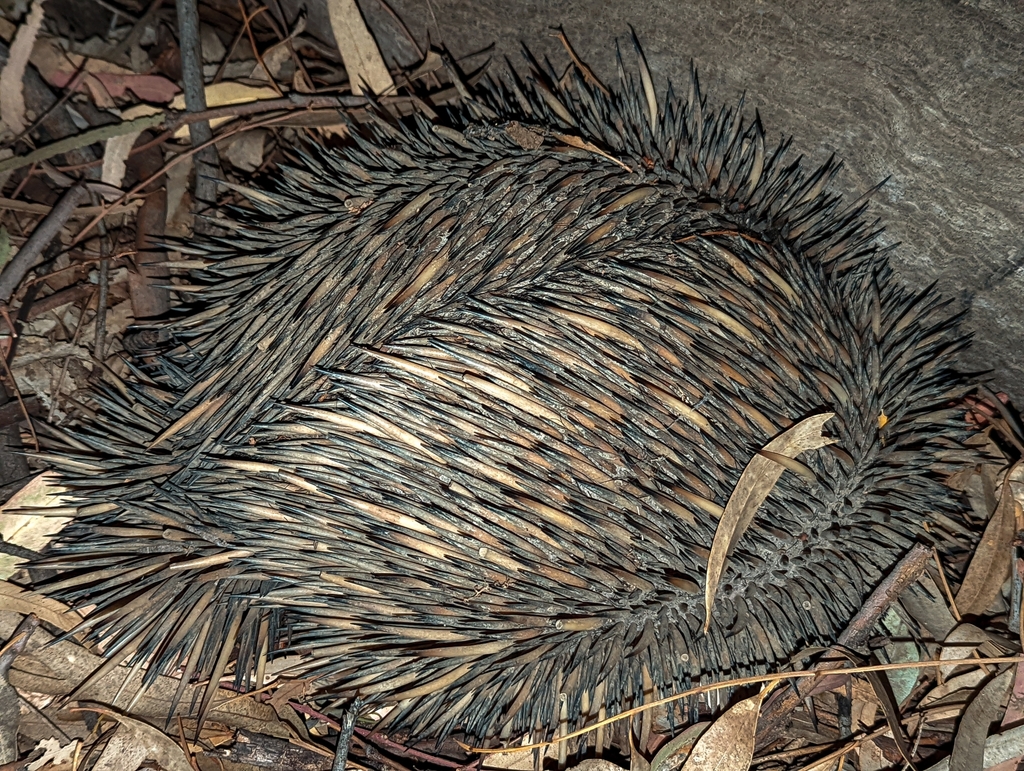
The short-beaked echidna (Tachyglossus aculeatus), also known as the common echidna, or short-nosed echidna, is one of four living species of echidna, and the only member of the genus Tachyglossus, from Ancient Greek ταχύς (takhús), meaning "fast", and γλῶσσα (glôssa), meaning "tongue". It is covered in fur and spines and has a distinctive snout and a specialised tongue, which it uses to catch its insect prey at a great speed. Like the other extant monotremes, the short-beaked echidna lays eggs; the monotremes are the only living group of mammals to do so. The short-beaked echidna has extremely strong front limbs and claws, which allow it to burrow quickly with great power. As it needs to be able to survive underground, it has a significant tolerance to high levels of carbon dioxide and low levels of oxygen. It has no weapons or fighting ability but deters predators by curling into a ball and protecting itself with its spines. It cannot sweat or deal well with heat, so it tends to avoid daytime activity in hot weather. It can swim if needed. The snout has mechanoreceptors and electroreceptors that help the echidna to detect its surroundings. During the Australian winter, it goes into deep torpor and hibernation, reducing its metabolism to save energy. As the temperature increases, it emerges to mate. Female echidnas lay one egg a year and the mating period is the only time the otherwise solitary animals meet one another; the male has no further contact with the female or his offspring after mating. A newborn echidna is the size of a grape but grows rapidly on its mother's milk, which is very rich in nutrients. By seven weeks baby echidnas grow too large and spiky to stay in the pouch and are expelled into the mother's burrow. At around six months they leave and have no more contact with their mothers. The species is found throughout Australia, where it is the most widespread native mammal, and in coastal and highland regions of eastern New Guinea, where it is known as the mungwe in the Daribi and Chimbu languages. It is not threatened with extinction, but human activities, such as hunting, habitat destruction, and the introduction of foreign predatory species and parasites, have reduced its abundance in Australia.
Gallery
Ajouter des photos
Partagez vos photos de cette espèce (jusqu'à 20 à la fois) : elles sont vérifiées automatiquement, puis publiées.
Répartition
Occurrences observées (données GBIF). Les zones hors aire d'origine peuvent indiquer une présence introduite ou invasive.
Sources et crédits
Informations provenant de plusieurs sources vérifiées. Dernière mise à jour : .
Crédits photos (5)
- Photo : Josh Vido (@jvido) · CC BY-NC 4.0 · via iNaturalist
- Photo : @stephenaw · CC BY-NC 4.0 · via iNaturalist
- Photo : SM Cameron (@sm-cameron) · CC BY-NC 4.0 · via iNaturalist
- Photo : Will Matthews (@willjmatthews04) · CC BY-NC 4.0 · via iNaturalist
- Photo : Brad (@b_martin_) · CC BY-NC 4.0 · via iNaturalist
Mentions de licence
Texte disponible sous licence CC BY-SA 4.0. Il adapte notamment Wikipedia (CC BY-SA) : Short-beaked echidna (Wikipédia, auteurs dans l’historique de l’article).
- Taxonomie : GBIF Backbone Taxonomy (CC BY 4.0)
- Carte : occurrences GBIF, fond © contributeurs OpenStreetMap (ODbL)
- Statut de conservation : Liste rouge de l'UICN, via Wikidata (CC0)
Détail : Sources et licences.
Discussion (0)
Aucun message pour l’instant. Lancez la discussion sur cette fiche (sources, précisions, débats éditoriaux).
Connectez-vous pour participer à la discussion.