
Dromedary
Camelus dromedarius
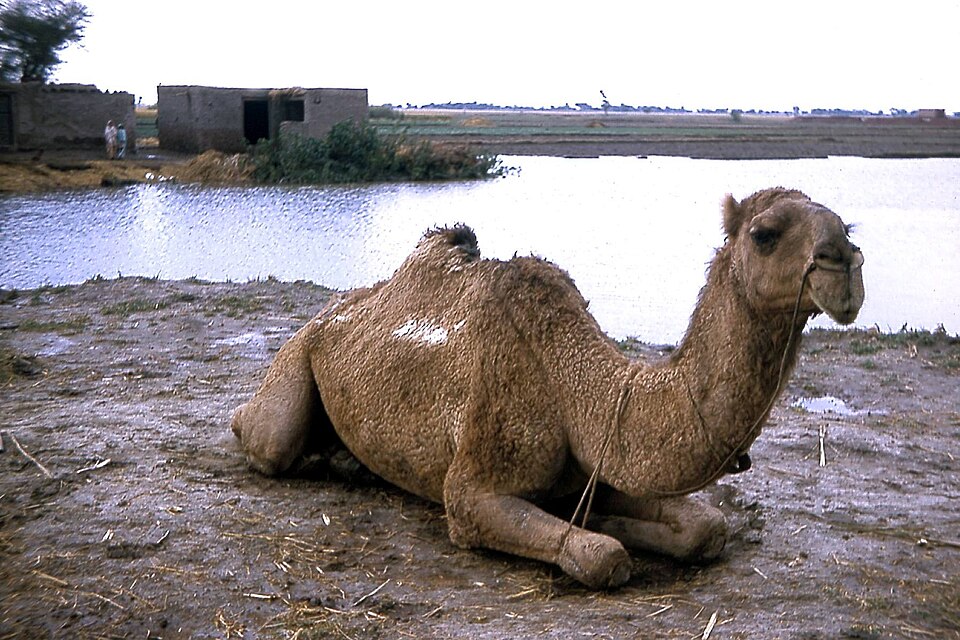
The dromedary (Camelus dromedarius), also known as the dromedary camel, Arabian camel and one-humped camel, is a large camel of the genus Camelus with one hump on its back.
- Kingdom
- Animalia
- Phylum
- Chordata
- Class
- Mammalia
- Order
- Artiodactyla
- Family
- Camelidae
- Genus
- Camelus
- Species
- Camelus dromedarius
Description
The dromedary (Camelus dromedarius), also known as the dromedary camel, Arabian camel and one-humped camel, is a large camel of the genus Camelus with one hump on its back. It is the tallest of the three camel species; adult males stand 1.8–2.4 m (5.9–7.9 ft) at the shoulder, while females are 1.7–1.9 m (5.6–6.2 ft) tall. Males typically weigh between 400 and 690 kg (880 and 1,520 lb), and females weigh between 300 and 540 kg (660 and 1,190 lb). The dromedary's distinctive features include its long, curved neck, narrow chest, a single hump, and long hairs on the throat, shoulders, and hump. The coat is generally a shade of brown. The hump is 20 cm (7.9 in) tall or more, and is made of fat bound together by fibrous tissue. The dromedary feeds on foliage and desert vegetation; several adaptations, such as the ability to tolerate losing more than 30% of its total water content, allow it to thrive in its desert habitat. Mating occurs annually and peaks in the rainy season; females bear a single calf after a gestation of 15 months. It is mainly active during daylight hours and forms herds of about 20 individuals, which are led by a dominant male. The dromedary has not occurred naturally in the wild for nearly 2,000 years. It was probably first domesticated in the Arabian Peninsula about 4,000 years ago. In the wild, the dromedary inhabited arid regions, including the Sahara. The domesticated dromedary is kept in the semiarid to arid regions of the Old World, mainly in Africa, the Arabian Peninsula and the Thar desert in Pakistan and India. A feral population occurs in Australia. Products of the dromedary, including its meat and milk, support several North African tribes; it is also commonly used for riding and as a pack animal.
Gallery
Ajouter des photos
Partagez vos photos de cette espèce (jusqu'à 20 à la fois) : elles sont vérifiées automatiquement, puis publiées.
Répartition
Occurrences observées (données GBIF). Les zones hors aire d'origine peuvent indiquer une présence introduite ou invasive.
Sources et crédits
Informations provenant de plusieurs sources vérifiées. Dernière mise à jour : .
Crédits photos (6)
- Photo : Dr. Alex Langmuir Originaly uploaded by fr:Utilisateur:Semnoz · Domaine public
- Photo : Als5ary · CC BY-SA 3.0
- Photo : Richard Mortel from Riyadh, Saudi Arabia · CC BY 2.0 · via Wikimedia Commons
- Photo : Bernard Gagnon · CC BY-SA 3.0 · via Wikimedia Commons
- Photo : ACEI Cheung (4Cheungs) from Flickr · CC BY-SA 2.0 · via Wikimedia Commons
- Photo : Ferdinand Reus from Arnhem, Holland · CC BY-SA 2.0 · via Wikimedia Commons
Mentions de licence
Texte disponible sous licence CC BY-SA 4.0. Il adapte notamment Wikipedia (CC BY-SA) : Dromedary (Wikipédia, auteurs dans l’historique de l’article).
- Taxonomie : GBIF Backbone Taxonomy (CC BY 4.0)
- Carte : occurrences GBIF, fond © contributeurs OpenStreetMap (ODbL)
Détail : Sources et licences.
Discussion (0)
Aucun message pour l’instant. Lancez la discussion sur cette fiche (sources, précisions, débats éditoriaux).
Connectez-vous pour participer à la discussion.