
Red-shanked douc
Pygathrix nemaeus
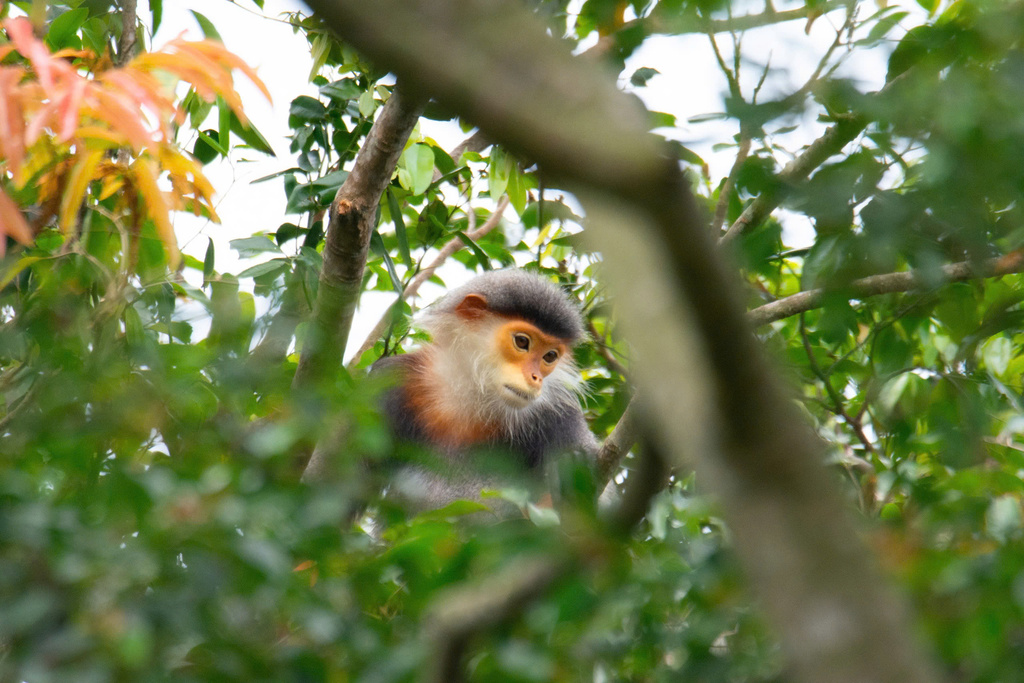
The red-shanked douc (Pygathrix nemaeus) is an arboreal and diurnal Old World monkey belonging to the Colobinae subfamily.
- Kingdom
- Animalia
- Phylum
- Chordata
- Class
- Mammalia
- Order
- Primates
- Family
- Cercopithecidae
- Genus
- Pygathrix
- Species
- Pygathrix nemaeus
Description
The red-shanked douc (Pygathrix nemaeus) is an arboreal and diurnal Old World monkey belonging to the Colobinae subfamily. They are endemic to Laos, Vietnam, and Cambodia. They are known for their bright colors and exhibit sexual dimorphism through their body size. The species has been declared critically endangered by the International Union for Conservation of Nature, with the main threats being: hunting, habitat loss and pet trade. They are one of three species in the genus Pygathrix, the other two being the black-shanked (P. nigripes) and gray-shanked (P. cinerea) doucs. Red-shanked doucs live in fission-fusion, multilevel societies that have a mean of 18 individuals per band. They are folivorous and consume mainly Acacia pruinescens, Ficus racemosa, Millettia nigrescens, Zanthoxylum avicennae and Castanopsis ceratacantha. Their four-chambered stomachs that allow for bacterial fermentation help them with their high-fiber diet.
Gallery
Ajouter des photos
Partagez vos photos de cette espèce (jusqu'à 20 à la fois) : elles sont vérifiées automatiquement, puis publiées.
Répartition
Occurrences observées (données GBIF). Les zones hors aire d'origine peuvent indiquer une présence introduite ou invasive.
Sources et crédits
Informations provenant de plusieurs sources vérifiées. Dernière mise à jour : .
Crédits photos (8)
- Photo : Next Continent: Wildlife, Photography and Natural History Tours (@nextcontinenttours) · CC BY-NC 4.0 · via iNaturalist
- Photo : @the_taxanaut · CC BY-NC 4.0 · via iNaturalist
- Photo : @the_taxanaut · CC BY-NC 4.0 · via iNaturalist
- Photo : Tien Nguyen (@ilolumi) · CC BY-NC 4.0 · via iNaturalist
- Photo : Keith Wheatley (@keithw1) · CC BY-NC 4.0 · via iNaturalist
- Photo : Luan Mai Sy (@luanmaisy) · CC BY-NC 4.0 · via iNaturalist
- Photo : Anders Haglund (@anders_haglund) · CC BY-NC 4.0 · via iNaturalist
- Photo : @kwokwokwo · CC BY-NC 4.0 · via iNaturalist
Mentions de licence
Texte disponible sous licence CC BY-SA 4.0. Il adapte notamment Douc, Wikipedia (CC BY-SA) : Red-shanked douc (Wikipédia, auteurs dans l’historique de l’article).
- Taxonomie : GBIF Backbone Taxonomy (CC BY 4.0)
- Carte : occurrences GBIF, fond © contributeurs OpenStreetMap (ODbL)
- Statut de conservation : Liste rouge de l'UICN, via Wikidata (CC0)
Détail : Sources et licences.
Discussion (0)
Aucun message pour l’instant. Lancez la discussion sur cette fiche (sources, précisions, débats éditoriaux).
Connectez-vous pour participer à la discussion.