
Mantled Guereza
Colobus guereza
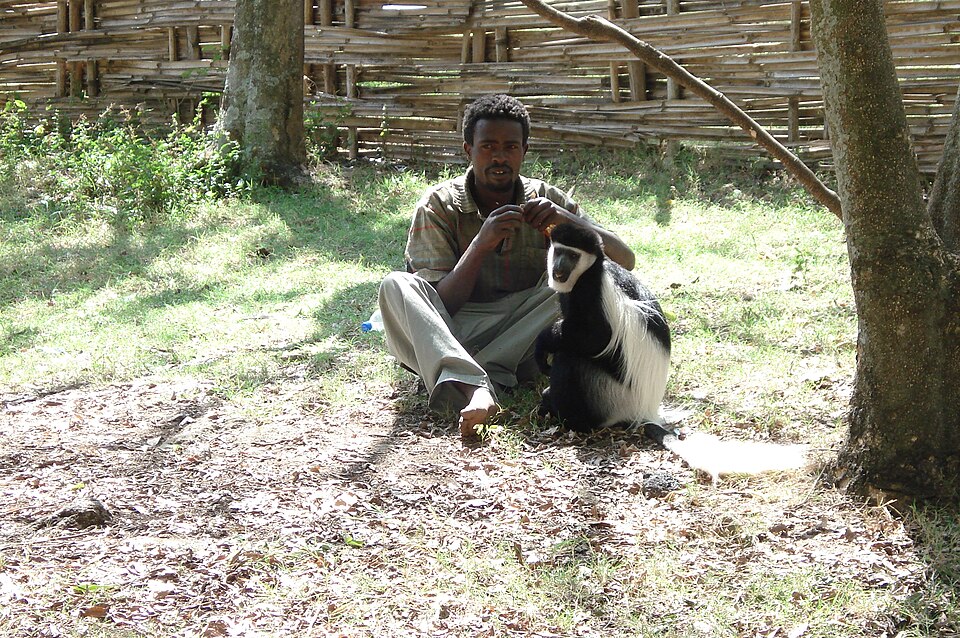
The mantled guereza (Colobus guereza), also known simply as the guereza, historically the eastern black-and-white colobus, and Abyssinian black-and-white colobus, is a black-and-white colobus, a type of Old World monkey.
- Kingdom
- Animalia
- Phylum
- Chordata
- Class
- Mammalia
- Order
- Primates
- Family
- Cercopithecidae
- Genus
- Colobus
- Species
- Colobus guereza
Description
The mantled guereza (Colobus guereza), also known simply as the guereza, historically the eastern black-and-white colobus, and Abyssinian black-and-white colobus, is a black-and-white colobus, a type of Old World monkey. It is native to much of west central and east Africa, including Cameroon, Equatorial Guinea, Nigeria, Ethiopia, Kenya, Tanzania, Uganda and Chad. The species consists of several subspecies that differ in appearance. It has a distinctive appearance, which is alluded to in its name; the long white fringes of hair that run along each side of its black trunk are known as a mantle. Its face is framed with white hair and it has a large white tail tuft. The mantled guereza is diurnal and arboreal, found in both deciduous and evergreen forests. It is an adaptable species that can cope with habitat disturbance and prefers secondary forest close to rivers or lakes. Although previously thought to eat only leaves, it also eats seeds, fruits, and arthropods. It is able to digest plant material with a high fibre content with its specialised stomach and may only eat from a few plant species at a time. It is preyed on by birds of prey and some mammals, such as the common chimpanzee and the leopard. The mantled guereza lives in social groups of three to fifteen individuals. These groups normally include a dominant male, several females, and the offspring of the females. It has a polygynous mating system and copulation is initiated with vocal communication. After a gestation period of just over five months, infants are born with pink skin and white fur, which darkens to the adult coloration by three to four months. The mantled guereza is well known for its dawn chorus, the males' "roar" is a method of long-distance communication that reinforces territorial boundaries. It also makes other vocalization and uses body postures, movements, and facial expressions to communicate. The mantled guereza is listed as Least Concern by the International Union for Conservation of Nature (IUCN) because it is widespread – although it is locally threatened in some areas, the decline is not great enough to list it in a higher category of threat. However, one subspecies found in Kenya is listed as Endangered. It can survive well in degraded forests and in some areas it is more common in logged areas than unlogged ones. The mantled guereza is also threatened by hunting for bushmeat and for its skin.
Gallery
Ajouter des photos
Partagez vos photos de cette espèce (jusqu'à 20 à la fois) : elles sont vérifiées automatiquement, puis publiées.
Répartition
Occurrences observées (données GBIF). Les zones hors aire d'origine peuvent indiquer une présence introduite ou invasive.
Sources et crédits
Informations provenant de plusieurs sources vérifiées. Dernière mise à jour : .
Crédits photos (6)
- Photo : Joe Castleman (Gyrofrog) · CC BY-SA 3.0
- Photo : Mike G. Rutherford (@mikegrutherford) · CC BY-NC 4.0 · via iNaturalist
- Photo : @bretthartl · CC BY-NC 4.0 · via iNaturalist
- Photo : @antoni_karolak · CC BY-NC 4.0 · via iNaturalist
- Photo : Ashley M Bradford (@ashley_bradford) · CC BY-NC 4.0 · via iNaturalist
- Photo : Lera Miles (@lera) · CC BY 4.0 · via iNaturalist
Mentions de licence
Texte disponible sous licence CC BY-SA 4.0. Il adapte notamment Wikipedia (CC BY-SA) : Mantled guereza (Wikipédia, auteurs dans l’historique de l’article).
- Taxonomie : GBIF Backbone Taxonomy (CC BY 4.0)
- Carte : occurrences GBIF, fond © contributeurs OpenStreetMap (ODbL)
- Statut de conservation : Liste rouge de l'UICN, via Wikidata (CC0)
Détail : Sources et licences.
Discussion (0)
Aucun message pour l’instant. Lancez la discussion sur cette fiche (sources, précisions, débats éditoriaux).
Connectez-vous pour participer à la discussion.