
African Civet
Civettictis civetta
The African civet (Civettictis civetta) is a large viverrid native to sub-Saharan Africa, where it is considered common and widely distributed in woodlands and secondary forests.
- Kingdom
- Animalia
- Phylum
- Chordata
- Class
- Mammalia
- Order
- Carnivora
- Family
- Viverridae
- Genus
- Civettictis
- Species
- Civettictis civetta
Description
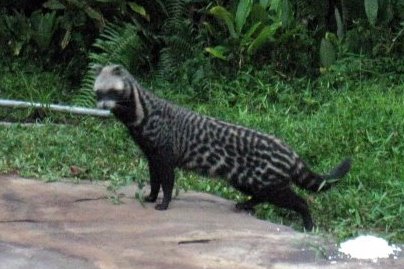
The African civet (Civettictis civetta) is a large viverrid native to sub-Saharan Africa, where it is considered common and widely distributed in woodlands and secondary forests. It has been listed as least concern on the IUCN Red List since 2008. In some countries, it is threatened by hunting, and wild-caught individuals are kept for producing civetone for the perfume industry. The African civet is primarily nocturnal and spends the day sleeping in dense vegetation, but wakes up at sunset. It is a solitary mammal with a unique coloration: the black and white blotches covering its coarse pelage and rings on the tail are an effective cryptic pattern. The black bands surrounding its eyes closely resemble those of the raccoon. Other distinguishing features are its disproportionately large hindquarters and its erectile dorsal crest. It is an omnivorous generalist, preying on small vertebrates, invertebrates, eggs, carrion, and vegetable matter. It is one of the few carnivores capable of eating toxic invertebrates such as termites and millipedes. It detects prey primarily by smell and sound rather than by sight. It is the only living member of the genus Civettictis.
Gallery
Ajouter des photos
Partagez vos photos de cette espèce (jusqu'à 20 à la fois) : elles sont vérifiées automatiquement, puis publiées.
Répartition
Occurrences observées (données GBIF). Les zones hors aire d'origine peuvent indiquer une présence introduite ou invasive.
Sources et crédits
Informations provenant de plusieurs sources vérifiées. Dernière mise à jour : .
Crédits photos (6)
- Photo : No machine-readable author provided. Danapelleg assumed (based on copyright claims). · Domaine public
- Photo : @thierry_aebischer_chinko · CC BY-NC 4.0 · via iNaturalist
- Photo : @jabulani_webcams · CC BY-NC 4.0 · via iNaturalist
- Photo : @eliegaget · CC BY-NC 4.0 · via iNaturalist
- Photo : @thierry_aebischer_chinko · CC BY-NC 4.0 · via iNaturalist
- Photo : Raphaël Colin (@raphcgo) · CC BY-NC 4.0 · via iNaturalist
Mentions de licence
Texte disponible sous licence CC BY-SA 4.0. Il adapte notamment Wikipedia (CC BY-SA) : African civet (Wikipédia, auteurs dans l’historique de l’article).
- Taxonomie : GBIF Backbone Taxonomy (CC BY 4.0)
- Carte : occurrences GBIF, fond © contributeurs OpenStreetMap (ODbL)
- Statut de conservation : Liste rouge de l'UICN, via Wikidata (CC0)
Détail : Sources et licences.
Discussion (0)
Aucun message pour l’instant. Lancez la discussion sur cette fiche (sources, précisions, débats éditoriaux).
Connectez-vous pour participer à la discussion.