
Vervet Monkey
Chlorocebus pygerythrus
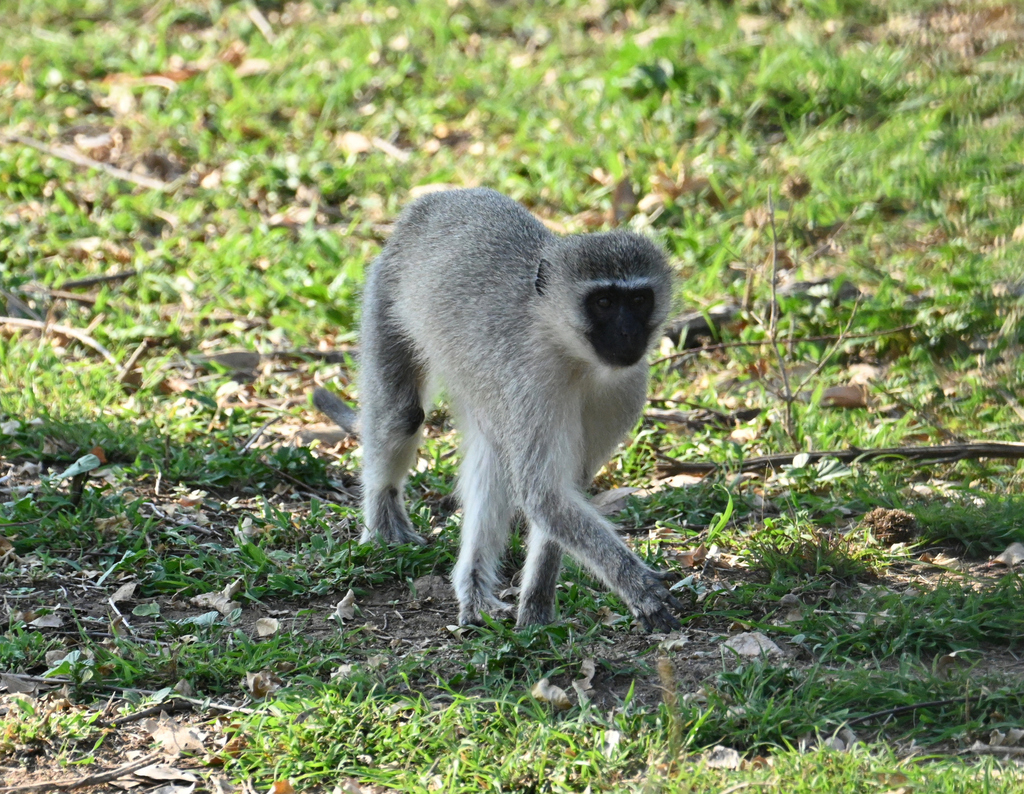
The vervet monkey (Chlorocebus pygerythrus), or simply vervet, is an Old World monkey of the family Cercopithecidae native to Africa.
- Kingdom
- Animalia
- Phylum
- Chordata
- Class
- Mammalia
- Order
- Primates
- Family
- Cercopithecidae
- Genus
- Chlorocebus
- Species
- Chlorocebus pygerythrus
Description
The vervet monkey (Chlorocebus pygerythrus), or simply vervet, is an Old World monkey of the family Cercopithecidae native to Africa. The term "vervet" is also used to refer to all the members of the genus Chlorocebus. The five distinct subspecies can be found mostly throughout Southern Africa, as well as some of the eastern countries. These mostly herbivorous monkeys have black faces and grey body hair color, ranging in body length from about 40 cm (16 in) for females, to about 50 cm (20 in) for males. In addition to behavioral research on natural populations, vervet monkeys serve as a nonhuman primate model for understanding genetic and social behaviors of humans. They have been noted for having human-like characteristics, such as hypertension, anxiety, and social and dependent alcohol use. Vervets live in social groups ranging from 10 to 70 individuals, with males moving to other groups at the time of sexual maturity. Studies done on vervet monkeys involve their communication and alarm calls, specifically in regard to kin and group recognition, and particular predator sightings.
Gallery
Ajouter des photos
Partagez vos photos de cette espèce (jusqu'à 20 à la fois) : elles sont vérifiées automatiquement, puis publiées.
Répartition
Occurrences observées (données GBIF). Les zones hors aire d'origine peuvent indiquer une présence introduite ou invasive.
Sources et crédits
Informations provenant de plusieurs sources vérifiées. Dernière mise à jour : .
Crédits photos (8)
- Photo : Russ Hoverman (@russh) · CC BY-NC 4.0 · via iNaturalist
- Photo : Prince Molokomme (@prince_za) · CC0 (domaine public) · via iNaturalist
- Photo : Mary Ellen Lindsay (@maryelindsay) · CC BY-NC 4.0 · via iNaturalist
- Photo : Lori Lohrenz (@microbl) · CC BY-NC 4.0 · via iNaturalist
- Photo : @linkie · CC BY 4.0 · via iNaturalist
- Photo : Africa Gomez (@hootinghoopoe) · CC BY-NC 4.0 · via iNaturalist
- Photo : Helena Trzeciak (@htrz) · CC BY-NC 4.0 · via iNaturalist
- Photo : @aie_ling · CC BY-NC 4.0 · via iNaturalist
Mentions de licence
Texte disponible sous licence CC BY-SA 4.0. Il adapte notamment Chlorocebus pygerythrus, Wikipedia (CC BY-SA) : Vervet monkey (Wikipédia, auteurs dans l’historique de l’article).
- Taxonomie : GBIF Backbone Taxonomy (CC BY 4.0)
- Carte : occurrences GBIF, fond © contributeurs OpenStreetMap (ODbL)
- Statut de conservation : Liste rouge de l'UICN, via Wikidata (CC0)
Détail : Sources et licences.
Discussion (0)
Aucun message pour l’instant. Lancez la discussion sur cette fiche (sources, précisions, débats éditoriaux).
Connectez-vous pour participer à la discussion.