
Sand cat
Felis margarita
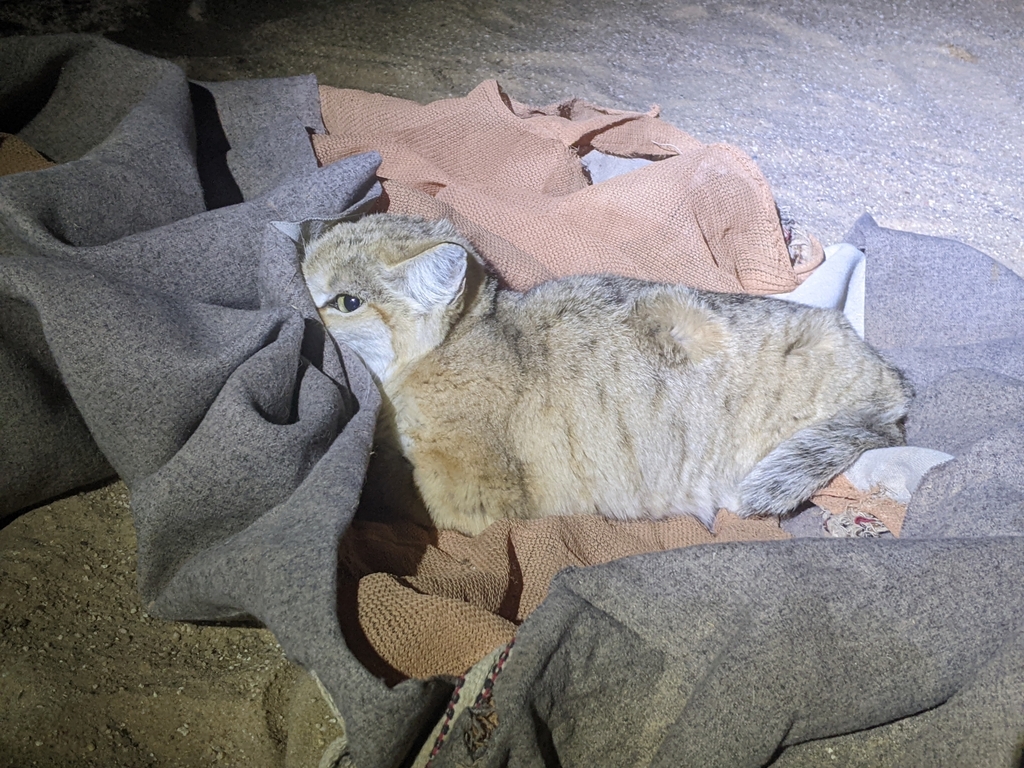
The sand cat (Felis margarita) is a small wild cat that inhabits sandy and stony deserts far from water sources.
- Kingdom
- Animalia
- Phylum
- Chordata
- Class
- Mammalia
- Order
- Carnivora
- Family
- Felidae
- Genus
- Felis
- Species
- Felis margarita
Description
The sand cat (Felis margarita) is a small wild cat that inhabits sandy and stony deserts far from water sources. With its sandy to light grey fur, it is well camouflaged in a desert environment. Its head-and-body length ranges from 39–52 cm (15–20 in) with a 23–31 cm (9.1–12.2 in) long tail. Its 5–7 cm (2.0–2.8 in) short ears are set low on the sides of the head, aiding detection of prey moving underground. The long hair covering the soles of its paws insulates its pads against the extreme temperatures found in deserts. The first sand cat known to scientists was discovered in the Algerian Sahara and described in 1858. To date, it has been recorded in several disjunct locations in Western Sahara, Morocco, Algeria, Libya, Niger, Chad, Egypt, the Arabian Peninsula and the Middle East. In Central Asia, it was first recorded in the Karakum Desert in 1925. The large gap between these two regions of its global range was partially closed in 1948, when a sand cat skin was found in an oasis of the Rub' al Khali in Oman. It is discontinuously distributed in the deserts of the Arabian Peninsula and the Middle East. In the early 1970s, sand cats were caught in southwestern Pakistan and exported to zoos worldwide. Due to its wide distribution and large population, it is listed as Least Concern on the IUCN Red List. The sand cat usually rests in underground dens during the day and hunts at night. It moves 5.4 km (3.4 mi) on average at night in search of small rodents and birds. It also kills and consumes venomous snakes. In spring, the female gives birth to two to three kittens, which become sexually mature around the age of one year. The sand cat's ecological requirements are still poorly understood, as only a few in-depth studies targeting wild sand cat populations have been conducted.
Gallery
Ajouter des photos
Partagez vos photos de cette espèce (jusqu'à 20 à la fois) : elles sont vérifiées automatiquement, puis publiées.
Répartition
Occurrences observées (données GBIF). Les zones hors aire d'origine peuvent indiquer une présence introduite ou invasive.
Sources et crédits
Informations provenant de plusieurs sources vérifiées. Dernière mise à jour : .
Crédits photos (3)
- Photo : @paul_doniol-valcroze · CC BY-NC 4.0 · via iNaturalist
- Photo : Alejandra O. (@ale-jan-dra) · CC BY-NC 4.0 · via iNaturalist
- Photo : Alejandra O. (@ale-jan-dra) · CC BY-NC 4.0 · via iNaturalist
Mentions de licence
Texte disponible sous licence CC BY-SA 4.0. Il adapte notamment Chat des sables, Wikipedia (CC BY-SA) : Sand cat (Wikipédia, auteurs dans l’historique de l’article).
- Taxonomie : GBIF Backbone Taxonomy (CC BY 4.0)
- Carte : occurrences GBIF, fond © contributeurs OpenStreetMap (ODbL)
- Statut de conservation : Liste rouge de l'UICN, via Wikidata (CC0)
Détail : Sources et licences.
Discussion (0)
Aucun message pour l’instant. Lancez la discussion sur cette fiche (sources, précisions, débats éditoriaux).
Connectez-vous pour participer à la discussion.